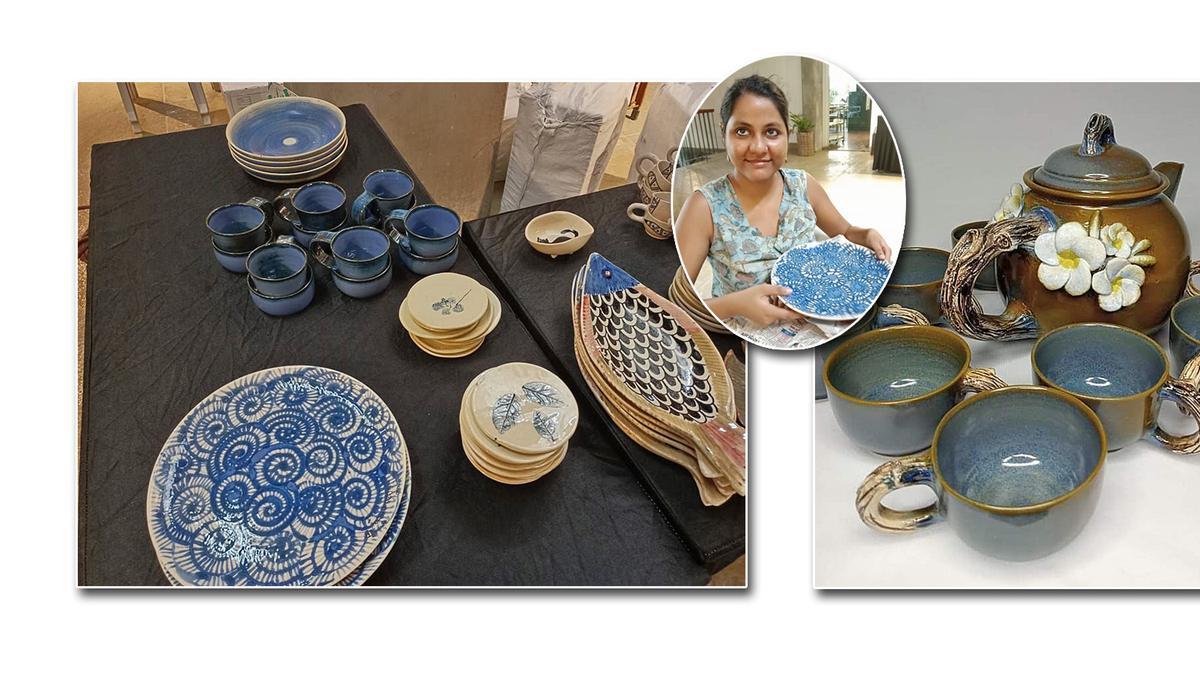
Hearing-challenged artist Srijoni Roy speaks through her ceramic art
The Hindu
Ceramic artist Srijoni Roy from Kolkata is hearing-impaired and creates unique pottery pieces, blending traditional techniques with contemporary aesthetics.
In the hands of Kolkata-based artist Srijoni Roy, ceramic art attains a new form in varied ways. An alumna of the National Institute of Design (NID), Ahmedabad, Srijoni was born as a hearing-challenged baby. Her imagination takes flight in ceramic art. “Srijoni views the world as a silent movie, translating its beauty and essence into her artistic pottery, ” says her mother, Sukanya, adding, ”Her handmade ceramic pieces reflect a blend of traditional techniques and contemporary aesthetics and are celebrated for their artistic richness and craftsmanship.”
Srijoni creates decorative pottery tea sets, wabi-sabi (visibly repaired pieces of ceramic) bowls, wall plates, and floor lamps in her ceramics studio Bakeclay Studio (bakeclay.com) in Kolkata. She recently displayed her collection at an exhibition by Baromarket in Hyderabad.
Srijoni shares her story over an email, a story of grit, her parents’ support and finding an avenue of expression in ceramic art.
Srijoni “could see, smell and feel but could not hear since childhood” and had to undergo speech therapy sessions to pronounce the syllables. Life seemed like a ‘silent movie reel’; without hearing aids, she could not hear the thunder, only feel its vibration, she mentions.
Srijoni ”fell in love with anything visual and enjoyed painting, sketching and photography. In the ‘science or art to study’ dilemma in Standard XII, art was the choice” as it came naturally to her followed by a bachelor of design degree at the NID. . After the first year of foundation, she opted for ceramics and has been working on the medium as her canvas. “It is engaging and makes me happy.”
A visit to Panchmura (West Bengal) in 2017 to live with a potter’s family helped her explore traditional pottery and witness their routine – collecting clay from a faraway pond, drying and firing it in a kiln. Srijoni, who also tried her hand at a huge manual wheel, says, “The craftsmen are popular in making clay horses and terracotta items. This came from a tradition of offering clay horses and elephants to the deities.”
A month-long stay in Jaipur in 2018 for a craft documentation course led her to a new love: painting on ceramics. “ Blue pottery is made of quartz powder and not clay. Like everybody, I was hypnotised by the blue colour.”


Mysuru-based anti-corruption activist Snehamayi Krishna, the complainant in the MUDA case against Chief Minister Siddaramaiah and his family members, was questioned for almost all day by the Bengaluru City Police on Friday for allegedly using forged documents and audio to make false allegations.

Alexandra Kosteniuk discusses her chess journey, the game's evolution, and her motivations as a top player in her 40s.

Youth Eco Summit 2026 Reframes the AI Conversation for the New Generation

O. Panneerselvam claims DMK has a strong chance of retaining power, citing their achievements in the past five years.

From traditional handicraft items from Manipur to a variety of dress materials from across state by women Self-Help group members are on display at the stalls at the National SARAS mela in Karavali Utsava ground in Mangaluru. The nine-day long mela began on Friday.

India participated as an observer at the Board of Peace meeting, reaffirming its support for a viable Palestinian state.

T.N. Deputy Chief Minister inaugurates CREDAI FAIRPRO 2026, showcasing over 500 real estate projects from 80 developers in Chennai.

Andhra Pradesh prioritizes Guntur Mirchi Yard's development with a new committee focused on quality yields and farmer support.

Navy delegates from 50 countries explore natural dyeing and local crafts at Sankalpa Art Village during the International Fleet Review.

Farmers complained about indiscriminate stone quarrying taking place in Madurai district, particularly at Kallanai in Kalligudi taluk. They urged authorities to take necessary action to stop the indiscriminate quarrying activities and protect the environment

Madras High Court dismisses Ramadoss's petitions to freeze 'mango' symbol, emphasizing resolution through civil court, not writs.

After more-than-two-year wait, the flyover at Goripalayam junction will be commissioned on Saturday. As of now, the main arm of the new flyover, named after freedom fighter Netaji Subash Chandra Bose, will help to decongest vehicular movement from Tamukkam junction till Nelpettai junction on East Veli Street.

PAC criticizes the government for poor execution and financial delays in the ₹4,455 crore SANKALP skill development scheme.