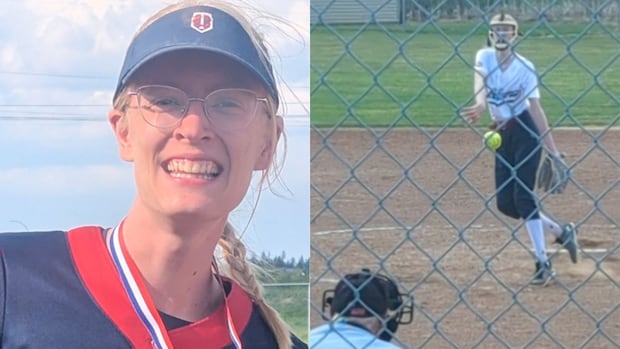
Girls' softball was an inclusive sport in Alberta. For this teen, a new law could end that
CBC
Riley Simpson has been playing softball since they were nine years old. They fell in love with the sport after watching their older sister play.
In June, their softball team won the Edmonton city championship and Riley was hoping to play on higher-level teams as they grew and got better.
In Alberta, where Riley is from, most competitive softball teams are girls' teams. This has never been a problem for Riley, who recently turned 15 years old and is non-binary, thanks to inclusive sporting policies, a co-ed mentality in softball and pre-puberty androgyny.
But the provincial government has enacted a controversial new law excluding athletes assigned male at birth from women's sports teams — known as Bill 29, or the Fairness and Safety in Sport Act — which goes into effect on Sept. 1.
Athletes not assigned female at birth will have to leave any girls' sports team belonging to any school, collegiate or provincial amateur competition level or play in boys' or co-ed divisions.
Some say that unfairly targets young athletes in recreational leagues.
The legislation is already having repercussions on some young athletes in the province: on June 24, Riley played what could effectively be their last competitive softball game ever.
"We won the city championship that day, so that's a good memory. But I also remember sitting on the pitching plate after the game, feeling so sad," Riley wrote, replying to emailed questions from CBC News.
Riley's mother, Eldyka Simpson, was at the game in Edmonton and, over the phone, recounted how most of her child's teammates weren't up to date on the reality of the new law until the team was drinking a ginger ale toast and one of the coaches announced it would be Riley's last game, and that she was proud they were a part of the team.
"Then people started to cry," Simpson said.
The team went to Dairy Queen for Blizzards afterward, but Riley stayed back and sat on the pitching mound "and just cried and cried, and cried," Simpson said.
It had been a difficult season for the teenager, who earlier in the year was turned away from a higher-level under-15 team, then qualified for an even-higher calibre U17B team — but was later voted off in what Simpson can only explain as transphobic sentiment coming from a small number of parents.
Simpson says one of them told her "boys don't belong" on a girls' softball team because they could have an advantage over the female players.
Simpson, who is also an umpire and has three other children, was frustrated. She says there were girls on the team stronger than Riley, who would have been probably the third or fourth pitcher. She turned to Softball Alberta — the association overseeing Riley's team — asking it to enforce its inclusion policy.


The U.S. government on Monday said electric vehicle (EV) maker Tesla and South Korea's LG Energy Solution had signed a supply agreement to build a $4.3 billion lithium iron phosphate (LFP) prismatic battery cell manufacturing facility in Lansing, Mich., with an expected production launch in 2027.

In one small town in Alberta, the assistant principal says teachers almost never meet alone with parents anymore.

Tens of thousands of customers are without power and four parts of Highway 401 are closed Tuesday morning as blasts of blowing snow hit the Ottawa-Gatineau area.

Melody Macsemchuk says volunteers at Grace Place in Thunder Bay, Ont., serve between 300 and 350 meals a day.

Groups of volunteers continue to search alongside police for a man who went missing in late January near Owen Sound, Ont., covering land on foot, and using drones for a view of the conservation area where his car was found.

Jessica Hay says her daughter Charlie loves to be included in everything — and a new accessible shopping cart at her local grocery store in Cornwall makes it possible for Charlie to come along for the ride.

The N.W.T. cabinet says it will review whether or not the territory needs an independent child and youth advocate after a motion by Range Lake MLA Kieron Testart calling on it to establish such a position was carried in the legislative assembly.

From affordable housing in Alberta to high taxes in Quebec, there are many widely accepted claims about the cost of living in different parts of the country. But are these preconceptions accurate?

An Ontario Provincial Police (OPP) report examining the conduct of investigators from a high-profile murder trial into the death of a Toronto police officer where a judge accused responding officers of lying and collusion is expected to be unveiled Tuesday.

While U.S. President Donald Trump tries to convince allies to help reopen the Strait of Hormuz, he is also sending 2,500 marines to the region — the first deployment of U.S. troops since it and Israel first attacked Iran on Feb. 28.

Management with the Southern Shore Breakers junior hockey team say the suspensions handed out following a March 7 rumble at the Goulds Arena in St. John's are excessive, and plan to appeal the discipline with Hockey NL.

On Hollywood's biggest night, newly crowned Oscar winner Tamara Deverell used her time in the spotlight to condemn the Nova Scotia government for cutting millions of dollars of support to the province's arts sector in this year's budget.

A campaign to convince the 17,000 New Brunswick households that have refused the installation of a smart meter to change their minds will likely be launched in June, the utility's ongoing rate hearing was told on Monday.