Fragile ceasefire leaves Iranians outside country torn about returning home
CBC
Overnight on Monday, U.S. President Donald Trump jubilantly announced a ceasefire between Israel and Iran, only to be visibly disappointed Tuesday morning when both sides were accused of violating it.
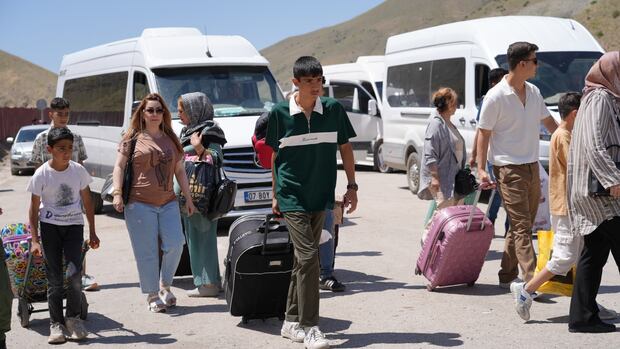
For Iranians at the Kapikoy-Razi border crossing in eastern Turkey, there was a mix of optimism and confusion — hope that a delicate truce could be maintained despite the violent swings that have gripped the region over the past 12 days.
While all welcomed the prospect of peace — even a fragile one — Iranians remained wary of speaking too openly about the effect the conflict has had on Iranian society and the long-ruling regime.
When CBC News approached a group of young Iranian women sitting on the pavement, surrounded by their large suitcases, one said she would like to speak but couldn't.
"We are afraid," she said. "Our government is shit."
PHOTOS | Iranians at the Kapikoy-Razi border crossing:
Iran's Supreme Leader, Ayatollah Ali Khamenei, has ruled the country since 1989. Under him, Iran has continued to develop its nuclear program, which Israel and the U.S. called a pressing threat in justifying the decision to launch recent airstrikes.
Iran and Israel have been firing missiles at each other since June 13, and on the weekend, the U.S. stepped in, dropping bunker-busting bombs at Iranian nuclear facilities, including one buried below a mountain.
In Iran, where the majority of the population is Shia Muslim, the regime has created an environment of violent suppression of any form of protest or dissent, leading to a climate of fear.
Over the last decade, Iranians have taken to the streets on numerous occasions to protest the ruling clerics and the state of the economy. In 2022, the death of a woman named Mahsa Amini in police custody for an alleged dress code violation led to months of demonstrations as well as a brutal crackdown.
At the Kapikoy-Razi border crossing on Tuesday, where waves of people are heading in and out of Iran, a few dual citizens told CBC News that Iranian authorities were searching their cellphones and looking at photos and contacts before they crossed.
One Iranian, who didn't want CBC News to use his name, asked to know the details of the ceasefire, because his phone hadn't been working and he wasn't able to get updates.
"It looked like [shooting] was supposed to stop officially at 4 a.m., but then we heard news about some missiles shooting.… So we were like, OK, what the hell is going to happen?" he said.
"I don't really have any clear understanding of who is really eager for a ceasefire."


U.S. President Donald Trump may delay his China trip due to the Iran war, but Treasury Secretary Scott Bessent said Monday it's not to pressure Beijing on the Strait of Hormuz.

U.S. President Donald Trump is urging other countries to help secure the Strait of Hormuz as Iran targets ships in the vital oil route, but so far there are few firm commitments.

Arab Gulf states reported new missile and drone attacks on Sunday after Iran threatened to widen its campaign as the war in the Middle East entered its third week.


The former secretary general of NATO says he doesn't think allies will be pulled further into the conflict in the Middle East, but he's concerned the ongoing war with Iran will benefit Russia's economy and take the world's attention away from the invasion of Ukraine.

As American and Israeli strikes pound Iran — while it attacks shipping and energy infrastructure across the Persian Gulf — U.S. President Donald Trump made a new threat to Tehran's leaders.

The armed man who rammed his vehicle into one of the largest Reform synagogues in the U.S. Thursday has been identified as a 41-year-old naturalized citizen born in Lebanon, according to federal officials.

With jagged cliffs rising from the Arabian Sea, the Strait of Hormuz is striking in its scenery — and these days, its emptiness. This resource superhighway, which normally hosts more than a hundred of the world’s largest oil and liquid natural gas (LNG) tankers every day, has seen no more than a handful all week.

The Canadian government said Tuesday it is alarmed by the escalation of violence and attacks in Lebanon, as the war in the Middle East expands.

In a resounding victory that is guaranteed to reshape Nepal's politics, rapper-turned-politician Balendra Shah appeared headed for a landslide win in the South Asian country's first polls since youth-led protests toppled the previous government last fall.

China’s latest blueprint for driving growth in its economy was largely written before the U.S. and Israel instigated the most far-reaching war in the Middle East in decades.

U.S. President Donald Trump's firing of Homeland Security Secretary Kristi Noem on Thursday overshadowed the announcement of his plans to nominate Republican Sen. Markwayne Mullin as her successor.

The truck carrying Nepali prime ministerial candidate Balendra Shah was swarmed by cheering supporters in the capital, Kathmandu, on Saturday, unable to inch forward as the former rapper, wearing sunglasses and a sleek black suit, danced on top of the roof.