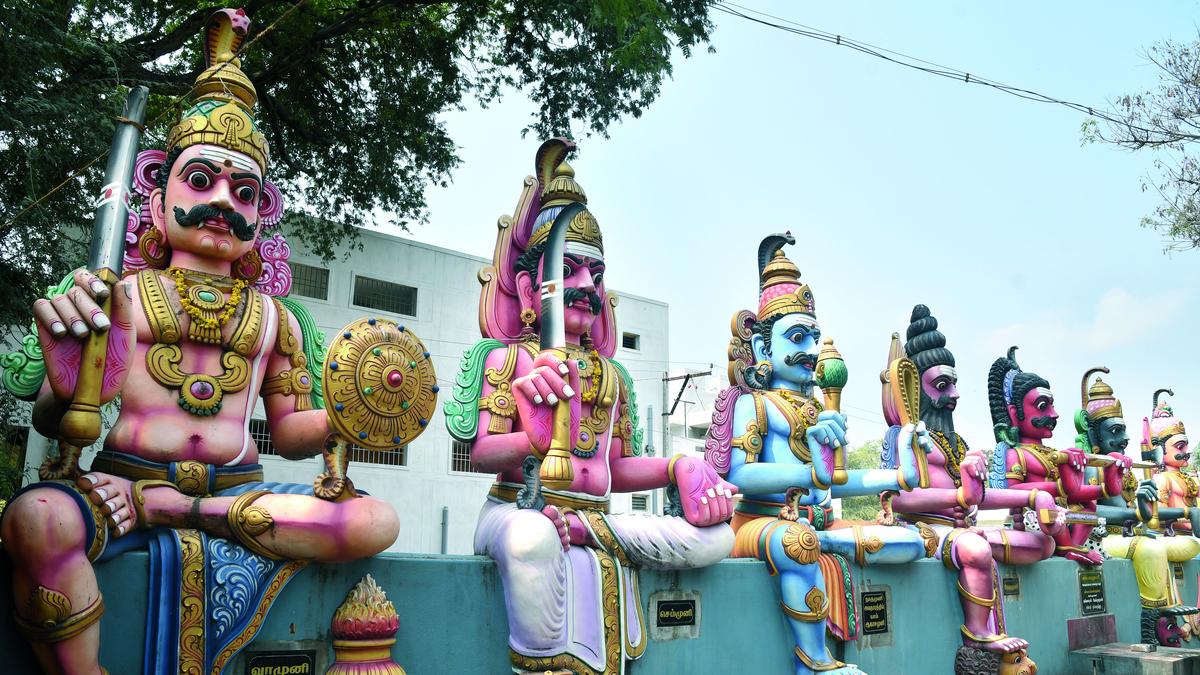
Folk Deities of Tamil Nadu | Gods who love surruttus and chappals
The Hindu
Coffee table book Folk Deities of Tamil Nadu, from The Hindu stable, delves into local customs, legends and ways of worship — from the deity of graveyards to the protector of the ill
It happened almost 35 years ago. The elders in my village had assembled to discuss a curious demand by the samiyadi (oracle) of the local Sudalaimadan temple, the presiding deity of graveyards. He insisted that the village should organise a kodai (festival) as the deity was very particular about it.
“He is not letting me sleep. If you organise the kodai, I will continue to perform the puja,” he said, and placed the keys of the sprawling graveyard, with its banyan and neem trees, before the elders.
There was an air of scepticism. Those familiar with the Vaishnavite tradition, however, accept such interactions between a god and his devotees. Legend has it that Thirukachi Nambi, one of the gurus of philosopher Ramanuja and founder of Vishishtadvaita, used to converse with Varadharaja Perumal, the presiding deity of Kancheepuram.
Guardian deities are colourful characters and they share a strong bond with their devotees. In Tamil Nadu, there are folk deities with pan-regional appeal, those worshipped in a specific area, and deities of particular communities and families.
Ballads narrate their stories. They are fearsome, ferocious, and capable of punishing wrongdoers. They drink liquor, smoke cigars, and eat meat. During kodai, goats, roosters and pigs are sacrificed to propitiate them. (In the southern part of the State, padiappu is an important offering to folk deities. Sacrificed animals are cooked and offered with rice, vegetable curry, a stir-fry of drumstick leaves, pappad, boiled eggs and lashings of ghee.)
In Srirangam, a neighbourhood of Tiruchirappalli, Muniappan is the guardian deity of the first Vaishnavite temple (among the 108 in the area). He occupies the entrance of the rajagopuram (entrance tower). Just outside the shrine is a small bowl on a makeshift stand where devotees drop surruttu (cigar) as an offering — praying that their problems would vanish like smoke. While in Tiruvarur, a town on the banks of the Cauvery, and a holy place for Saivaites as it houses the biggest temple of Lord Shiva, the Aazhi Ther (chariot festival) begins only after a kodai for Pidari, a folk goddess.
I’ve always been fascinated by folk deities, and my childhood passion was strengthened by watching folk art forms such as Naiyandi Melam, Kaniyaan Koothu, Villupaatu and Thappu.


Explore 2026's wallpaper trends in India, highlighting botanicals and handmade designs that enhance modern homes with nature-inspired aesthetics.

Mercedes-Benz CLA 250+ with EQ Technology review: design, performance, range and features explained. Discover how the new electric CLA combines advanced AI, long range, fast charging and futuristic styling for the next generation of luxury EVs.

AI tool for sparrow conservation

BTS’s comeback with ‘Arirang’ marks a major global music event. When does the album release, and where can you watch their concert live stream? We have all the details

The 2026 U.S. cholesterol guidelines urge starting screening and treatment at 30 to prevent cardiovascular disease effectively.

Olam Festival 2026 in Thiruvananthapuram returns March 27-29 with 120+ vendors, music, art, and cultural zones.

A few storytellers in Thiruvananthapuram share their journeys, challenges, and evolving methods on World Storytelling Day, inspiring young minds.

76-year-old Kurian Jacob from Kerala triumphs with seven medals, including five golds, at the Open Masters Games in Abu Dhabi.

Explore the nature of the human mind as an emergent property of brain activity and complex neural interactions.

CERN's Large Hadron Collider discovers the Xi-cc-plus particle, enhancing understanding of quantum mechanics and baryon behavior.

Vibha Batra’s latest book, Spotless (Hachette India) is a novel in verse for young adults

In its first edition, the Madras Art Salon spotlights the works of journalist and artist Narayan Lakshman at The Botanical Club, a social space in the British Deputy High Commission, Chennai

Cholesterol enhances melanoma cell invasion by making nuclei squishier, revealing a potential treatment target in cancer progression.