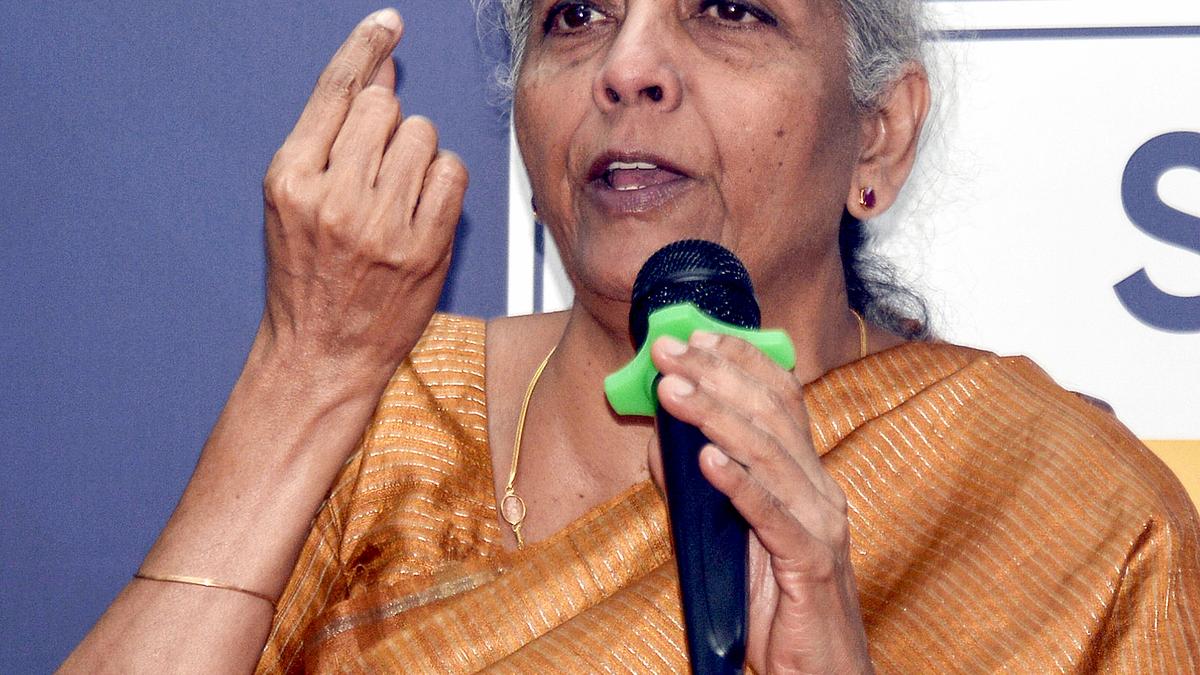
FM asks RRBs to develop suitable products aligning with MSME clusters
The Hindu
Finance Minister urges RRBs to align products with MSME clusters for increased financial inclusion and banking penetration nationwide.
Finance Minister Nirmala Sitharaman urged Regional Rural Banks (RRBs) and sponsor banks to develop suitable products aligning with MSME clusters to further increase banking penetration and financial inclusion across the country.
She was speaking at a review meeting, held in connection with National MEME cluster Outreach Programmes here on Saturday, with chairpersons of RRBs and CEOs of their sponsored banks.
The Finance Minister emphasised active outreach by the RRB branches located in MSME clusters to ensure credit to small and micro enterprises in areas like textile, wooden furniture, leather, food processing, packing materials and engineering and machine tools. “These areas hold immense potential for increasing the loan portfolio of RRBs to MSMEs,’‘ she observed.
According to Ms. Sitharaman, all RRBs should have their own updated technology stack to stay relevant especially when digital and mobile banking service are already boosting financial access to regions such as northeastern states and hilly regions, with limited physical connectivity.
However, she also cautioned sponsor banks and RRBs to recognise the challenges ahead and urged to continue focusing on maintaining asset quality, expanding digital services, and ensuring robust corporate governance.
She further urged RRBs to put greater thrust on the clear identification of beneficiaries while sanctioning loans under various schemes like PM Vishwakarma and PM Surya Ghar Muft Bijli Yojana etc. RRBs were also asked to increase credit disbursement in ground-level agriculture.
‘’There should be focus on scaling up agriculture credit disbursement with special focus on allied agriculture activities like dairy, animal husbandry, fisheries,’‘ she stressed.


The Thane police have arrested two co-founders of cryptocurrency exchange platform CoinDCX in connection with an alleged fraud of Rs 71.6 lakh, officials said

Meta Chief Executive Mark Zuckerberg is building a CEO agent to help him do his job, the Wall Street Journal reported

Insurance penetration and density are often misunderstood and do not reveal how many families are insured or whether they would be financially secure if the main earning member were to die. The real issue is not reach but adequacy, as households may have life insurance but not enough cover to replace lost income, leaving them financially vulnerable.

Five top firms lose ₹1 lakh crore in market value, with HDFC Bank experiencing the largest decline of ₹56,124.48 crore.

L&T confirms 95% of its West Asia project sites are safe, while addressing logistics challenges amid ongoing regional conflicts.

Mines Ministry to auction 19 critical mineral blocks on March 23, expanding strategic resources for clean energy and technology sectors.

Mines Ministry to auction 19 critical mineral blocks on March 23, expanding strategic resources for clean energy and technology sectors.

Five top firms lose ₹1 lakh crore in market value, with HDFC Bank experiencing the largest decline of ₹56,124.48 crore.

HDFC Bank terminates three senior officials over client onboarding issues at its DIFC branch amid ethical concerns following chairman's resignation.

Air India CEO warns of potential flight cuts and reduced travel demand due to rising fuel costs amid ongoing Gulf conflict.

Options are widely used by retail traders to speculate on the value of the stock for immediate gains and such behaviour in large scale can distort the market

India achieves 1 billion tonne coal production for the second consecutive year, ensuring stable energy supply and economic growth.

Generic drugmakers in India launch affordable Semaglutide versions, targeting a $1 billion diabetes and weight loss market.