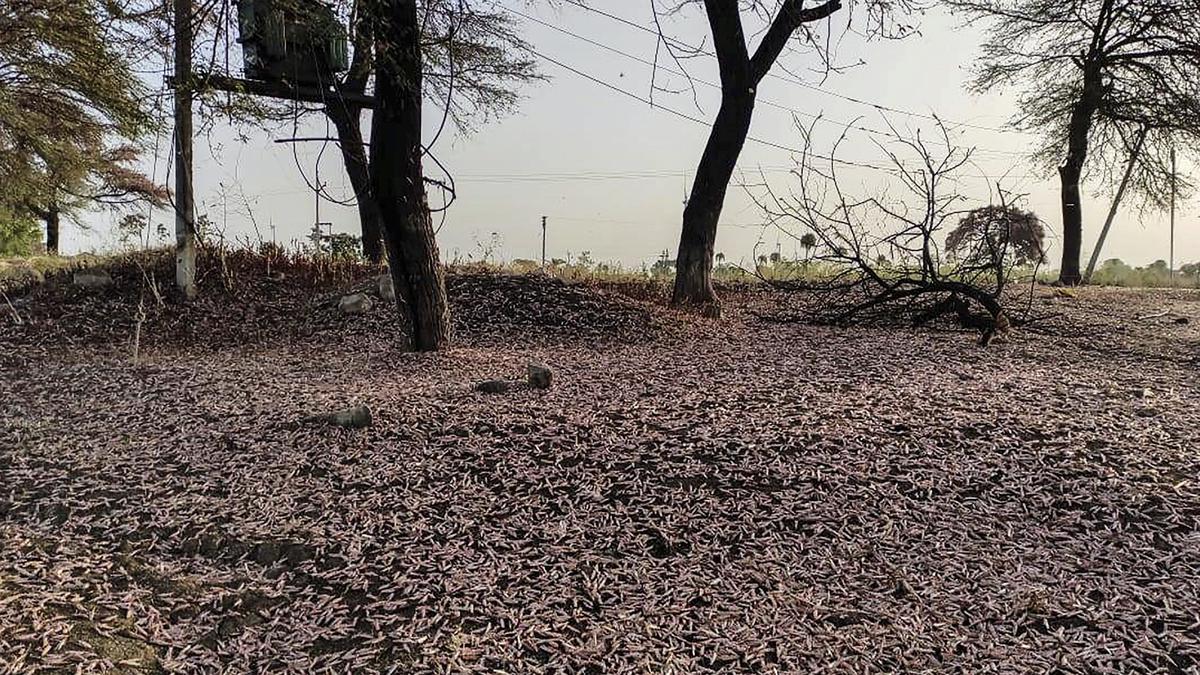
FAO warns of severe locust outbreak across 8 provinces in Afghanistan
The Hindu
A locust outbreak in eight Afghanistan provinces worsens the current humanitarian crisis the nation is undergoing.
The United Nations’ Food and Agriculture Organisation (FAO) has warned about a widespread Moroccan locust outbreak across eight provinces in Afghanistan’s wheat-growing north and northeast region, Khaama Press reported.
In addition to Badakhshan, Badghis, Baghlan, Balkh, Kunduz, Samangan, Sar-e-Pul, and Takhar, there have been reports of locust sightings in the provinces of Herat and Ghor in Afghanistan.
This occurs as the country is experiencing a severe humanitarian catastrophe under the hardline regime of the Taliban. According to the analysis, Afghanistan will still be experiencing the greatest humanitarian crisis in the world in 2023, and the widespread Moroccan Locust outbreak in the aforementioned districts will worsen matters.
“The reports of Moroccan Locust outbreak in Afghanistan’s wheat basket is a huge concern. The Moroccan locust eats more than 150 species of plants, including tree crops, pastures, and 50 food crops, all of which grow in Afghanistan. It represents an enormous threat to farmers, communities, and the entire country,” said the FAO Representative in Afghanistan, Richard Trenchard, according to Khaama Press.
The Moroccan locust is one of the most expensive plant pests in the world. According to the FAO, crop losses from this year’s epidemic might range from 700,000 to 1.2 million tonnes of wheat, leading to economic loss.
“The last two big outbreaks, 20 and 40 years ago, cost Afghanistan an estimated 8 and 25 % of its total annual wheat production. Harvest forecasts this year are the best we have seen for the last three years - but this outbreak threatens to destroy all these recent gains and dramatically worsen the food insecurity situation later this year and into next year,” Mr. Trenchard said further, according to Khaama Press.


Shorts News:Watch: Cuba right now in ‘very bad shape’: Trump

As political loyalties shift, Vice President Vance navigates the turbulent MAGA landscape amidst Trump's new war strategy.

Oil prices drop over $2 as Iraq and Kurdish authorities finalize an export deal, easing supply concerns amid ongoing conflict.

Marco Rubio denies U.S. efforts to oust Cuba's President, calling a New York Times article "fake" and misleading.

Shooting at Holloman Air Force Base in New Mexico leaves one dead and another wounded; lockdown lifted, base declared safe.

The U.S. offers undocumented migrants $2,600 and free flights to voluntarily self-deport through a new DHS program.

Israeli strikes in central Beirut reportedly kill six, escalating tensions amid ongoing conflict with Hezbollah and regional instability.

Few people realise that the ocean floor beneath the Persian Gulf and Red Sea is crisscrossed with thousands of kilometres of fibre-optic cable.

Ali Larijani, Iran's influential politician, played a key role in both security policy and the violent suppression of protests.

Shooting at a Georgia VA clinic leaves one employee hospitalized and the gunman dead, prompting investigations by authorities.

UNICEF reports 100,000 flee South Sudan's Akobo due to escalating conflict, worsening conditions for displaced populations in Ethiopia.

Cuba restores electricity to two-thirds of the country after a nationwide blackout amid ongoing economic challenges and U.S. sanctions.

U.S. President Donald Trump declares the U.S. no longer needs ally support in Iran conflict amid rising tensions and global energy concerns.