Family unearths ancient spearhead at their Paris, Ont., farm in 'freak' discovery
CBC
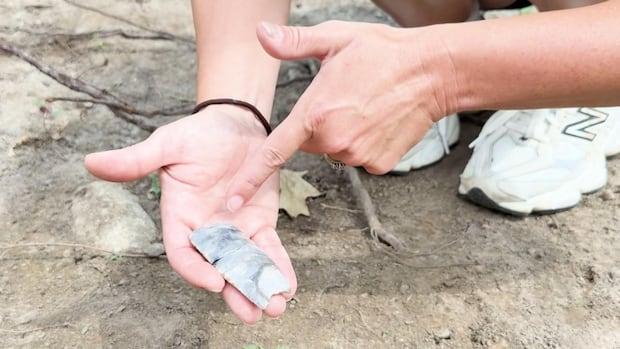
The two pieces were buried under the earth for possibly more than 12,000 years. This summer, they were accidentally unearthed on a Paris, Ont., dairy farm.
For Laura Vellenga, finding what are believed to be two parts of an ancient spearhead is a once-in-a-lifetime discovery.
"I knew right away this was something special," she said, carefully admiring two pieces of light grey flint in her cupped hands.
"You can tell that it was made by a person and chiselled by a person.... We found it here in the cornfield, at the back of the farm, about kilometre away from the house. It was just a freak chance that we found this here."
The two pieces she found connect like a puzzle to create a roughly seven-centimetre-long piece. Vellenga wonders if a third piece remains hidden on their farm because the spearhead is missing its tip.
Vellenga found the pieces while working on the farm with her husband, Mike Vellenga. He was driving their ATV through the cornfield when he heard it bump against something hard in the soil.
"My husband looked down here and he sat kind of half buried in the dirt; he thought [it] was like a piece of plastic."
After picking the two pieces up and tapping them against their ATV, the Vellengas immediately knew they were no ordinary rocks. They decided to take the pieces home, carefully, and began looking for an archeology expert to tell them more about their unique find.
"A human being from 13,000 years ago, before the pyramids, before any of the history that we know about of civilization held this in their hand and made it, and used it and lived here," Laura said.
"It's exciting to think how different the world was back then during the [last] ice age ... then it got lost and now we're holding it 13,000 years later."
To help learn more about what the family believes is a rare find, the family turned to Christopher Ellis, a leading expert in Paleo and Archaic archeology from the Great Lakes area.
Ellis, a professor emeritus at London's Western University, has spent his 50-year career unearthing and identifying spearheads like the one discovered by the Vellengas.
He has not had a chance to hold the artifact, but has studied it using detailed pictures. He said the kind of point the family found "is a style that we know is characteristic of the oldest documented people in Ontario," and noted that with the modern calendar, it would date it to 10,000 BC.
Ellis said he was shocked to see that the family had accidentally stumbled upon a fluted point spear tip.


The government of Saskatchewan has announced plans to reduce the length of non-resident game bird hunting licences to combat illegal guiding.

An 87-year-old Alberta man is fighting extradition to the United Kingdom to stand trial for historical allegations of physical and sexual assault involving minors.

Eight casinos across southwest B.C. have been sold to First Nations in the last two years, with the province's gambling scene set to be reshaped as a result.

Hamilton hosts the Junos Sunday, and the musical awards show is bringing tourists, musicians, concerts and a ton of themed events to the city this week.

The multi-million-dollar deal at the heart of a high-profile fight between the Canadian government and one of the world’s biggest carmakers contains multiple clauses about the company’s footprint in Ontario, according to a copy obtained by CBC Windsor.

In recent months, Calgary police have carried out three day-long safety blitzes, parading out dozens of officers to flood an area with their increased presence — at least, temporarily.

A national organization is seeking people with experience in Canada's forestry sector as they put together a working group that will examine ways to improve forest recovery following wildfires.

Ella Heyder is bracing for a breakup, even though she already moved out decades ago.

Shawne Hopkins never saw it coming.

Politicians return to Queen’s Park Monday for a shortened spring session, as Premier Doug Ford prepares to unveil his eight budget amid heightened global economic uncertainty.

Despite a recent announcement that a water supply pipeline will be build in Oneida Nation of the Thames, some members of the community say that's no excuse for taking water for granted.

As scandal has swirled around former prince Andrew Mountbatten-Windsor, questions and curiosity have also focused on his ex-wife, Sarah Ferguson, and their daughters, Princesses Beatrice and Eugenie.

Friday may have been the first day of spring, but winter storms are not over yet for Newfoundland.