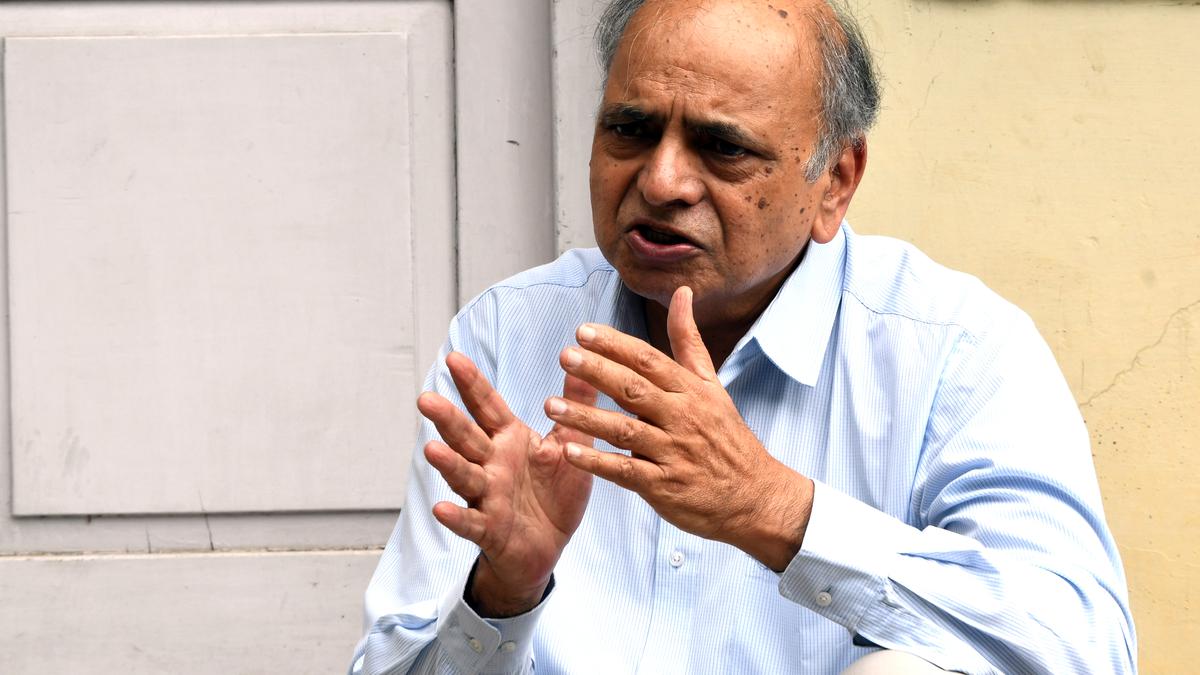
Failure to count DNTs in 2027 Census could alienate over 10 crore people: G.N. Devy Premium
The Hindu
G.N. Devy warns that excluding DNTs from the 2027 Census could alienate over 10 crore people in India.
As denotified, nomadic, and semi-nomadic tribes (DNTs) across the country come together to demand a “separate column” for themselves in the 2027 Census forms, linguist and cultural scholar professor G.N. Devy has warned that India risks further alienating these communities—classified as “criminal” under the colonial-era 1871 Criminal Tribes Act and left uncounted since the formation of the Republic—if they are not explicitly counted.
In an exclusive interview with The Hindu, professor Devy—who headed the Ministry of Social Justice’s Technical Advisory Group on DNTs in 2006, and co-founded the DNT-Rights Action Group (DNT-RAG) with author Mahasweta Devi—said that inclusion of the DNTs must begin with a declaration by the Census Commissioner that these communities will be counted explicitly. He added that the problem of alienating over 10 crore people could become much bigger than that of counting them.
Edited Excerpts:
What opportunity does the upcoming Census present for the welfare of DNTs, given that caste will be enumerated in 2027?
The census and the Criminal Tribes Act (CTA) were both instituted in 1871. While the census has continued unbroken, except for this time, the plight of DNTs has also continued, with no proper count, except in 1931. The Iyengar Committee in 1950, the NHRC in the early 2000s, the Renke Commission in 2008, and the Idate Commission (2017) have all called for a census of DNTs. Yet questions such as ‘Have you been a DNT?, Have you been nomadic or semi-nomadic? Or denotified former criminal tribe?’ have never been included in Census schedules.
If that is not done this time, and if the DNTs are taken for a ride again with no specific data emerging at the end of the exercise, India will alienate close to 10 crore or more people from the mainstream. The problem can be much bigger than the problem of calculating, tabulating, and making a proper list.


C.V. Sudarsan, esteemed Kennel Club of India secretary and Madras Canine Club president, passed away at 77 in Chennai.

Police and Excise conduct raids in Perumbavoor, registering nine NDPS cases and detaining three undocumented migrant women.

Harish Rao claims BRS will dominate Medak's municipalities, criticizing CM Revanth Reddy for unmet promises and false propaganda.

Siraj — swinging back into India’s T20 blueprint

PM Modi and Malaysia's PM strengthen ties through key agreements, emphasizing anti-terrorism, trade, and regional stability during Kuala Lumpur talks.

After mounting public outrage and an intense political exchange between the ruling Congress and the BJP in the State, the Bangalore Metro Rail Corporation Ltd. (BMRCL) has put on hold the implementation of the proposed annual fare revision for Namma Metro, which was scheduled to come into effect on February 9, 2026.

Islamiah College in Tirupattur signs MoU with CIIC to enhance the innovation ecosystem and support startup growth.

Two men arrested in Vellore for tusk possession after forest officials seize tusks from their hideout in Aravatala Reserve.

Villupuram launches startup communities in two villages to foster innovation and connect rural entrepreneurs with corporate partners.

Revanth Reddy questions the Centre's inaction on a CBI inquiry against KCR, alleging unethical wealth accumulation by the BRS.

Mata Vaishno Devi Shrine Board approves Shakti Museum and light show, enhancing pilgrim experience and regional development initiatives.

Experts highlight biotechnology's potential to drive sustainable growth and career opportunities in India's emerging bio-economy at a recent webinar.

Sawangkaew beats Tagger to win the title