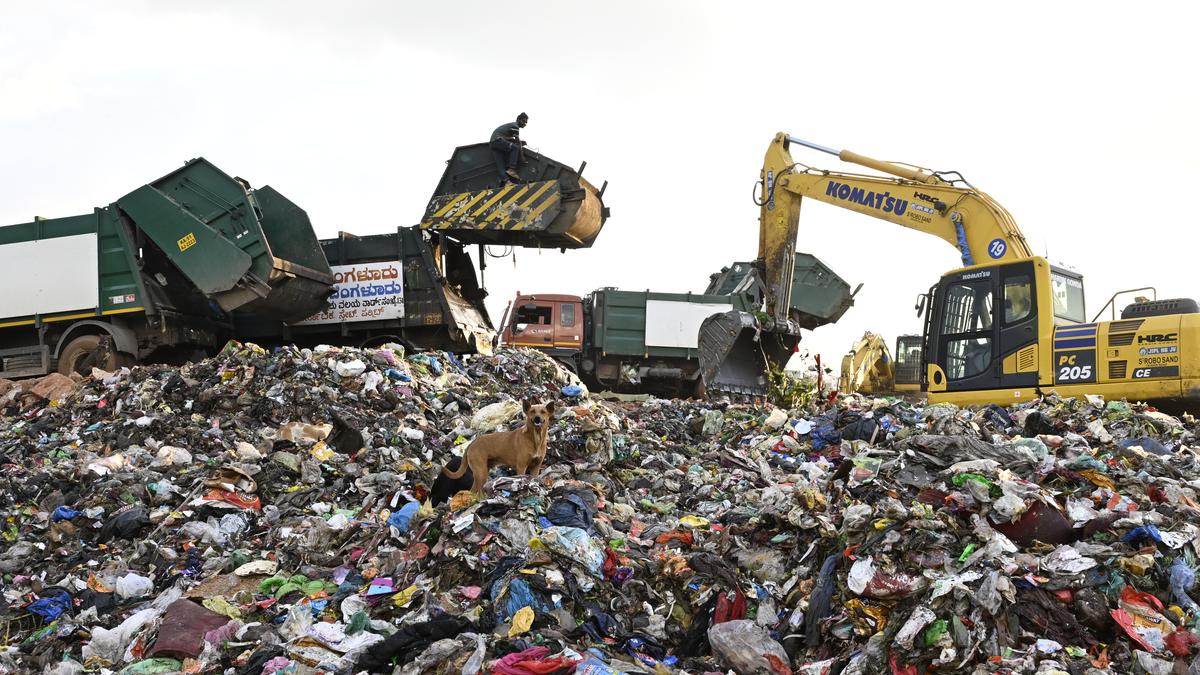
Failure of waste-to-energy plant exposes lack of segregation in Bengaluru
The Hindu
The waste required by the plant is called refuse-derived fuel (RDF), which is essentially combustible waste, which is obtained at the dry waste collection centres after sorting items, which can be recycled or reused. This RDF should ideally be free of metals, which hamper the working of the plant. KPCL officials say that this is not the case with the RDF they receive.
On one side, the civic administration is finding it difficult to manage the waste in Bengaluru. On the other side, the waste-to-energy (WtE) plant at Bidadi, which is a joint venture of Karnataka Power Corporation Limited (KPCL) and Bruhat Bengaluru Mahanagara Palike (BBMP), is looking for more dry waste to produce energy, but is not getting it.
Karnataka’s first of its kind WtE plant was set up across 10 acres of the vast 163-acre premises of the KPCL. While one may expect a waste processing plant to generate a stench that stretches a few hundred metres, this plant spanning four levels looks surprisingly tidy. Except for the place where garbage is dumped and transported, there is no stench at any other place.
After an accident claimed the lives of five persons in January, the plant resumed operations on April 4. However, the plant has not been able to generate 11.5 Megawatts (MW) of electricity every day, which is its full generation capacity, due to the lack of dry waste.
The plant requires 600 metric tonnes of properly segregated dry waste every day to produce 11.5 MW of electricity. The KPCL officials say that they have been receiving not more than 400 metric tonnes of waste every day from the BBMP. Since the plant was commissioned in October 2024, it has run for a total of 115 days, and the gross generation has been 20.4636 Million Units (MU).
“We have received 67,529 metric tonnes of waste till now. If we had received the required quantity of 600 tonnes a day, then we could have generated 31 MU more power,” said Satish Kumar H., executive engineer (Bidadi), KPC Gas Power Corporation Limited.
Once the waste arrives at the plant, it is dumped into a storage pit whose total capacity is 4,200 metric tonnes (to hold enough waste for power generation for one week). The waste is treated, and all the moisture is removed before sending it to the combustor where it burns at high temperatures. This heat is used to heat the water inside boilers, which forms steam, which is then used to rotate the turbines and produce electricity.
The electricity is evacuated to a Bidadi sub-station to be integrated into the grid. The fly ash goes out through the chimney while other ash is aggregated and sent back to landfills.


L&T confirms 95% of its West Asia project sites are safe, while addressing logistics challenges amid ongoing regional conflicts.

Mines Ministry to auction 19 critical mineral blocks on March 23, expanding strategic resources for clean energy and technology sectors.

Mines Ministry to auction 19 critical mineral blocks on March 23, expanding strategic resources for clean energy and technology sectors.

Five top firms lose ₹1 lakh crore in market value, with HDFC Bank experiencing the largest decline of ₹56,124.48 crore.

HDFC Bank terminates three senior officials over client onboarding issues at its DIFC branch amid ethical concerns following chairman's resignation.

Air India CEO warns of potential flight cuts and reduced travel demand due to rising fuel costs amid ongoing Gulf conflict.

Options are widely used by retail traders to speculate on the value of the stock for immediate gains and such behaviour in large scale can distort the market

India achieves 1 billion tonne coal production for the second consecutive year, ensuring stable energy supply and economic growth.

Generic drugmakers in India launch affordable Semaglutide versions, targeting a $1 billion diabetes and weight loss market.

Indian and Asian refiners eye Iranian oil purchases as U.S. waives sanctions amid energy crisis linked to the Iran-Israel war.

Iran war impacts pesticide prices, warning of a 20-25% rise and increased risk of counterfeit products during the kharif season.

India's forex reserves fell by $7 billion to $709.76 billion, according to RBI data for the week ending March 13.

Natco Pharma will launch its Semaglutide injection (multi dose vials) in the domestic market on Saturday.