Explained | Understanding the Saudi-Iran detente
The Hindu
What has led to the restoration of diplomatic relations between Saudi Arabia and Iran? What initially led to the breakdown of relations? Why is the U.S. deprioritising the West Asian region? Is China emerging as a new great power in West Asia?
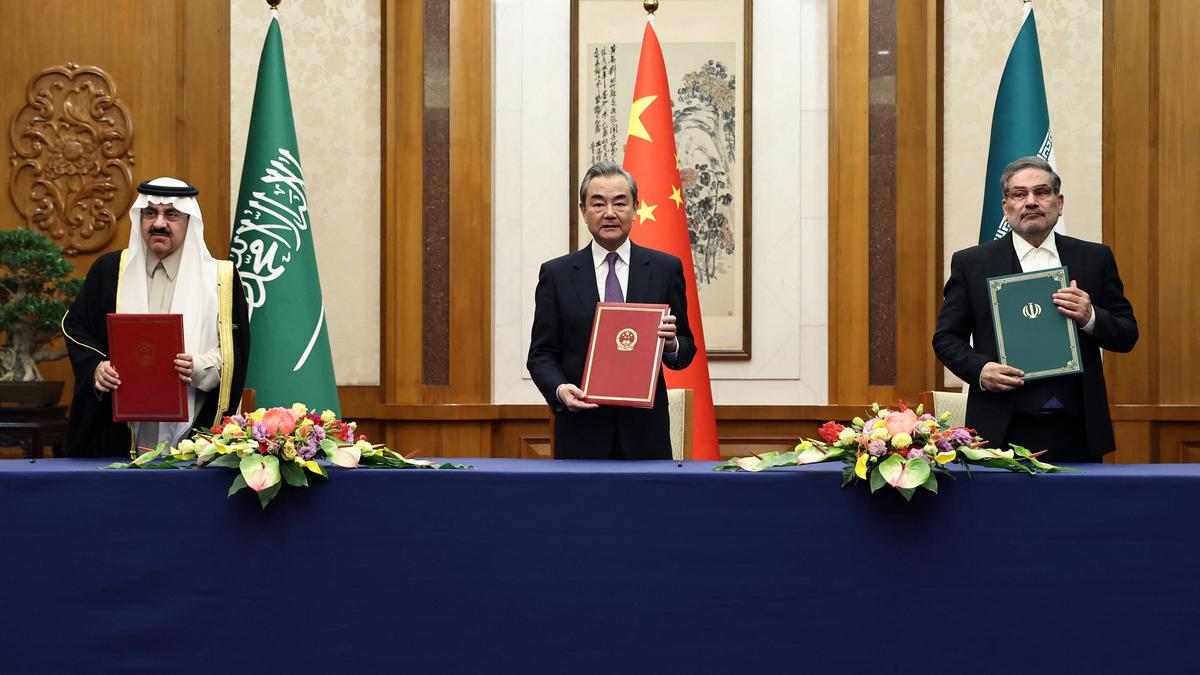
The story so far: Saudi Arabia and Iran, two of West Asia’s major powers that have been at odds with each other for decades, agreed to restore diplomatic relations last week in an agreement brokered by China. The rivalry between the two dates back to pre-revolution Iran when they competed with each other for regional dominance. After the 1979 revolution brought down the Iranian monarchy and turned the country into a Shia theocratic republic, sectarian and ideological flavours were added to the mix. In recent times, it had turned into a cold war with both sides supporting their proxies across West Asia. Formal ties between them collapsed in 2016 after the Saudi embassy in Tehran was overrun by protesters following Riyadh’s execution of a revered Shia cleric. Now, under China’s mediation, they have agreed to start a new beginning. If peace holds, it could have far-reaching implications for regional security, stability and geopolitics.
Saudi Arabia and Iran started directly talking to each other in 2021 and had held multiple rounds of negotiations thereafter, first in Iraq and then Oman, without any breakthrough. There was, however, a growing realisation on both sides that the diplomatic path should be kept open. In February 2022, a senior Iranian Foreign Ministry official told The Hindu in Tehran’s National Gardens, “The Saudis now realise that they don’t have an alternative to having stable relations with us. It’s too early to say if there will be a breakthrough, but we’re talking.” When China’s President Xi Jinping visited Riyadh last December, he pushed for a rapprochement between the two. In January, Saudi Foreign Minister Prince Faisal bin Farhan said in Davos, Switzerland, that Riyadh had “reached out [to Iran] and we are trying to find a path to dialogue”, without specifying China’s role. Last week, the reconciliation was announced after days-long secret talks in Beijing.
Finer details of the agreement are yet to be unveiled. But officials on both sides say, according to reports, that Iran has agreed to prevent further attacks against Saudi Arabia, especially those from the Houthi-controlled parts of Yemen (Iran backs Houthis, a Shia militia in Yemen while the Saudis back the government forces). Saudi Arabia, on its part, agreed to rein in Iran International, a Farsi news channel that is critical of the Iranian regime (which the Iranian intelligence has termed a terrorist organisation). The Foreign Ministers of both countries would meet soon to thrash out the terms of the reconciliation before reopening embassies in each other’s capitals in two months. China is also planning to host a cross-Gulf conference of Iran and the six Gulf monarchies (Saudi Arabia, the UAE, Qatar, Bahrain, Kuwait and Oman, who make up the Gulf Cooperation Council, or GCC) this year to further strengthen peace in the region.
West Asia has been undergoing strategic realignments in recent years. In 2020, the UAE became the first Arab country to normalise relations with Israel in a quarter century. In the following years, Israel and Arab countries deepened their partnerships. In 2021, Saudi Arabia, the UAE and their allies decided to end their failed blockade of Qatar. The U.S. was also trying to broker a normalisation agreement between Saudi Arabia and Israel. One of the key drivers of these realignments is the U.S.’s deprioritisation of West Asia. The U.S., the traditional great power in the region, has bigger foreign policy challenges in its hand now such as the Russian war in Ukraine and China’s rise in the Indo-Pacific. America’s allies in the region see the twin realities of a power vacuum created by the U.S.’s deprioritisation and the challenge posed by Iran’s rise. To address these problems, the U.S. wanted to bring the two pillars of its West Asia policy — Israel and the Arab world — together against Iran so that the American alliance system in the region would not be disrupted. While the UAE chose this path through the Abraham Accords, the Saudis decided to go slow on reconciling with Israel, especially since violence kept spreading in Israeli-occupied Palestinian territories.
Additionally, relations between Saudi Arabia and the U.S. have been rocky in recent years. The bedrock of the partnership, which goes back to the meeting between King Abdul Aziz bin Saud and President Franklin Roosevelt aboard USS Quincy in 1945 off Egyptian waters, was America’s security guarantees in return for Saudi oil. The U.S. is now one of the top oil producers in the world and is not as dependent on the Gulf Arabs as it used to be during the Cold War. This allowed American Presidents to expedite the U.S.’s deprioritisation of the region. When Saudi oil facilities were attacked in 2019 (for which Iran was widely blamed), the U.S. looked away. This seems to have prompted the Saudis to look for alternative solutions for the Iran problem. The solution they came up with was to reach out to the Iranians.
Iran is going through one of the toughest phases of economic isolation and domestic pressure. Tehran knows that getting a reprieve from Western sanctions is not a near-term possibility and at home, despite its crackdown, protests refuse to die down. Its economy is deteriorating and its currency, the rial, is struggling. Iran wanted Chinese investments and support for the rial. According to Iranian media reports, China allowed Tehran to withdraw parts of the $20 billion funds that were frozen with Chinese banks (after the U.S. sanctions). So, while struggling with isolation and sanctions, a deal with Saudi Arabia, under China’s mediation, could open economic lifelines for Iran. And strategically, Iran knows that such a deal could complicate American effort to rally Arab countries and Israel against it. So economically and strategically, a reconciliation is beneficial for Tehran, at least in a tactical sense.
Unlike the U.S., which has a history of military interventions in West Asia, China comes with a cleaner record. While the U.S.’s ties with Saudi Arabia faced headwinds in recent years and it has hostile ties with Iran, China has warm ties with both — it is a leading buyer of Saudi oil and the largest trading partner of Iran. This allowed China to use its economic leverage to bring the parties closer.


Shorts News:Watch: Cuba right now in ‘very bad shape’: Trump

As political loyalties shift, Vice President Vance navigates the turbulent MAGA landscape amidst Trump's new war strategy.

Oil prices drop over $2 as Iraq and Kurdish authorities finalize an export deal, easing supply concerns amid ongoing conflict.

Marco Rubio denies U.S. efforts to oust Cuba's President, calling a New York Times article "fake" and misleading.

Shooting at Holloman Air Force Base in New Mexico leaves one dead and another wounded; lockdown lifted, base declared safe.

The U.S. offers undocumented migrants $2,600 and free flights to voluntarily self-deport through a new DHS program.

Israeli strikes in central Beirut reportedly kill six, escalating tensions amid ongoing conflict with Hezbollah and regional instability.

Few people realise that the ocean floor beneath the Persian Gulf and Red Sea is crisscrossed with thousands of kilometres of fibre-optic cable.

Ali Larijani, Iran's influential politician, played a key role in both security policy and the violent suppression of protests.

Shooting at a Georgia VA clinic leaves one employee hospitalized and the gunman dead, prompting investigations by authorities.

UNICEF reports 100,000 flee South Sudan's Akobo due to escalating conflict, worsening conditions for displaced populations in Ethiopia.

Cuba restores electricity to two-thirds of the country after a nationwide blackout amid ongoing economic challenges and U.S. sanctions.

U.S. President Donald Trump declares the U.S. no longer needs ally support in Iran conflict amid rising tensions and global energy concerns.