Explained | How will Putin’s mobilisation impact Ukraine?
The Hindu
Why has the Russian President threatened nuclear retaliation? Will the referendums in four breakaway regions in Ukraine on joining the Russian Federation change the course of the conflict? What is the domestic position of Vladimir Putin?
The story so far: On September 21, almost seven months after his war in Ukraine began, Russian President Vladimir Putin announced a partial military mobilisation and dialled up the nuclear threat. Separately, four Russia-backed breakaway regions in Ukraine — Donetsk and Luhansk in the east and Kherson and Zaporizhzhya in the south — are holding referendums on joining Russia. These decisions followed Russia’s first major battlefield defeat in Ukraine earlier this month with Mr. Putin’s troops forced to retreat from the territories they captured in the Kharkiv Oblast by a lightning Ukrainian counter-offensive.
When Mr. Putin announced his “special military operation” on February 24, after mobilising over 1,50,000 troops on the border, his plan appeared to be making quick territorial gains in Ukraine through a limited war. Russian troops tried to make a sharp thrust into Ukraine from multiple fronts — in the north, towards Kyiv and Kharkiv; in the east, towards Donbas; and in the south, towards Kherson, Zaporizhzhya and Mykolaiv. The Russians made substantial territorial gains in the east and south — the four regions that are holding referendums make up some 15% of Ukraine’s landmass — but they had to pay a heavy price for those gains, which themselves fell short of the original objectives. Ukraine’s troops, backed by the North Atlantic Treaty Organization (NATO), stopped the Russians on the outskirts of Kyiv, repelled them from Kharkiv and put up a prolonged resistance in the east. Despite the slow progress, Russia had maintained that its operation was going according to plan — until its troops were pushed back from the Kharkiv Oblast.
The military setback, which strengthened the right-nationalist criticism of the way the war was conducted, forced the Kremlin to come out of the fiction that everything was going as planned. The frontline is now as long as 1,000 km, stretching from the northern edges of the Oskil River to the borders of Mykolaiv in the south, and Russia, which is suffering from supply problems and manpower shortage, finds it difficult to hold the line in the face of Ukrainian counterattacks. Mr. Putin acknowledged the limits of his operation and the challenges his troops face in Ukraine in his address. The reality is that Russia has reached a level where it cannot sustain its military gains without further troop mobilisation. And Mr. Putin has gone for it.
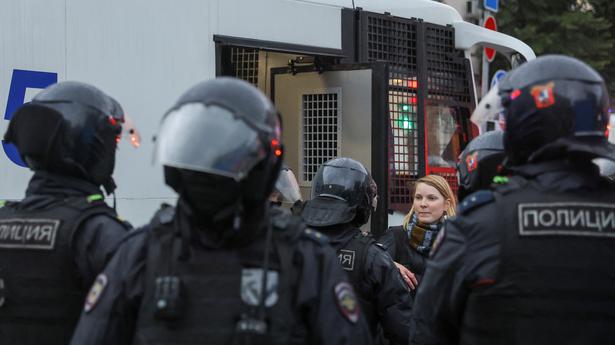
Both Mr. Putin and his Defence Minister, Sergei Shoigu, have said that only those who are currently in the reserves and those who have served in the armed forces and have got military training would be conscripted. Mr. Shoigu says Russia can mobilise some 25 million people from the country’s vast reserves but the Defence Ministry is planning to call in only 1% of that potential — some 3,00,000 troops. It may not have been an easy decision for Mr. Putin, who is now in a difficult situation — the Generals need more manpower and hardliners are exerting pressure on him to commit more troops and resources. Some have even expressed rare public criticism such as the Chechen leader Ramzan Kadyrov. On the other side, a general mobilisation, which would need nationwide conscription, could be unpopular. This explains why Mr. Putin delayed the mobilisation so long and hasn’t declared war on Ukraine. He can’t afford to take further battlefield defeats either. So he struck a balance by opting for a partial mobilisation — which also triggered some protests — immediately after pro-Russian separatists in Ukraine’s breakaway regions decided to hold referendums on joining Russia. This move itself is a major escalation. The 3,00,000 troops the Russian Defence Ministry is mobilising is almost twice the size of the original mobilisation Russia made before launching this war.
Of the four regions holding the vote, Russia has recognised Donetsk and Luhansk, which make up the industrial Donbas region, as independent republics. Since the war began, Russia and the separatists have captured almost all of Luhansk and some 65% of Donetsk. They also control parts of Kherson, including the port city that fell in the initial days of the war, and Zaporizhzhya, including the eponymous nuclear plant, Europe’s largest. The separatists have been planning to hold the referendums for some time, but Russia’s setbacks in Kharkiv seem to have quickened their move, with blessings from Moscow. While there won’t be any surprise in the results, what needs to be seen is if and when Moscow recognises the referendums and annexes these territories. If Moscow does it, Ukraine’s borders would be redrawn for good and it would require greater commitment from the Kremlin to defend those territories or capture the rest of these regions that are still controlled by Ukrainians. It’s not a surprise that both the referendums and Mr. Putin’s additional mobilisation were announced almost simultaneously. They are part of the same strategy.
Editorial | A dangerous moment: On Vladimir Putin’s troop mobilisation
While Mr. Putin’s declaration of mobilisation is a major escalation, a careful examination of his speech shows mixed signals. Mr. Putin referred to the March talks between Russia and Ukraine where both sides agreed to further discuss peace proposals, which, according to him, was sabotaged by the U.S. and the U.K. Here, the reference is to the Istanbul talks in which Ukraine had made a proposal to adopt neutrality (give up NATO membership plan) in return for multilateral security guarantees, discuss the status of Donbas with Mr. Putin and agree to a 15-year consultation period for Crimea (during which the status quo would be respected). After the talks, Russia announced its withdrawal from around Kyiv and Kharkiv (city). But then, footage of the Bucha bodies emerged, after which the peace process collapsed. While we don’t know the fine print, Mr. Putin’s positive reference to the peace process is an indication that the hope for a negotiated settlement is not yet dead. In the speech he said he would use “all available means” (read nuclear weapons) to protect the territorial integrity of Russia — which was a direct threat to Ukraine against attacking Crimea, which Russia had annexed in 2014. While he backed the referendums, he didn’t say if and when he would recognise the results. This leaves a window of opportunity for the peace process which will not stay open forever.


PJAK emphasizes its autonomy in the fight for a democratic Iran, rejecting involvement in external conflicts, says co-chair Peyman Viyan.

The Hindu quiz: Does the joint U.S.-Israeli military operation on Iran constitute a war, conflict, escalation, or campaign change? A quiz on lexicons and lives.

A 5.8-magnitude earthquake struck off Cuba's coast, with no immediate reports of casualties or damage.

Israel's Defence Minister announces the killing of Iran's security chief Ali Larijani in an overnight military strike.

China pledges humanitarian aid to Iran and West Asia amid ongoing conflict, highlighting the region's urgent humanitarian crisis.

Ofcom extends BT Openreach regulation for five years, widening price caps to boost competition and enhance broadband access in the U.K.

Israeli Prime Minister Netanyahu shares Nowruz greetings with Iranians, emphasizing hope and freedom amid ongoing tensions.

India strongly condemns Pakistan's airstrikes on a Kabul hospital, urging accountability for violence against Afghan civilians.

A federal court blocks Trump's funding freeze, impacting up to $3 trillion in federal assistance amid legal disputes.

Afghanistan cricketers, including Rashid Khan, condemn Pakistan's airstrike in Kabul, calling for justice over civilian casualties.

Shorts News:Watch: ‘We don’t know if he’s dead or not’: Trump on Ayatollah Mojtaba Khamenei

Trump claimed Iran's attacks on Gulf allies were unexpected, despite prior warnings of potential retaliation from U.S. intelligence.

UAE temporarily closes airspace amid escalating West Asia conflict and missile threats from Iran, then quickly reopens it.