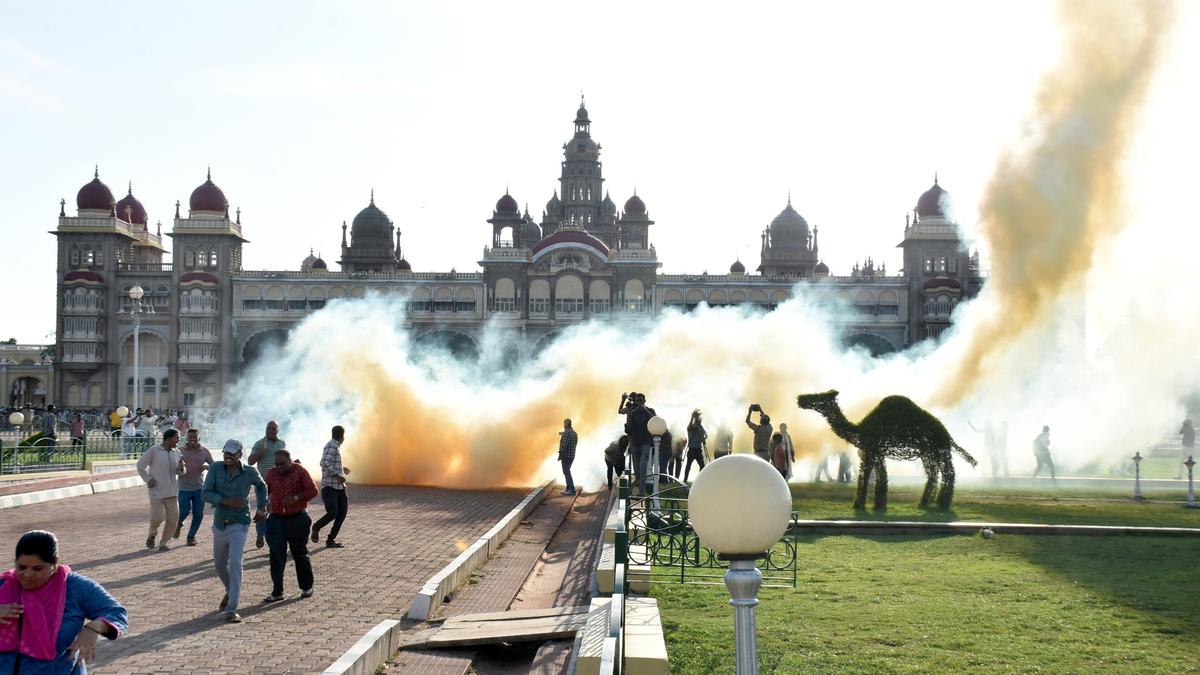
Emergency response preparedness tested during civil defence drill in Mysuru
The Hindu
Tension-filled emergency response drill tests Mysuru palace security personnel's preparedness in crisis management, involving explosions and casualties.
Tension gripped the Mysuru palace grounds on Friday evening as an unidentified aircraft was “sighted in restricted airspace,” followed by a series of explosions, triggering an emergency response from the authorities.
As plumes of smoke emanated from the fire, sirens blared through the air, alerting the general public while security personnel swept in to take control of the situation. And it was meant to be just that: a test of the security personnel’s preparedness to handle a crisis due to tensions and the outbreak of hostilities (since suspended following a ceasefire) between India and Pakistan.
The drill - Operation Abhyas - was designed and the scenario simulated in a manner to test the efficacy of all players in the district administration who will be on the forefront during a real-life crisis. Hence, the “first sign of trouble” was noticed by the Air Traffic Control (ATC), which detected suspicious aerial movement over the palace area and swiftly alerted both the district and police control rooms.
At 4.36 p.m., the Assistant Commissioner of Police (ACP) Harsha received the alert and immediately initiated a city-wide emergency response, warning of potential threats to several key installations including Infosys, CFTRI, HPCL, IOCL, and BPCL. Soon after, sirens echoed signalling a high-alert situation.
The simulated scenario included sighting of an aircraft, explosions near the clock tower, collapse of a wall to indicate structural damage, while there were signs of casualties at the spot. The emergency units were quickly mobilised, and medical, police, fire, and bomb disposal teams were activated. Meanwhile, ACP Rajendra secured the area, enabling the bomb squad to conduct inspections before issuing an “all clear” signal.
While fire at a corner of the palace was brought under control, rescue efforts were launched, and about 100 home guards “assisted the injured.”
Medical teams entered through the Jayarama and Balarama gates, established a temporary triage area, and transported the injured to hospitals, while the Karnataka State Road Transport Corporation buses evacuated other personnel and bystanders to safety zones. A one-minute continuous siren indicated that the “crisis” was brought under control, marking the end of the drill.


Indian vessels can freely sail through the Strait of Hormuz without needing permission, confirms a senior government official.

The Hindu Morning Digest gives a select list of stories to start the day. Read the top news today on March 25, 2026

An IndiGo flight at Vijayawada airport was grounded due to a tyre burst, but all 79 occupants are safe.

Tamil Nadu Assembly election 2026: TMC(M) gets five seats in NDA, to contest on BJP's 'Lotus' symbol
TMC(M) secures five NDA seats, to contest Assembly elections using BJP's 'Lotus' symbol in Tamil Nadu.

The Karnataka government will discuss with officials the possibility of creating a portal for unemployed youth to share their details and access job opportunities in micro, small and medium enterprises (MSMEs), Minister for Small Industries and Public Enterprises Sharanabasappa Darshanapur said in the Legislative Council on Tuesday.

AIADMK's 2026 manifesto promises free rations, women's benefits, education reforms, and economic growth initiatives for Tamil Nadu.

U.S.-Israel war on Iran LIVE: Follow The Hindu for updates on the West Asia conflict on March 24, 2026

Join the 'Click & Commit' campaign on World TB Day, uniting Chennai's community to pledge against tuberculosis.

Brahmin candidates join Naam Tamilar Katchi, marking a significant shift in Tamil Nadu's political landscape and inclusivity.

Over 750 wheelchairs are prepared in Thoothukudi for accessible voting, ensuring convenience for differently abled and elderly voters.

Madras HC dismisses S.P. Velumani's petition challenging I-T assessment of ₹7 crore as unexplained election expenses from 2016.

The Lok Sabha passes a contentious Transgender Bill, sparking praise from the government and criticism from opposition parties.

Kamal Haasan announces support for DMK in 2026 elections, emphasizing the need for 'Dravidian Model 2.0' for Tamil Nadu's welfare.