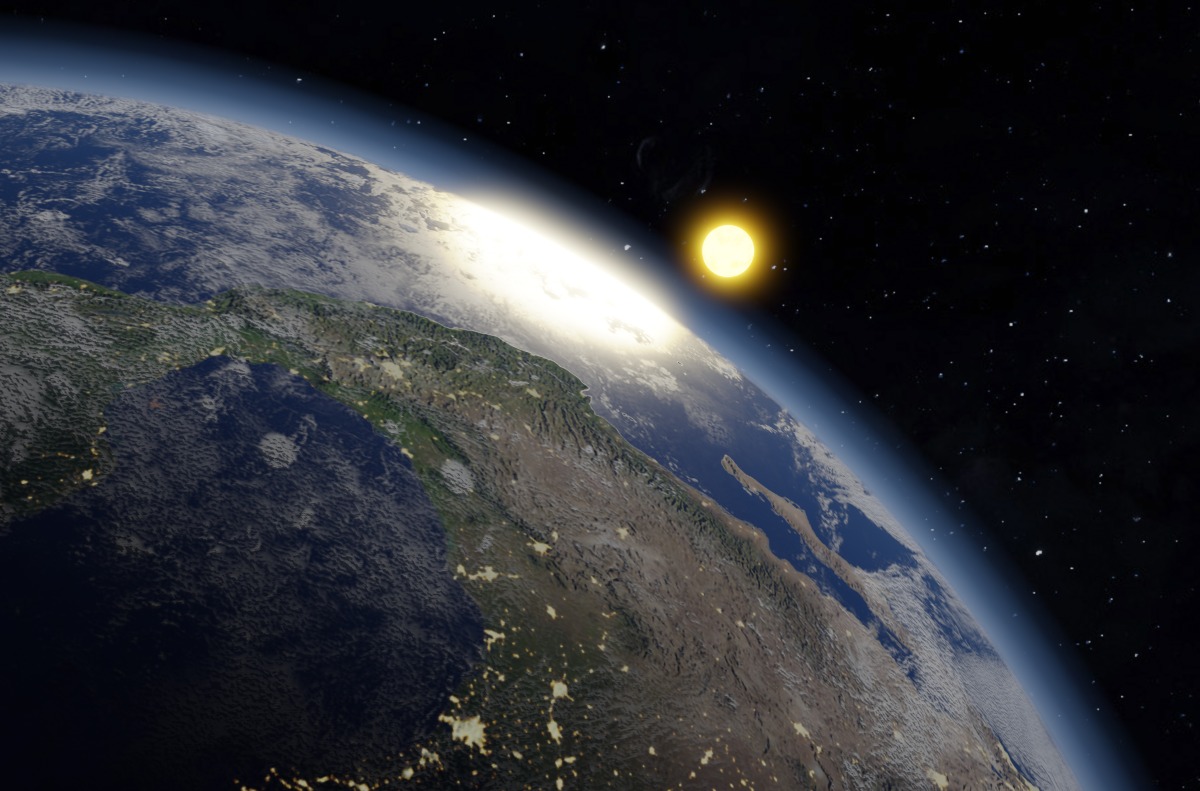
Earth to reach closest point to Sun on Saturday evening
The Peninsula
Doha: The Qatar Calendar House on Thursday said that planet Earth will reach the closest point in its orbit around the Sun, known as perihelion, on Sa...
Doha: The Qatar Calendar House on Thursday said that planet Earth will reach the closest point in its orbit around the Sun, known as perihelion, on Saturday evening, 14 Rajab 1447 AH, corresponding to January 3, 2026. At that time, Earth will be at an approximate distance of 147 million kilometers from the Sun, about five million kilometers closer than it was in July of last year.
Dr. Bashir Marzouq, an astronomy expert at the Qatar Calendar House, stated that Earth reaches perihelion at the beginning of January each year, while it reaches the farthest point in its orbit around the Sun-known as aphelion-during the month of July.
He noted that variations in the distance between the Earth and the Sun are not the cause of climatic changes on Earth's surface. Rather, this variation plays an important role in determining the lengths of the four astronomical seasons. He emphasized that this phenomenon is entirely natural and has no negative effects on the inhabitants of the planet, contrary to claims made by non-specialists.
Dr. Marzouq further pointed out a striking paradox: despite Earth being closest to the Sun in January, which corresponds to winter in the Northern Hemisphere, temperatures are low.
Conversely, when Earth is farthest from the Sun in July-summer in the Northern Hemisphere-temperatures are high. This is due to the angle of incidence of solar radiation. In winter, the Sun's rays strike the Northern Hemisphere at a more oblique angle, causing them to pass through a longer path in the atmosphere and lose a significant portion of their heat. In summer, the Sun's rays fall more directly, traverse a shorter atmospheric path, and therefore retain more of their heat. The situation is entirely reversed in the Southern Hemisphere.
