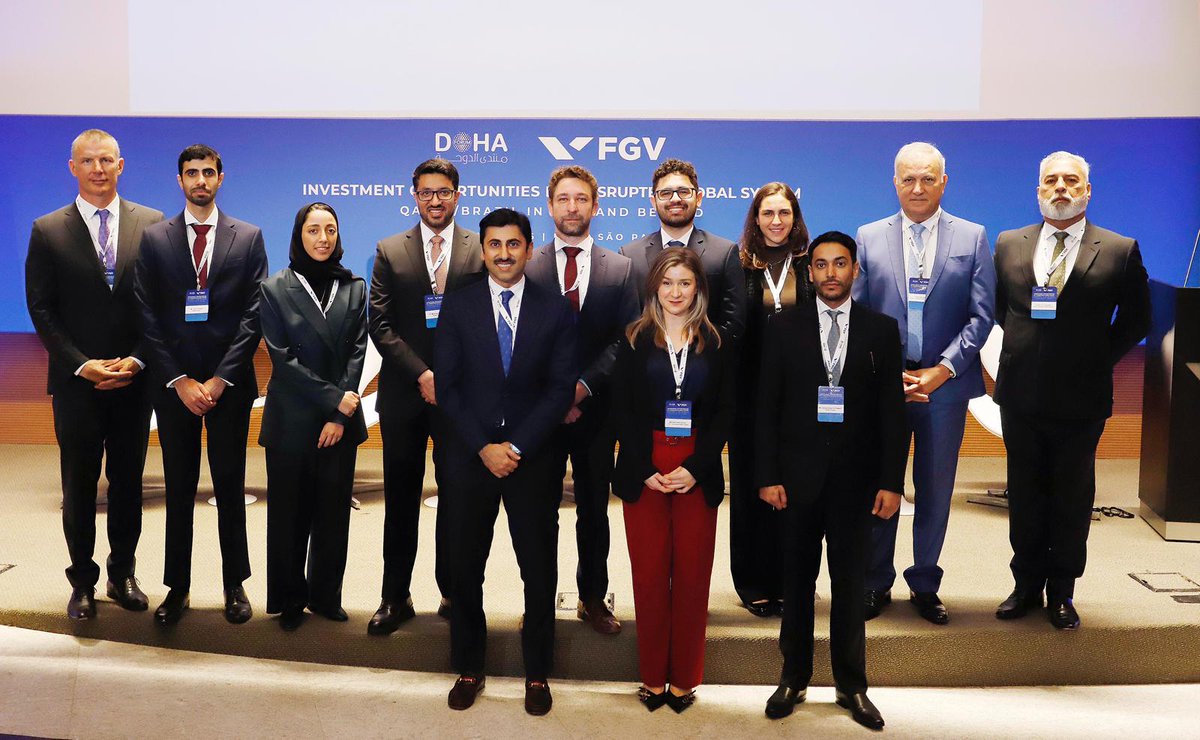
Doha Forum, FGV host strategic dialogue on investment opportunities
The Peninsula
Sao Paulo: Doha Forum, in collaboration with Fundacao Getulio Vargas (FGV), co hosted a high level panel and reception in Sao Paulo yesterday, under t...
Sao Paulo: Doha Forum, in collaboration with Fundacao Getulio Vargas (FGV), co-hosted a high-level panel and reception in Sao Paulo yesterday, under the title “Investment Opportunities in a Disrupted Global System: Qatar/Brazil in 2025 and Beyond.”
The discussions highlighted that current political changes have contributed to fundamental changes in some existing systems, but have also opened up broad horizons for innovation, forward-looking growth, and strengthening strategic partnerships.
The speakers emphasized that investment, particularly in the areas of infrastructure, energy, technology, and agribusiness, represents a key lever for economic diversification, enhancing resilience, building trust, and opening broader avenues for dialogue and cooperation in the areas of sustainability, innovation, diplomacy, and development.
Panel opening remarks were delivered by Executive Director of Doha Forum Mubarak Ajlan Al Kuwari, and Director for International Affairs at Fundacao Getulio Vargas Professor Marlos Correia Lima. Al Kuwari commented by saying that “Brazil and Qatar share a commitment to resilience, innovation, and forward-looking growth. At a time of systemic transformation in the global economy, this event is an opportunity to deepen strategic dialogue, unlock new investment partnerships, and chart a more cooperative path forward.” For his part, Professor Correia Lima added that: “FGV is proud to host this dialogue, in this emerging framework, new opportunities arise for countries willing to cooperate, innovate, and, most of all, build bridges.”
The event brought together senior figures from Qatar and Brazil to explore how strategic investment and targeted cooperation can strengthen bilateral ties, enhance economic resilience, and support a more inclusive global economic order. Amid shifting trade flows, reconfigured supply chains, and growing pressure on multilateral frameworks, both countries are navigating a landscape of significant challenges and opportunities.


Doha, Qatar: Artificial intelligence is rapidly reshaping the modern workplace, driving both unprecedented efficiency and complex challenges, accordin...

Ambassador of the State of Qatar to the Republic of India H E Mohammed bin Hassan Jaber Al Jaber participated in a meeting of Minister of External Aff...

Doha, Qatar: The Qatar National Library reopened its facilities to the public yesterday, marking the resumption of full operations and services follow...

Doha, Qatar: The Qatar National Library reopened its facilities to the public yesterday, marking the resumption of full operations and services follow...

Doha, Qatar: In times of geopolitical crisis, information spreads at unprecedented speed, and the risk of disinformation taking hold has never been gr...

Doha, Qatar: QNB Group, a leading financial institution in the Middle East and Africa, has published its Sustainability Report 2025, detailing the Gro...

Doha, Qatar: The Asian Football Confederation (AFC) yesterday confirmed that all remaining knockout matches in its club competitions across the West R...

Doha, Qatar: Advisor to Prime Minister and Official Spokesperson for the Ministry of Foreign Affairs Dr. Majed bin Mohammed Al Ansari has said Qatar i...

Geneva: The United Nations Human Rights Council (UNHRC) will hold an urgent debate today on Iran s military attacks against Qatar, Bahrain, Kuwait, Om...

Doha, Qatar: Weather inshore until 6pm on Wednesday will be hazy and partly cloudy to cloudy at times with a chance of scattered rain, maybe thundery...

Doha, Qatar: Weather inshore until 6pm on Wednesday will be hazy and partly cloudy to cloudy at times with a chance of scattered rain, maybe thundery...

Doha, Qatar: The Amir HH Sheikh Tamim bin Hamad Al Thani received a phone call on Tuesday from the President of the Republic of Turkiye HE Recep Tayyi...

Doha, Qatar: The Amir HH Sheikh Tamim bin Hamad Al Thani received a phone call on Tuesday from the President of the Republic of Turkiye HE Recep Tayyi...