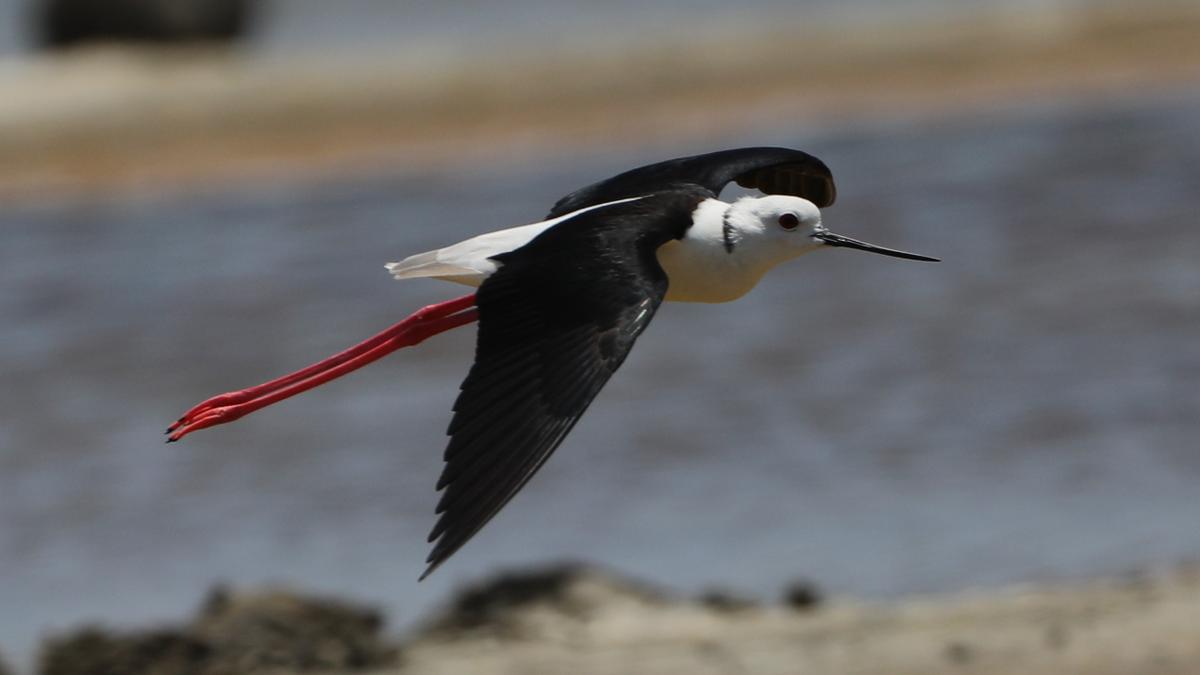
Do not mess with the black winged stilt in these times
The Hindu
At the end of the wintering season, when Perumbakkam wetland dries up, images of belligerent black winged stilts guarding the stones they had marked for nesting are inevitable. Never mind that their response to the danger (usually more of a perception than a reality) would be disproportionate to the threat. These stones are a boon to the black-winged stilt, and around April, they are prompt in taking possession of them, as these images from April 10 and 13, 2025 illustrate. The black-winged stilts’ breeding season falls in the April to August time band. Where they do not find stones such as these parked in shallow waters, nesting black-winged stilts — both male and female together working shoulder to shoulder (pectoral girdle to pectoral girdle, to be more accurate) — would create mounds by shovelling earth and even decaying plant material to make their nests. Equally inevitably, showers, some out-of-season and the others according to the dictates of the rain chart (usually those from South West monsoon), might submerge these stones, dashing these birds’ efforts to raise a family. This year, the downpour on April 16 set the black-winged stilts plans back a wee bit, and in characteristic style, they resumed nesting effort after the water receded again. Time and again, one has seen this scene play out. After the water drains and the stones re-emerge, they would be at it again, making another attempt at nesting. In these times, this beanpole of a bird is the picture of resilience, illustrating the power of stick-to-itiveness.
Recreating the world in their own image is a irresistible temptation for human kind. Imparting human characteristics to animals is a subset of this human inclination. Considering its usefulness in elucidating moral instructions (recall “Aesop’s Fables”), this usually turns out a good temptation that human kind yielded to. There is however a yawning chasm, wider than Australia’s Capartee Valley, between fableism and anthropomorphism.
Fableism does not for a second pretend that the animal characters possess any of the human characteristics they portray. Anthropomorphism is a wholly different kettle of fish: it might compare human and animal behaviours, suggesting the species in question mirrors a specific human trait. For example, the male jacana attending to child-rearing duties can be presented as a mirror image of men exemplifying fatherly commitment.
The human mind can create points of convergence in this manner, and here is one more born out of an entirely anthropomorphic viewpoint. The belligerence and resilience of the black winged stilt as a “householder”. And why do we persist with it: it is irresistible and it does seem to mirror the extent human parents would go to protect the little home they create and raise.
At the end of the wintering season, when Perumbakkam wetland dries up, images of belligerent black winged stilts guarding the stones they had marked for nesting are inevitable. Never mind that their response to the danger (usually more of a perception than a reality) would be disproportionate to the threat.
These stones are a boon to the black-winged stilt, and around April, they are prompt in taking possession of them, as these images from Perumbakkam wetland on April 10 and 13, 2025 as also the one from Kelambakkam taken on April 29, 2025 illustrate. The black-winged stilts’ breeding season falls in the April to August time band.
Where they do not find stones such as these parked in shallow waters, nesting black-winged stilts — both male and female together working shoulder to shoulder (pectoral girdle to pectoral girdle, to be more accurate) — would create mounds by shovelling earth and even decaying plant material to make their nests.
Equally inevitably, showers, some out-of-season and the others according to the dictates of the rain chart (usually those from South West monsoon), might submerge these stones, dashing these birds’ efforts to raise a family. This year, the downpour on April 16 set the black-winged stilts plans back a wee bit, and in characteristic style, they resumed nesting effort after the water receded again.


First-level randomisation of EVMs completed in Nagapattinam for upcoming elections, ensuring transparency and security.

A district-level committee in Krishnagiri has been formed to assess and verify seizure claims of goods and cash.

Minister Anam Ramanarayana Reddy pledges government support for local fishermen and farmers facing challenges in Andhra Pradesh.

MP M. Sribharat urges collective efforts to revive Visakhapatnam Steel Plant, highlighting key reforms for crucial recovery and growth.

141 candidates have filed nominations for Kozhikode's Assembly elections, with scrutiny on March 24 and campaigning intensifying.

BJP's Vijayendra accuses Congress of using money to influence Bagalkot bypolls, urging voters to reject their tactics.

First randomization of electronic voting machines completed in Tirunelveli and Tenkasi districts for upcoming Assembly elections.

RPF seizes 10.12 kg of unclaimed cannabis worth ₹5.06 lakh from a train in Mangaluru.

Kolar's groundwater levels rise to 50-100 ft due to the K.C. Valley project, ensuring clean water and improved health outcomes.

Three smugglers arrested in Sangareddy with 574 kg of ganja valued at ₹2.87 crore during a police operation.

Mysuru MP urges a 'flex-free Mysuru' by discouraging birthday banners, promoting responsible celebrations to preserve the city's heritage.

Farmers of Kalakudi demand payment for paddy bags procured at DPC

BJP's seal on a 2019 Election Commission letter ignites controversy in Kerala, prompting claims of careless handling by CPI(M).