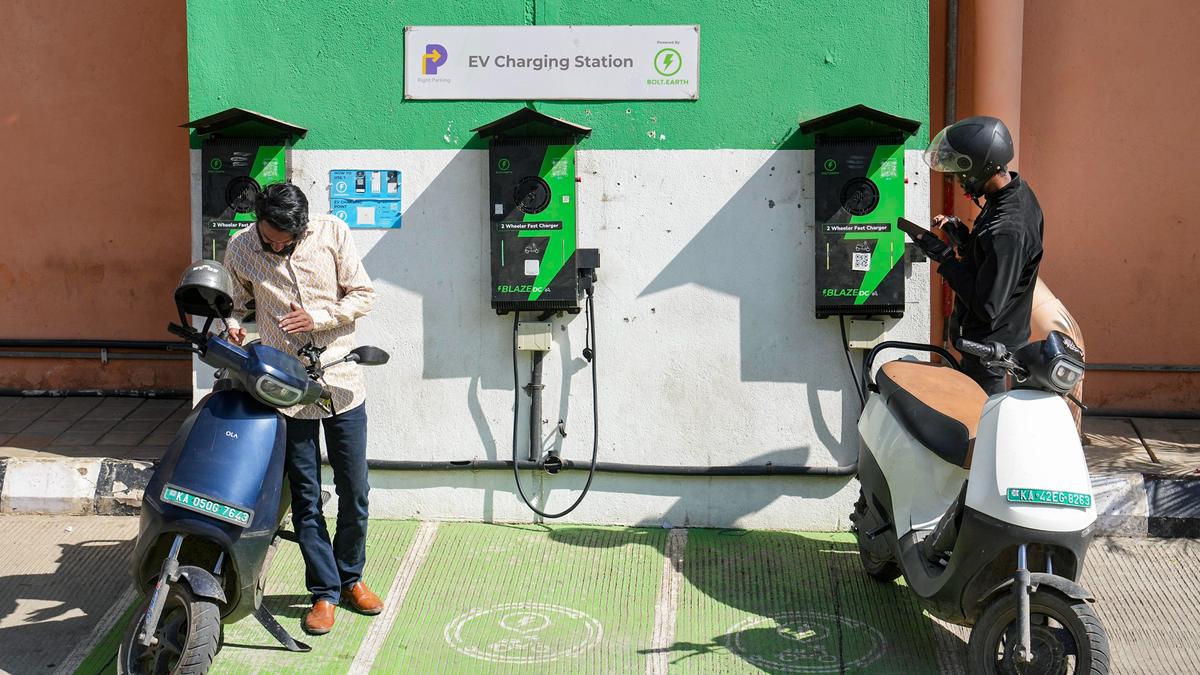
Decarbonise transport sector through modal shift, zero emission vehicles: NITI report
The Hindu
NITI Aayog's report advocates for decarbonising India's transport sector through zero-emission vehicles and clean technologies to achieve Net Zero by 2070.
NITI Aayog on Tuesday (February 10, 2026) stressed on decarbonising the transport sector through modal shift, zero-emission vehicles (ZEVs), and clean fuels & technologies to meet India's Net Zero 2070 goal.
The transport sector is one of the key drivers of India’s economy. It also contributes significantly to the country's energy use and emissions, accounting for 20% of final energy demand and around 10% of greenhouse gas (GHG) emissions in 2020, the government think tank said in a report.
As per the report, implementing the Net Zero pathway requires about $4.3 trillion in cumulative investment till 2070, around 25% higher than the $3.44 trillion under the Current Policy pathway.
This additional investment, however, is a strategic opportunity than a cost burden. As India urbanises rapidly and travel demand surges, the sector risks being locked into higher fuel imports, poorer air quality, and rising logistics costs.
"Decarbonising transport through modal shift, zero-emission vehicles (ZEVs), and clean fuels and technologies is therefore critical to meet India’s Net Zero 2070 goal," the report said.
NITI Aayog has also stressed on Adoption of Zero-Emission Vehicles (ZEVs) including Battery Electric Vehicles (BEVs), hydrogen based vehicles, Biofuels (Ethanol based Flex Fuel Vehicles (FFVs) and Compressed Bio-Gas (CBG) based vehicles) should be kept as key priority for the long term vision and accordingly fomalise segment-wise ZEV acceleration through 2035 for two-/three-wheelers, passenger cars, buses, and trucks.


Induction stove adoption in low-income Indian households remains low due to limited electrical infrastructure and high costs despite rising demand.

India's coal stock stands at 210 MT, ensuring an 88-day supply to meet rising power demand ahead of summer.

Investment rule tweaks will benefit electronics and rare earth sector in India, says DPIIT Secretary
DPIIT's investment rule changes will enhance India's electronics and rare earth sectors, boosting capital flow and joint ventures.

ED conducts searches at 19 locations in Haryana and Chandigarh linked to ₹590 crore IDFC First Bank fraud investigation.

Oil Ministry reassures no LPG panic needed; normal delivery maintained at 2.5 days amid secure crude oil supplies.

Sensex and Nifty fall nearly 2% as crude oil prices rise amid West Asia tensions and sustained foreign fund outflows.

Rupee falls 16 paise to 92.01 against the dollar amid FII outflows and weak domestic market sentiments.

John Deere launches a 130 HP tractor in India for ₹65 lakh, featuring advanced technology and sustainable farming solutions.

Stock markets decline as Sensex and Nifty drop amid geopolitical tensions and foreign fund outflows in early trade.

Polymarket, the world's largest prediction market, said Tuesday it had formed a partnership with Palantir Technologies to monitor its sports betting markets

ArcelorMittal and Nippon Steel seek EoI for a steel fabrication unit near their new Integrated Steel Plant in Andhra Pradesh.

Amazon.com is looking to raise about $37 billion in an 11-part bond sale, according to a term sheet seen by Reuters on Tuesday, as it looks to fund its spending on AI infrastructure buildout.

Oracle on Tuesday said its revenue in the recently ended quarter soared more than expected as demand for services boosted by artificial intelligence outpaced supply.