CSIR-NIIST develops technology for in situ disposal of biomedical waste
The Hindu
At a time when hospitals are struggling to get rid of biomedical waste, the National Institute for Interdisciplinary Science and Technology (NIIST), a Council of Scientific and Industrial Research (CSIR) laboratory here, has developed a technology for their in situ disposal in an ecofriendly and cost-effective way.
At a time when hospitals are struggling to get rid of biomedical waste, the National Institute for Interdisciplinary Science and Technology (NIIST), a Council of Scientific and Industrial Research (CSIR) laboratory here, has developed a technology for their in situ disposal in an ecofriendly and cost-effective way.
Models meant for regular hospitals and one for the Military Hospital in the high-altitude Siachen glacier are currently undergoing tests, C. Anandharamakrishnan, Director, CSIR-NIIST, told The Hindu.
The NIIST design, which is quite compact, is expected to boost the decentralised disposal of biomedical wastes, benefitting States such as Kerala where they are often transported over long distances to a couple of facilities for the purpose, Dr. Anandharamakrishnan said. The treated waste is expelled from the unit in the form of a powder which is useful as a soil additive, according to him. CSIR-NIIST is hoping that the model for the Military Hospital in Siachen can be commissioned by August 15 to coincide with the Independence Day celebrations this year.
The unit undergoing tests for the Military Hospital in Siachen is capable of handling 10 kg at a time, and up to about 100 kg a day, Dr. Anandharamakrishnan said. Here, the real challenge was redesigning the original idea to suit the climatic conditions of Siachen, often dubbed the world’s highest and coldest battlefield. “It has to be a low-temperature operation there. The temperatures being extremely low, it is very difficult to manage biomedical waste. They cannot burn or bury it. In other locations, incinerators are at least possible. There they don’t have that option. Even if the cabin housing the waste treatment is artificially heated, the temperatures still tend to be lower than what it is here,” he said.
The 10 kg unit takes about half-an-hour to dispose of a single batch.
Studies are also under way on another CSIR-NIIST prototype, which will prove useful to regular hospitals, at the All India Institute of Medical Sciences (AIIMS), New Delhi. “The Ministry of Environment, Forest and Climate Change wanted units specifically for remote areas where the wastes are still burned or buried. We hope to complete the study in two months and hand over the report to the Ministry,” This biomedical waste conversion rig is capable of handling 100 kg per day.
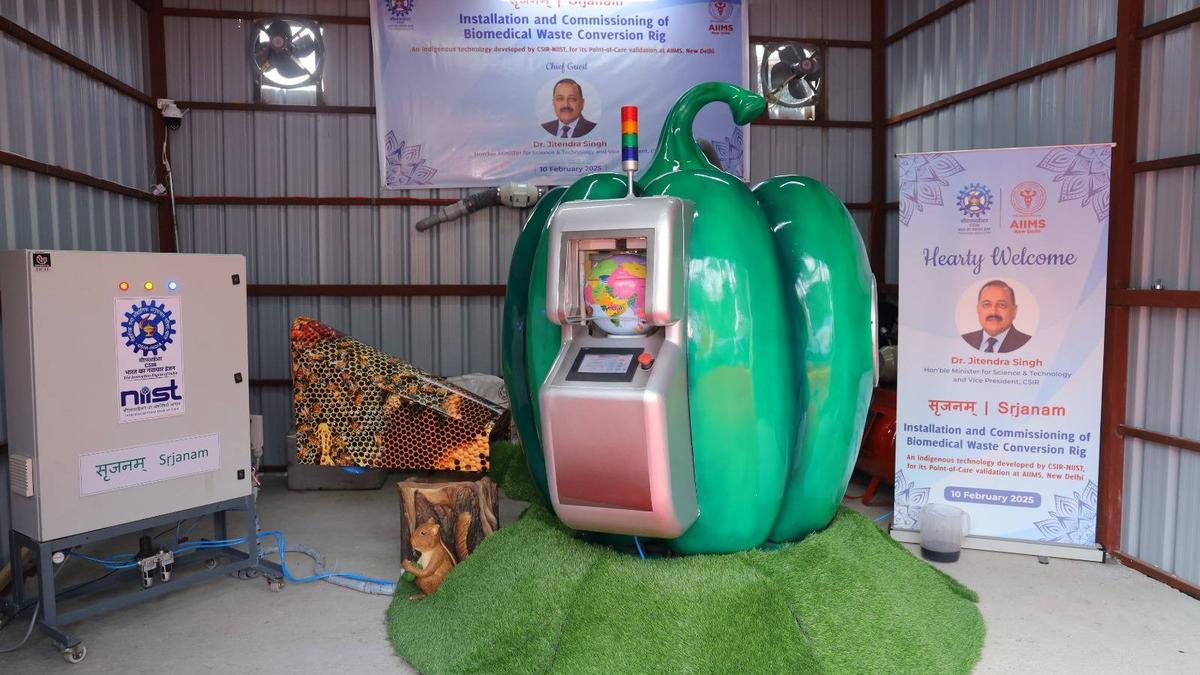
Given the misgivings biomedical waste treatment plants tend to arouse in the public, NIIST scientists have also taken the effort to make sure that their design is easy on the eye. The compact units resemble huge green capsicums. The waste is put in by opening the (automated) door provided at the side of the unit.


The government plans to amend the FCRA, introducing new regulations for NGO asset management and accountability for key functionaries.

The draft policy for “Responsible Digital Use Among Students”, released on Monday by the Department of Health and Family Welfare, has recommended that parents set structured routines with clear screen-time rules and prioritise privacy, safety, and open conversation with children on digital well-being.

Police Observer Sushant Kumar Saxena conducts surprise inspection at Shencottai police station, reviewing warrants and security arrangements ahead of elections.

Andhra Pradesh government to launch key projects in April, focusing on industrial growth and infrastructure development, says Nara Lokesh.

Lok Sabha refers the Corporate Laws (Amendment) Bill to a JPC amid opposition concerns over CSR provisions dilution.

SHG members in Kanniyakumari use snakes and ladders to raise election awareness and boost voter turnout.

Government accelerates consultations for early implementation of the Women’s Reservation Act to ensure women’s representation in 2029 elections.

CM A. Revanth Reddy distributes ₹1 crore insurance cheques to families of deceased Electricity department employees, enhancing financial security for workers.

The Bengaluru Traffic Police (BTP) registered 634 cases of drunk driving during a week-long special enforcement drive conducted across the city between March 16 and March 22.

GHMC intensifies action against property tax defaulters, seizing properties and offering a One Time Settlement scheme for payments.

CCB arrests three drug peddlers in Mangaluru, seizing ₹2.5 lakh worth of MDMA and other valuables.

TVK's 28 candidates in Puducherry include former BJP MLAs, a sitting Independent, and a retired police IG.

BRS submits notice on private member bill to Speaker