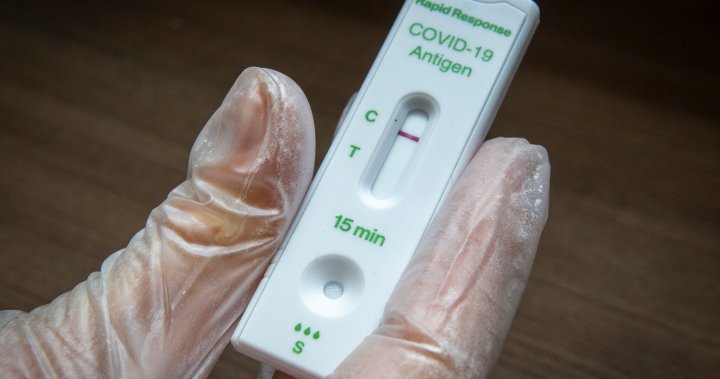
COVID-19 rapid tests aren’t always accurate. But they’re still useful, experts say
Global News
When used properly while adhering to public health measures, experts rapid antigen tests can be an incredibly useful and effective tool in anyone's COVID-19 toolkits.
Ontario announced its plans to start a rapid antigen testing blitz on Wednesday, as the Omicron variant continues its swift spread across Canada.
The province follows others, like New Brunswick, Nova Scotia and Saskatchewan, which are already handing out rapid tests. Alberta, Quebec and British Columbia have also all vowed to follow suit.
But reports have suggested the accuracy of these tests could be anywhere between 50 and 95 per cent, depending on what kind you buy and how you use them. That means even if you take one of these tests, you can’t always trust that it’s giving you the right result.
“If someone tests positive with a rapid antigen test, it makes sense to go and get PCR testing as confirmation,” said Dr. Matthew Miller, assistant dean at McMaster University’s department of biochemistry and biomedical sciences.
This reality has prompted some — including, on Tuesday, a Liberal MP — to say that because rapid tests are “not as efficacious” as other kinds of tests, it means they are “unreliable” in the fight against Omicron.
But public health experts say it’s a bit more complicated than that — and that, when used properly while adhering to public health measures, rapid antigen tests can be an incredibly useful and effective tool in anyone’s COVID-19 toolkits.
Here’s what you need to know.
Rapid antigen tests can be bought online, at pharmacies, or, depending on your province, can be picked up for free at participating locations.


Three Canadians from Quebec who were stranded in the Persian Gulf since Feb. 28 have returned home following a coordinated repatriation effort.

Federal departments announced that they plan to cut more than 12,000 jobs over three years as part of the Carney government’s spending review plan.

Canada’s Integrated Threat Assessment Centre says the U.S.-Israeli war against Iran has heightened an already present threat against Jewish Canadians and public officials.

Edward Warner, his wife Tania and his seven-year-old step-daughter Ayla were coming back from a friend's baby shower on Saturday when they went through an ICE checkpoint in Sarita.

A fire chief from a village that battled flames during Saskatchewan's destructive wildfire season last year says the province's latest budget does not provide enough funding.

Manitoba’s upcoming budget will include more child care funding and a smaller deficit, as the NDP government aims to balance finances by 2027.

A member of the Royal Canadian Air Force in Winnipeg has just been crowned the World's Strongest Firefighter, outlifting athletes from around the world.

Muslims across Canada are celebrating Eid al-Fitr while some reflect on conflict affecting loved ones abroad, as leaders highlight unity, charity and renewal.

The Iran war has raised the price of crude oil beyond US$110 per barrel in international markets, spurring affordability concerns in Canada and around the world.

The statement from Global Affairs Canada comes a day after U.S. intelligence leaders unanimously testified that reports denying foreign involvement should be retracted.

It may be the first day of spring, but Ontario’s long winter isn’t over, with more snow and icy conditions expected before a full warm-up arrives

The policy is something of a reversal from a government that killed a similar idea shortly after taking power. Back in 2019, the province said the policy would be unenforceable.

The recall states that 'the ovens in the ranges can experience a delayed ignition of the oven's bake burner, which can create a potential risk of burns.'