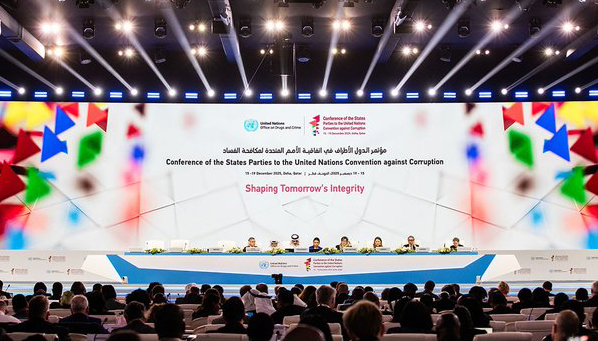
Conference of the States Parties to the UN Convention against Corruption concludes in Doha
The Peninsula
Doha, Qatar: The eleventh edition of the Conference of the States Parties to the United Nations Convention against Corruption concluded its work in Do...
Doha, Qatar: The eleventh edition of the Conference of the States Parties to the United Nations Convention against Corruption concluded its work in Doha with the adoption of the Doha Declaration 2025.
A statement issued by the Conference affirmed that the Doha Declaration delivered a clear message that building the integrity of the future requires the responsible use of technology and the strengthening of international cooperation to address the growing challenges associated with corruption and transnational financial crimes. It is noted that the increasing complexity of corruption patterns requires law enforcement and progressive systems to keep pace with these evolving threats, and called on States to leverage digital technologies, including artificial intelligence, to enhance international cooperation and improve the accuracy, efficiency, and objectivity of corruption risk assessment.
The Declaration encouraged the use of technologies developed by expert networks, including the Global Operational Network of Anti-Corruption Law Enforcement Authorities of the United Nations Office on Drugs and Crime (UNODC), enabling the secure and rapid exchange of information, given the critical importance of time in corruption cases and its direct impact on the integrity of investigations.
Acting Executive Director of UNODC John Brandolino said that the new Doha Declaration, with its focus on artificial intelligence, represents an important recognition of the impact of this technology and a fundamental step toward harnessing its potential in preventing and combating corruption. Meanwhile, the Integrity Advisory Board of the Youth Initiative at UNODC called for the meaningful engagement of youth in anti-corruption frameworks and for monitoring the implementation of the commitments made during the Conference.
The Conference adopted eleven resolutions, including those related to enhancing transparency in the financing of political parties and election campaigns, promoting integrity among children and youth through education, examining the role of corruption in facilitating other crimes such as migrant smuggling and environmental crimes, and addressing the future of the peer review mechanism of the United Nations Convention against Corruption.


Baghdad: Two unmanned aerial vehicles crashed in Iraq, authorities said, with no human casualties or material damage reported. A security source sa...

Doha, Qatar: The Amir HH Sheikh Tamim bin Hamad Al Thani received a phone call on Tuesday from thePresident of the Republic of Slovenia HE Nata a Pirc...

Washington, United States: NASA s chief on Tuesday said the US space agency will invest $20 billion to develop a base on the Moon, while suspending it...

Doha, Qatar: Weather inshore until 6am on Wednesday will be partly cloudy to cloudy with scattered rain, thundery at times, the Department of Meteorol...

Doha, Qatar: Weather inshore until 6am on Wednesday will be partly cloudy to cloudy with scattered rain, thundery at times, the Department of Meteorol...

Brussels: Growth in the eurozone s private sector slowed in March 2026, as conflict in the Middle East drove up energy costs and disrupted companies...

Doha, Qatar: The State of Qatar expressed its sincere condolences and deep sympathy to the sisterly United Arab Emirates on the martyrdom of a civilia...

Doha, Qatar: The State of Qatar expressed its sincere condolences and deep sympathy to the sisterly United Arab Emirates on the martyrdom of a civilia...

Doha, Qatar: The Ministry of Defense of the United Arab Emirates has announced today, March 24, 2026, that one person was killed and five others were...

Doha, Qatar: QatarEnergy on Tuesday declared force majeure on some of its affected long term liquefied natural gas (LNG) contracts, according to a...

Manama: Amazon s cloud arm told AFP on Tuesday that its service in Bahrain had been disrupted, after drone attacks hit the region. An Amazon Web Se...

Geneva: The United Nations Human Rights Council will hold an urgent debate Wednesday on Iran s military attacks against Qatar, Bahrain, Kuwait, Oman,...

Manila: Philippine President Ferdinand Marcos declared a state of national energy emergency on Tuesday, citing risks to the domestic fuel supply and...