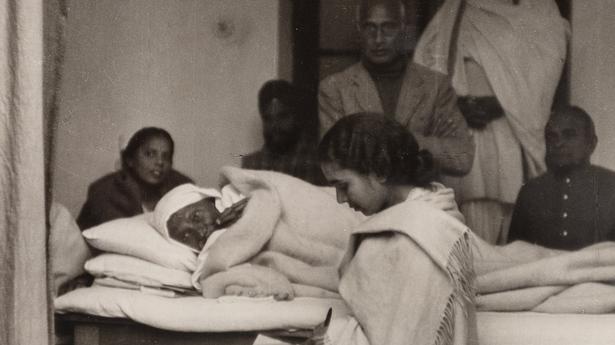
Celebrating 75 years of Independence through over 200 years of art
The Hindu
Show that opens this weekend at Kolkata’s Indian Museum intends to reinterpret the story of the country’s freedom struggle
This weekend, Kolkata will witness the opening of a nearly two-month-long exhibition that will mark 75 years of India’s Independence by showcasing artworks spanning over 200 years. Titled March to Freedom, the show held in collaboration with the Delhi Art Gallery (DAG) will open at the Indian Museum on Saturday and remain on view till September 18.
The exhibition intends to reinterpret the story of the Indian freedom struggle and anti-colonial movement through art, seldom-seen photographs, historical maps, and posters. It will consist of 160 works — representing close to 70 celebrated artists and photographers — chosen from DAG’s collection, ranging from European paintings and prints, to unknown works by Indian artists as well as several iconic pieces by renowned modern artists.
“As the first capital of British India, Calcutta is a key part of any exploration of the anti-colonial movement. And it is the home of India’s first official museum. So, there’s more than one link to Kolkata. But every city and place in India is connected to the story too,” said historian Mrinalini Venkateswaran, based at Royal Holloway, University of London, who is curating the exhibition.
“Learning to approach something from multiple perspectives such as the different parts of the subcontinent — and revisiting one’s views based on new evidence — is among the greatest lessons that one learns as a historian. I wanted to represent a well-known and well-worn nationalist story to prompt reflection. That lies at the heart of this project for me, because it reminds us that we can choose where to go in future,” Dr. Venkateswaran told The Hindu.
Instead of following a chronological order of historical events, the narrative of the exhibition has been divided into eight distinct thematic sections: Battles for Freedom (looking at wars scattered through India’s past); Traffic of Trade (situating India’s history within a global history of trade); See India (on the role of travel); Reclaiming the Past (about being able to tell one’s own story); Exhibit India (about being able to showcase one’s culture); From Colonial to National (on different places and spaces in which the anti-colonial struggle took place); Shaping the Nation (about individuals who led the effort to imagine a nation); and Independence (exploring the moment of freedom and its aftermath).
Each weekend will take a closer look at these different sections through performances, workshops, walks and talks. “We start with Tanashah, a solo performance by Navtej Johar based on the jail diaries of Bhagat Singh. The drama reveals new sides of the iconic freedom fighter, while Johar’s own story as one of the people who helped overturn Section 377 leaves us with questions about our role in the ongoing march to freedom,” said Sumona Chakravarty of DAG.


Vaccination policies must prioritize saving human lives over individual choice amid rising vaccine skepticism, asserts scientist Dr. Virander Singh Chauhan.

Seven Indian fishermen from Rameswaram arrested by Sri Lankan Navy, sparking protests and calls for government intervention.

Kerala cyber police file a case against X for an AI video allegedly defaming PM Modi and the Election Commission.

iKure and Izawa Co. partner to combat avoidable blindness by integrating innovative eye care technology into rural healthcare networks.

Thousand Lights MLA from the DMK N. Ezhilan, in an interview to The Hindu, observes that any popular personality entering politics will attract the limelight. But only a structured party machinery combined with popularity can ensure success. In this interview, he speaks about his tenure as first-time MLA from Thousand Lights Assembly constituency in Chennai, Vijay’s political entry shaping the 2026 elections, redressal of key grievances and more.

Abhishek Banerjee challenges BJP's Suvendu Adhikari in Nandigram, pledging community health initiatives if Trinamool Congress wins.

Rising LPG shortages in Karnataka boost firewood demand, reviving an informal market as households and hotels seek alternatives.

Against the backdrop of intense poll activity, a 400-metre stretch of an arterial road in the outskirts of Chennai (technically in Madurapakkam panchayat under Tambaram assembly constituency) presents a salute to the idea of res publica, which underpins India’s system of governance, where citizens have a say, at least before a government is securely ensconced in the seat of power. A Republic Day initiative shines bright every night

Fadnavis claims zero FIR in Ajit Pawar crash is a defamation attempt by Karnataka against Maharashtra's investigation efforts.

Set to unfold as a one-day pop-up on April 5, the Easter Sadya brings together both vegetarian and non-vegetarian menus, offering a peek into the food traditions of the Syrian Christian (Nasrani) community. While the traditional Sadya is often associated with dishes such as sambar, avial, and rice, this version expands to include community-specific festive dishes.

BJP nominates mother of R.G. Kar victim Abhaya to contest from Panihati in West Bengal Assembly elections.

Veteran Malayalam actor-director E.A. Rajendran passes away at 71, leaving behind a rich legacy in the film industry.

Dakshina Kannada Zilla Panchayat has rolled out digital mode of water bill generation and collection in 23 gram panchayats on a pilot basis for the first time in Karnataka. This is set to be extended to the remaining 200 panchayats shortly, according to the Zilla Panchayat Chief Executive Officer Narwade Vinayak Karbhari.