Cautious consumers in Indonesia scale back Hari Raya spending as uncertainty weighs
The Straits Times
Most have opted to invest or save instead. Read more at straitstimes.com.
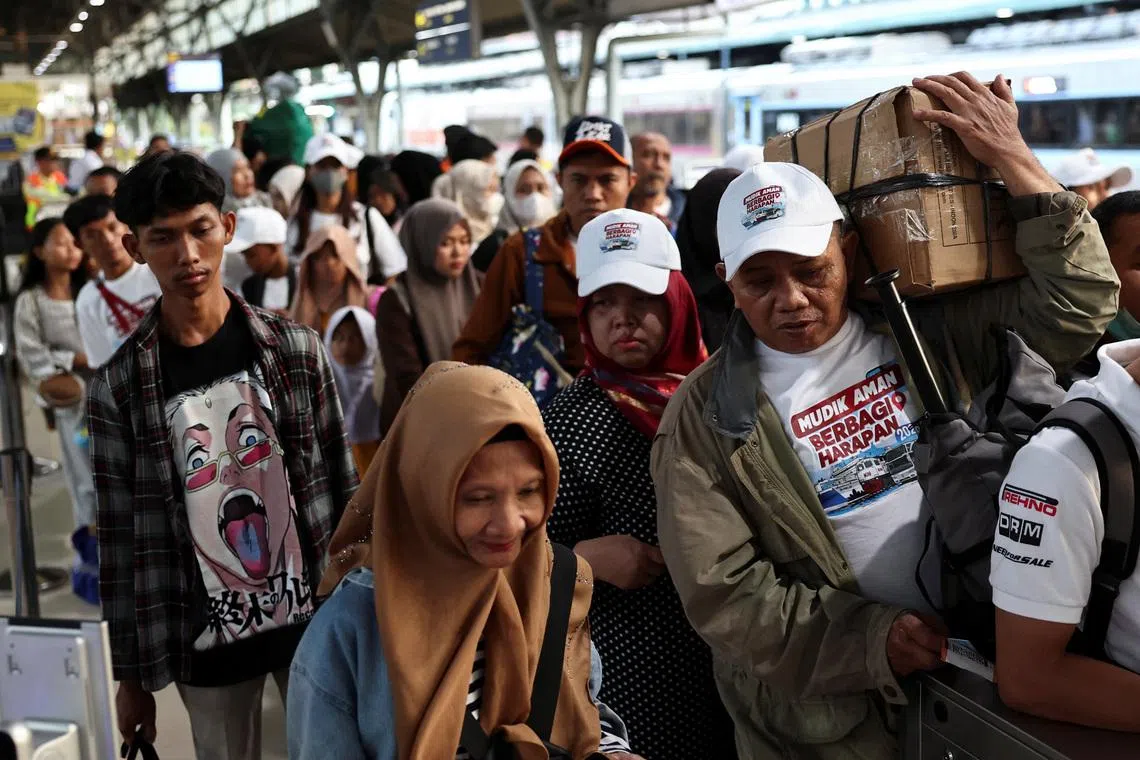
JAKARTA – The annual spending surge during Hari Raya, typically supported by the mass exodus to hometowns (mudik) and holiday allowance (THR) payouts, may lose momentum in 2026 as weaker mobility and more cautious households dampen consumption.
The Transportation Ministry estimates that only 143.91 million people will travel during the Hari Raya exodus in 2026, a 6.55 per cent decline from the 154 million recorded in 2025.
At the same time, the disbursement of THR, another key pillar of the Ramadan economy, is progressing but remains uneven across worker groups.
A survey by Litbang Kompas, the research arm of Kompas daily, conducted from March 6 to 10, showed that only 27 per cent of workers, primarily civil servants (ASN), had received THR at the time. Meanwhile, more than a third of private-sector respondents had yet to receive it, and 23.4 per cent had not been paid despite being informed they would.
Current regulations stipulate that THR must be paid no later than seven days before Hari Raya, which is expected to fall on either March 20 or March 21.
The delay has affected Mr Baihaqi, a Gen Z start-up employee, who has yet to receive his allowance after the deadline.


The US-Israeli war against Iran, now in its third week, has thrown global aviation into turmoil. Read more at straitstimes.com.

March 17 - Rosatom, Russia's state nuclear energy corporation, condemned a strike on the territory of Iran's Bushehr nuclear power plant on Tuesday and called for de-escalation around the facility. Read more at straitstimes.com.

March 17 - Global airlines sounded the alarm on Tuesday over soaring jet fuel prices triggered by the U.S.-Israeli war against Iran, warning of hundreds of millions of extra costs, higher fares and cuts to some routes. Read more at straitstimes.com.

LONDON, March 17 - The British government on Tuesday opened an inquiry into how details of a top-secret national security meeting to discuss a U.S. request to use British military bases at the start of the Iran conflict were leaked to a journalist. Read more at straitstimes.com.

BRUSSELS, March 17 - Ukraine accepted the European Union's offer of technical support and funding to restore oil flows through the damaged Druzhba pipeline on Tuesday but also signalled any resumption of Russian crude deliveries to Hungary and Slovakia was still weeks away. Read more at straitstimes.com.

WASHINGTON, March 17 - President Donald Trump on Tuesday said the United States had been informed by most of its NATO allies that they did not want to get involved with the country's military operation in Iran, a move he described as a \"very foolish mistake\". Read more at straitstimes.com.

ROME, March 17 - Italy's Prime Minister Giorgia Meloni has turned to an unlikely platform in her push for a 'yes' vote in next week's justice referendum, joining an irreverent podcast hosted by a popular rapper in a bid to reach younger voters. Read more at straitstimes.com.

The seized tankers, Asphalt Star, Al Jafzia and Stellar Ruby, are currently docked off Mumbai. Read more at straitstimes.com.

PARIS, March 17 - President Emmanuel Macron said on Tuesday France would never take part in operations to unblock the Strait of Hormuz, pushing back on comments by U.S. President Donald Trump that Paris was willing to help. Read more at straitstimes.com.

ANKARA, March 17 - Turkish Foreign Minister Hakan Fidan reiterated that Turkey is ready to host the next round of negotiations between Russia and Ukraine, during a phone call with Russian Foreign Minister Sergei Lavrov on Tuesday, Turkey's foreign ministry said. Read more at straitstimes.com.

BERLIN, March 17 - More than 36,000 Palestinians in the West Bank were forcibly displaced over a year by Israeli settlement expansion and associated violence, the U.N. human rights office said on Tuesday. Read more at straitstimes.com.

Hungary was blocking a loan to Ukraine over the pipeline outage, which was caused by a Russian attack. Read more at straitstimes.com.

SARAJEVO, March 17 - Slovenia's prime minister on Tuesday accused \"foreign services\" of interfering in Sunday's election after a report alleged officials from Israeli private spy firm Black Cube visited the country in December and met the main opposition contender. Read more at straitstimes.com.