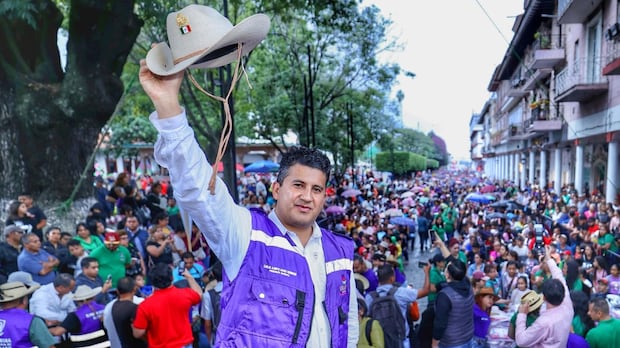
Cartel-fighting mayor’s assassination in Mexico’s avocado heartland fuels citizen fury
CBC
Shortly after 8 p.m. last Saturday, an assassin, wearing a white hoodie pulled over his head, exited the Hotel Alamada and walked about 50 metres to Plaza Morelos in the centre of Uruapan, a city in western Mexico branded as the avocado capital of the world.
His target: Mayor Carlos Manzo, who had risen to national prominence by loudly confronting the heavily armed organized crime groups who’ve unleashed violence throughout his region in power struggles over territory.
The assassin, carrying a 9-mm Beretta handgun, began weaving through crowds in the plaza, which included families with children, gathered for the Festival of Candles, part of the local Day of the Dead celebrations.
Surveillance video released by local authorities along with a timeline of events showed the assassin edging closer, homing in on Manzo, who was also dressed in white and accompanied by his wife and two children as he greeted people in the crowd.
When the assassin reached Manzo, he fired seven times before the mayor’s bodyguards — assigned by the federal government — responded, much too late, with lethal force.
Manzo’s killing triggered a spasm of fury that's now fuelling protests across the fertile state of Michoacan, which produces limes and avocados found on Canadian grocery shelves. Uruapan, with a population of 400,000, is the state’s second-largest city.
Manzo was the seventh mayor killed in the state since 2022 and the second high-profile assassination in a two-week span. Bernardo Bravo, a prominent Michoacan lime grower and agricultural association president who spoke out against the extortion of producers by crime groups, was killed on Oct. 20.
Manzo’s assassination hit a raw nerve in Michoacan’s population, weary of the violence and impunity afflicting their lands, and that anger is now being felt 400 kilometres to the east, in Mexico City.
Francisco Garcia Davish, founder of Quadratin Mexico, a news agency founded in Michoacan with a presence in 22 Mexican states (as well as New Jersey), said he’s never witnessed the local population react this way to a political assassination.
“There have been protests in the streets, in public places, on social media — a multitude of people, of institutions and organizations that have never demonstrated following incidents like this,” said Garcia Davish in a telephone interview with CBC News from Morelia, the state capital of Michoacan.
He called it "a social rebellion.”
The level of violence in the demonstrations — in which state and municipal buildings were partially ransacked and torched — prompted Manzo’s widow to issue a video statement on social media this week calling for protests to remain peaceful.
“We are going to call for justice for Carlos, but I call on citizens who are protesting … who are falling into vandalism, I am asking you please, in the memory of Carlos, let’s do this in a peaceful way, a civilized way,” said Grecia Quiroz, who is replacing her slain husband as Uruapan’s mayor.
Stability in Michoacan was shattered long ago following waves of militarized operations launched by successive federal governments and aimed at destroying established cartels in the region, experts say.


In a resounding victory that is guaranteed to reshape Nepal's politics, rapper-turned-politician Balendra Shah appeared headed for a landslide win in the South Asian country's first polls since youth-led protests toppled the previous government last fall.

China’s latest blueprint for driving growth in its economy was largely written before the U.S. and Israel instigated the most far-reaching war in the Middle East in decades.

U.S. President Donald Trump's firing of Homeland Security Secretary Kristi Noem on Thursday overshadowed the announcement of his plans to nominate Republican Sen. Markwayne Mullin as her successor.

The truck carrying Nepali prime ministerial candidate Balendra Shah was swarmed by cheering supporters in the capital, Kathmandu, on Saturday, unable to inch forward as the former rapper, wearing sunglasses and a sleek black suit, danced on top of the roof.

Israel sent troops into southern Lebanon on Tuesday and warned residents of more than 80 villages to evacuate as the Iran-backed militant Hezbollah group said it was ready for an "open war" with Israel in the wake of the U.S.-Israeli war with Iran.

U.S. President Donald Trump has given Americans a short list of his objectives in attacking Iran, but when it comes to the justification for launching the war and how the conflict is expected to play out, he and his team are sending mixed messages.

Omid Golabkesh dragged his suitcase down a long hallway marking the exit of the Kapikoy border crossing in eastern Turkey. He had nearly reached the end of an exhausting journey that included a 12-hour drive to the checkpoint from his home in Tehran.