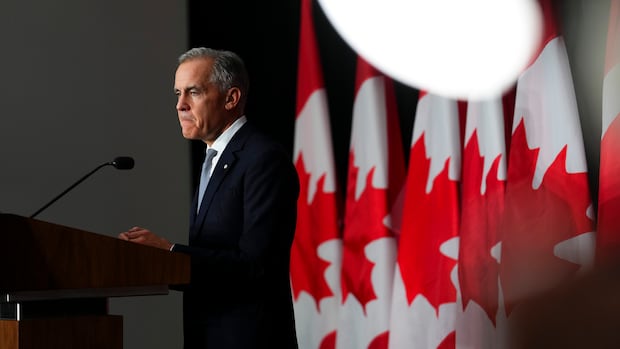
Carney's talk of 'sacrifices' suggests Canadians could soon face those tough choices
CBC
The morning after Mark Carney's 30-minute address to an audience at the University of Ottawa, Pierre Poilievre appeared before reporters to offer his review. The Conservative leader was unimpressed.
"This was the sacrifice speech," Poilievre said, gamely trying to coin a moniker.
Poilievre's specific charge was that Carney was asking for sacrifices from young Canadians, a cohort that is already faced with acute challenges. But given Poilievre's own stated belief in the need to be precise when describing someone else's words, it's worth noting that Carney's warning of coming sacrifices was not specific to young people.
The prime minister was speaking at a university to an audience that seemingly included a number of students. And he went further than he has before to suggest that not all of the decisions ahead will be easy or perfectly enjoyed by all.
"The upcoming budget will balance the operating deficit in three years by reducing wasteful government spending and doing more with less," Carney said. "But the fact is, even with such efficiencies and with better management, we will have to do less of some of the things that we want to do, so we can do more of what we must do to build a bigger and better Canada."
It remains unclear exactly what those sacrifices will be or how they will be distributed.
Nonetheless, the mere mention of sacrifices makes clear that Canadians are about to be faced with some real choices about how to move forward in a very different world.
If Carney's talk of sacrifice caught the attention of journalists and opposition politicians last week it was perhaps in part because political leaders so rarely use the word, at least outside of extraordinary times. Justin Trudeau spoke of sacrifice during the pandemic, but it would appear to have been 17 years since a finance minister explicitly invoked a spirit of sacrifice during a major speech on budget policy in the House of Commons.
As the Great Recession took hold in the fall of 2008, Jim Flaherty said the federal government would emulate Canadian families facing sudden economic challenges.
"To protect the future they want, they make sacrifices today," he said.
Mind you, that fiscal update — which proposed, among other things, to eliminate the per-vote subsidy for political parties and change the rules around pay equity in federally regulated workplaces — went over so badly that Stephen Harper's Conservative government had to completely reverse course to avoid being defeated and replaced by a Liberal-NDP coalition.
Paul Martin didn't use the word sacrifice when presenting his pivotal 1995 budget which made steep cuts to federal spending (nor did the word appear in the 197-page budget document). But Martin did use the word in his budget speeches in 1996 and 1997 to describe what Canadians had experienced.
"We will not break faith with the Canadian people after all the sacrifices they have made and after all that we together have been able to achieve," he said in 1997.
In 2025, Carney may want Canadians to see elements of both 2020 and 1995 — an extraordinary moment of crisis that requires remarkable action by the federal government.


The government of Saskatchewan has announced plans to reduce the length of non-resident game bird hunting licences to combat illegal guiding.

An 87-year-old Alberta man is fighting extradition to the United Kingdom to stand trial for historical allegations of physical and sexual assault involving minors.

Eight casinos across southwest B.C. have been sold to First Nations in the last two years, with the province's gambling scene set to be reshaped as a result.

Hamilton hosts the Junos Sunday, and the musical awards show is bringing tourists, musicians, concerts and a ton of themed events to the city this week.

The multi-million-dollar deal at the heart of a high-profile fight between the Canadian government and one of the world’s biggest carmakers contains multiple clauses about the company’s footprint in Ontario, according to a copy obtained by CBC Windsor.

In recent months, Calgary police have carried out three day-long safety blitzes, parading out dozens of officers to flood an area with their increased presence — at least, temporarily.

A national organization is seeking people with experience in Canada's forestry sector as they put together a working group that will examine ways to improve forest recovery following wildfires.

Ella Heyder is bracing for a breakup, even though she already moved out decades ago.

Shawne Hopkins never saw it coming.

Politicians return to Queen’s Park Monday for a shortened spring session, as Premier Doug Ford prepares to unveil his eight budget amid heightened global economic uncertainty.

Despite a recent announcement that a water supply pipeline will be build in Oneida Nation of the Thames, some members of the community say that's no excuse for taking water for granted.

As scandal has swirled around former prince Andrew Mountbatten-Windsor, questions and curiosity have also focused on his ex-wife, Sarah Ferguson, and their daughters, Princesses Beatrice and Eugenie.

Friday may have been the first day of spring, but winter storms are not over yet for Newfoundland.