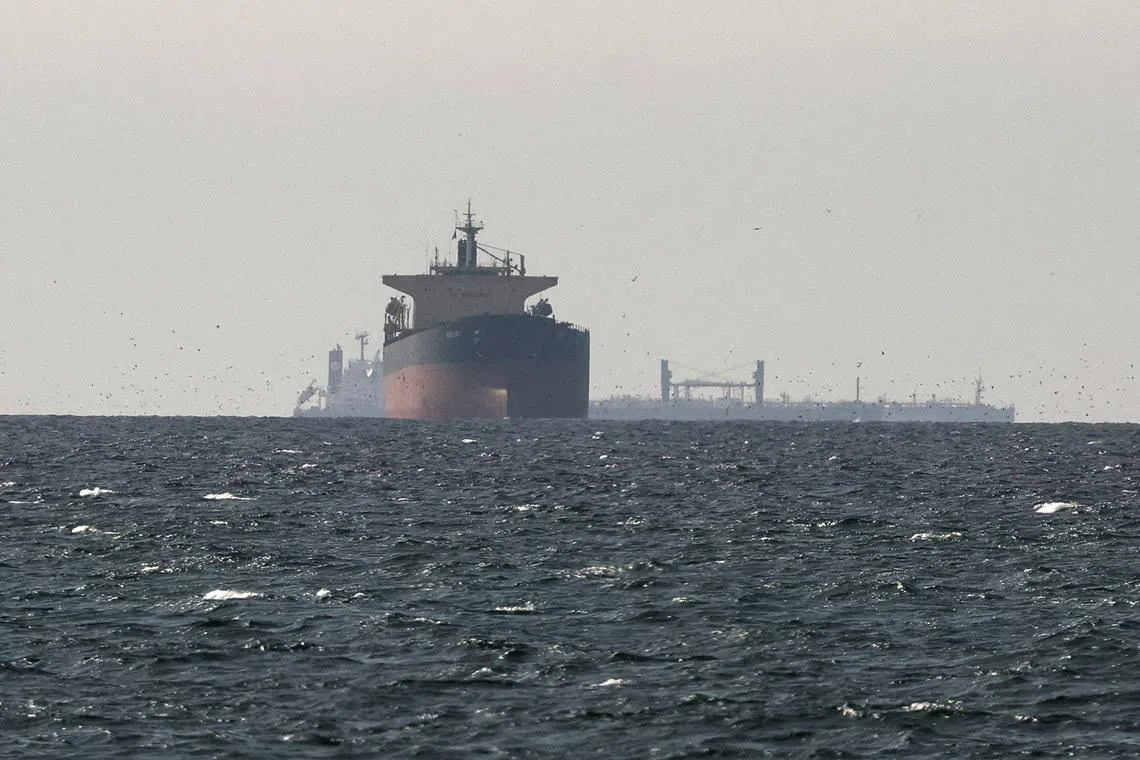
‘Business as usual’ for Iranian shadow fleet passing through South-east Asia, say analysts
The Straits Times
Malaysia has been identified as a hub for illegal ship to ship transfers of crude oil in recent years. Read more at straitstimes.com.
KUALA LUMPUR – Even as war in the Middle East places significant strain on global oil supplies, it is business as usual for Iran’s shadow fleet, say maritime intelligence analysts.
This network of tankers transports sanctioned oil from Iran through illegal ship-to-ship (STS) transfers, evading detection through opaque ownership, frequent flag changes and disabled tracking systems.
Ms Bridget Diakun, of UK-based Lloyd’s List Intelligence, said the Iranian shadow fleet continues to transport and export Iranian oil through the Strait of Hormuz towards East Asia even after the outbreak of war in Iran.
“There is more evidence to suggest that things are moving in a relatively normal pattern, rather than indicating that ships are stopping or significantly changing their behaviour,” she told The Straits Times on March 17.
Malaysia has in recent years been identified as a hub for illegal STS transfers. According to United Against Nuclear Iran (UANI), instances of such activity involving sanctioned Iranian oil in Malaysian waters rose from 280 in 2023 to 679 in 2025, driven largely by demand from China.
Since the 1979 Iranian Revolution, the US – and later the United Nations and European Union – has sanctioned Iran over terrorism support and nuclear activities. The sanctions were eased in 2015 but reinstated by US President Donald Trump in 2018.


Malaysia has been identified as a hub for illegal ship to ship transfers of crude oil in recent years. Read more at straitstimes.com.

LONDON, March 18 - Five new cases of meningitis have been found in Kent in southeast England, Britain said on Wednesday, taking the total to 20 in what has been called an \"unprecedented\" outbreak that has already killed two young people. Read more at straitstimes.com.

MADRID, March 18 - Spanish Prime Minister Pedro Sanchez said on Wednesday that the crisis in the Middle East would not distract from his country's support for Ukraine in its battle against Russia, as the two countries signed co-production agreements for battle material including drones, radar and missiles. Read more at straitstimes.com.

MOSCOW, March 18 - Russia on Wednesday condemned a strike near Iran's Bushehr nuclear power plant a day earlier which it said was just metres away from its reactor and called on the United States and Israel to stop attacking the Islamic Republic's nuclear facilities. Read more at straitstimes.com.

Iran has attempted to use its grip on the narrow Hormuz as leverage against overwhelming US and Israeli attacks. Read more at straitstimes.com.

ROME, March 18 - The damaged Russian liquefied natural gas tanker that has been adrift in the Mediterranean for the past two weeks has now entered Libyan search and rescue waters, Italy's civil protection agency said on Wednesday. Read more at straitstimes.com.

STOCKHOLM, March 18 - A Swedish citizen was executed in Iran on Wednesday, Sweden's foreign minister said in a statement. Read more at straitstimes.com.
WARSAW, March 18 - A Warsaw court decided on Wednesday that Russian archaeologist Alexander B. should be extradited to Ukraine, where he is accused of involvement in unauthorised excavation and plundering historical artefacts in Crimea, his lawyer said. Read more at straitstimes.com.

COPENHAGEN, March 18 - The wealth tax on which Danish Prime Minister Mette Frederiksen is campaigning ahead of a March 24 election may appear modest: a 0.5% levy set at such a high threshold that barely 20,000 Danes - one in 300 residents - will pay it. Read more at straitstimes.com.

Analysts predict US drivers will face long-term pain at the pump, despite Trump's prediction of falling oil prices after the Iran crisis. Read more at straitstimes.com.

US officials said the warship was deployed to the region, without disclosing its destination or mission. Read more at straitstimes.com.

PARIS, March 18 - It is unreasonable to expect the Lebanese government to disarm Iran-backed Hezbollah while the country is being bombed by Israel, France's special envoy for Lebanon said on Wednesday. Read more at straitstimes.com.

The Fishers have won more than US$8 billion in contracts from the Department of Homeland Security. Read more at straitstimes.com.