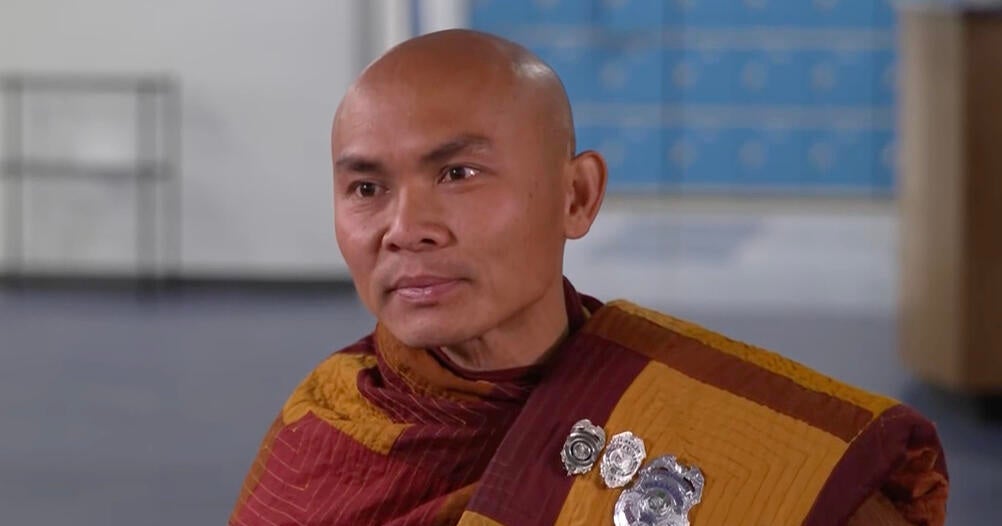
Buddhist monk who led 15-week peace walk to D.C. tells CBS News peace "always begins from within"
CBSN
The Buddhist monk who led a "Walk for Peace" from Texas to the nation's capital said he believes peace can be achieved even in a world filled with conflict, citing the overwhelming displays of public support for his walk as a source of hope for future change. In:
The Buddhist monk who led a "Walk for Peace" from Texas to the nation's capital said he believes peace can be achieved even in a world filled with conflict, citing the overwhelming displays of public support for his walk as a source of hope for future change.
"Peace always begins from with ourself. It's not the world peace out there," the Venerable Bhikkhu Pannakara said in an exclusive interview with CBS News on Wednesday. "No one can change this world, but together, all people and all the venerable monks are walking together on this journey. ... We can make a difference."
Pannakara, who serves as vice president of the Huong Dao Vipassana Bhavana Center in Fort Worth, Texas, embarked on a mission to spread that message of mindfulness, inner peace and unity on Oct. 26, 2025, with the temple as its starting point.
Joined by a group of 19 Buddhist monks from the Fort Worth area as well as temples in Georgia, New York, Utah, plus others abroad from Thailand and Vietnam, the 15-week procession would ultimately carry them across 2,300 miles of the southern United States.
The venerable — joined by Aloka, the 5-year-old "peace dog" — sat down with CBS News at George Washington University Wellness Center, where the monks spent the night. They were set to go on a shorter walk on Wednesday to the Lincoln Memorial, after which the group of monks was scheduled to return to Texas by bus.


The U.S. job market shed 92,000 jobs in February, a sharp and unexpected setback for the economy after economists had forecast job growth. Edited by Aimee Picchi In:

Washington — The Justice Department released additional Jeffrey Epstein files Thursday that included uncorroborated accusations by a woman against President Trump that the department said had been mistakenly withheld during an earlier review. In:

The U.S. military plans to exhume the remains of 88 sailors and Marines killed when the USS Arizona was bombed during the Japanese attack on Pearl Harbor and who were buried as unknowns in a Honolulu cemetery. In:

Austin, Texas — Rachel Reyes' son, 23-year-old American citizen Ruben Ray Martinez, was shot and killed by a U.S. Immigration and Customs Enforcement agent nearly one year ago. But she said she's still trying to understand why. In:

Republican Rep. Tony Gonzales dropped his reelection bid for his Texas congressional district on Thursday, after admitting to an affair with a staffer who later died by suicide.

Bernard LaFayette, the advance man who did the risky groundwork for the voter registration campaign in Selma, Alabama, that culminated in the passage of the Voting Rights Act of 1965, has died, according to the Associated Press. In:

The United States and Venezuela agreed to reestablish diplomatic relations in a major shift in a historically adversarial relationship, the State Department said on Thursday. In:

Washington — Lindsey Halligan, the former interim U.S. Attorney for the Eastern District of Virginia, is under investigation by the Florida Bar, according to a letter from the organization confirming the probe which was obtained by CBS News.

Defense Secretary Pete Hegseth said Thursday that Iran is hoping the U.S. cannot sustain its operation against the country, even though, according to Hegseth, the U.S. can "sustain the fight for as long as it takes."

Mortgage rates are edging up on Thursday amid renewed inflation fears tied to the war in Iran. Edited by Alain Sherter In:

Savannah Guthrie stopped by the "Today" show studio to see colleagues on Thursday, NBC News said in a statement shared with CBS News. It was the first time Guthrie had been in the studio since her mother, Nancy Guthrie, disappeared over a month ago. In:

About 350 Whirlpool factory workers in rural Iowa will lose their jobs on March 9 — a blow to a community where the plant has anchored the local economy for eight decades. The layoffs are also another sign of U.S. manufacturers' ongoing struggles, which have persisted despite the Trump administration's pledge to revive the sector. Edited by Alain Sherter In:

Washington — Department of Homeland Security Secretary Kristi Noem is out, and will be replaced by GOP Sen. Markwayne Mullin of Oklahoma, President Trump announced on Truth Social Thursday. The announcement comes amid criticism of DHS spending and as Congress has allowed the department's funding to lapse. Alan He contributed to this report.