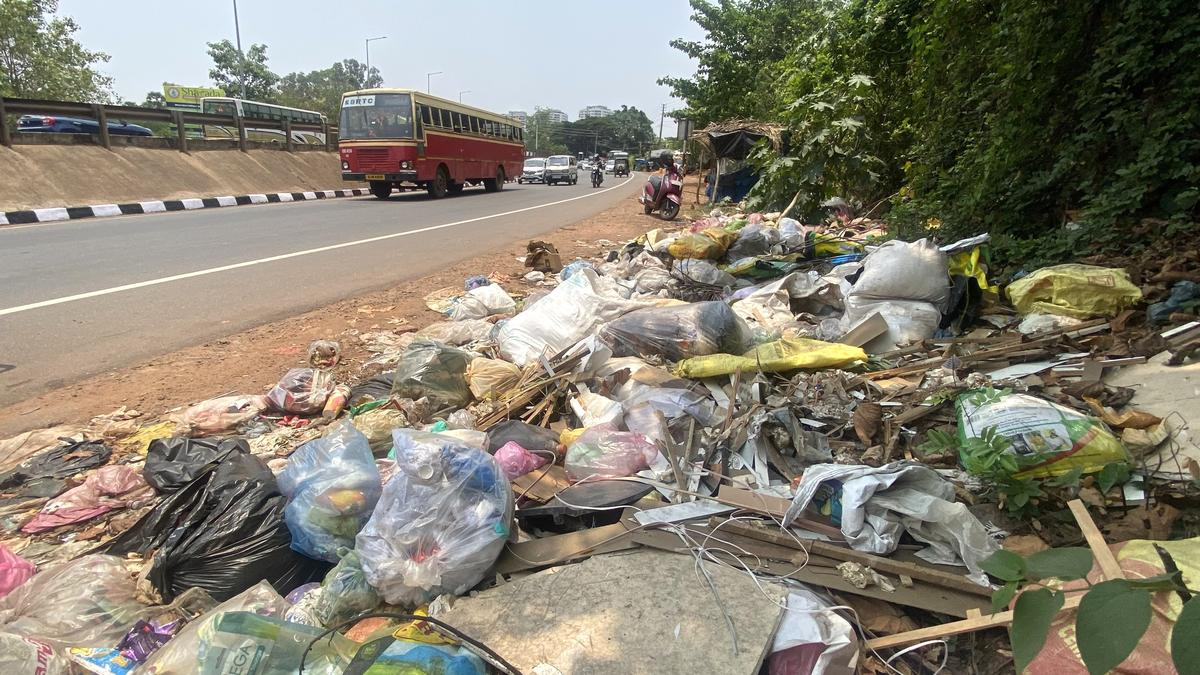
Blackspots resurface showing all is not well in solid waste management in Mangaluru
The Hindu
In spite of a number of awareness programmes conducted over the years, by the mission and other voluntary organisations prior to 2015, black spots have returned in the same places, and in new places.
MANGALURU
A roadside blackspot in front of the busy KSRTC bus stand in Mangaluru greets visitors, showcasing the sorry state of affairs in solid waste management in the coastal city. The blackspot on the corner of Bejai-Kuntikana Road in front of the bus stand now mocks Mangaluru City Corporation (MCC), which once bagged a series of awards for maintaining cleanliness among urban local bodies in India.
Blackspots across 60 wards of the corporation have gone up in the past one year. Ravichandra Naik, Commissioner, MCC, says, “The civic body has identified 60 major blackspots for installing CCTV cameras to prevent people from dumping waste in public places.”
Mangaluru once took pride by bagging the third rank among 476 cities in India in the Swachh Survekshan Survey of the Union Government. The civic body received ‘India’s best city in solid waste management’ award in 2018. Mangaluru was among the 23 cities selected in the country for the 2018 national award under different categories. Later it also bagged the Green Leaf Award and Solid Waste Management Icon Award for best solid waste management (SWM).
Glaringly, the sanitation rating of Mangaluru drastically dropped to 253rd among 446 cities in the country in the survey in 2023.
Incidentally, the black spots are on the rise notwithstanding Ramakrishna Mission (mutt) of Mangaluru, on the call of Prime Minister Narendra Modi, undertaking citizen-driven Swachh Mangaluru Abhiyan twice. If the first phase, the campaign was held from January 30, 2015, to 2019. The second phase went on for a year from October 1, 2023. The first phase focused on cleaning roads and the surroundings. The focus of the second phase was on visiting houses and creating awareness on the proper disposal of domestic waste by segregating.
Ranjan Bellarpady, the coordinator of the mutt and the campaign, told The Hindu that the first phase of the weekly drive held on 200 Sundays covered 20 lakh man hours. “Awareness programmes on wet waste management reached three lakh houses. In addition, cleanliness education was imparted to 25,000 school children. The mission also reached 15,000 college students through workshops,” he said.


Telangana Minister assures adequate petroleum stocks for three months, warns against illegal fuel carrying amid panic buying rumors.

TMC calls for the removal of Bhabanipur returning officer, citing alleged ties to BJP and concerns over neutrality.

Kerala CM Pinarayi Vijayan condemns UDF's misogynistic attacks on CPI(M) legislator U. Prathibha, highlighting political degeneration.

Selected from 9,400 submissions across 37 countries, the 100 photographs on display traverse intimate and political terrains. In MRC Nagar, photographer Swastik Pal captures life in the Sundarbans, where severe climate change has brought humans and wildlife into closer contact. Shane Hynan’s Beneath Beofhod reflects on Ireland’s boglands as sites of memory and restoration, while Mateo Trevisan’s More than the Sun examines the impact of coal-driven industrialisation in the Western Balkans.

Hyderabad officials assure sufficient fuel supply for 60 days, warn against misinformation and illegal sales amid panic buying.

Telangana MP urges Centre to expedite ₹1,270 crore dues transfer from Andhra Pradesh for financial fairness and development.

A Karnataka man was detained with ₹62.5 lakh in cash during election checks on NH 544, claiming it was from a property sale.

Telangana Government issued 16 notifications to fill 31,798 vacancies, with 67,763 total recruitments since Congress took power.

Supreme Court directs Tarun Butolia's family to seek safety assessment from Delhi Police after fatal Uttam Nagar clash.

CM Stalin asserts unity in the DMK-led alliance, dismissing division attempts and emphasizing collaborative efforts for the upcoming elections.

Rahul Gandhi to skip Kerala rally due to Sonia Gandhi’s ill health; Kharge to attend Kozhikode event
Rahul Gandhi will miss the Kerala rally due to Sonia Gandhi's health; Congress president Kharge to attend instead.

Thunderstorms with lightning and gusty winds forecasted for 20 Telangana districts on March 26

TGSRTC reduces Metro AC and Deluxe bus fares by 30% in Hyderabad to encourage public transport amid the fuel crisis.