Artist Shaurya Kumar explores divinity in stolen and damaged idols
The Hindu
When an object of worship is damaged or dislocated, it loses its original meaning. Artist Shaurya Kumar interprets the shift in sacredness in his exhibition There Is No God in the Temple, on at Delhi’s Threshold Gallery
What happens when the walls of the sanctum crumble or the tombs are emptied, columns of temples and idols are carted off to mantles of private collectors or cultural artefacts vanish without a trace and temples are left in ruins?
“The devotee’s faith in divinity is shaken and the memory of the object gets fragmented,” says artist Shaurya Kumar whose ongoing exhibition at the Threshold Gallery puts out a stark and meaningful representation of long-vanished slices of history.
The exhibition is an eclectic collection of miniature paintings, 3-D sculptures and gold leaf imprints on paper drawings that attempt to fathom what objects tell us about history, society, nature or culture when they are destroyed or distorted and how it shakes up people when their deities are looted.
The title is drawn from Tagore’s poem echoing the sentiments of the people who found their shrines and altars desecrated. It forms the central piece with a porcelain installation on a gold wall that carries the Bengali title Oi mondire kono debota nei, (There Is No God in the Temple) as a 3D black sculpture of Nandi looks on.
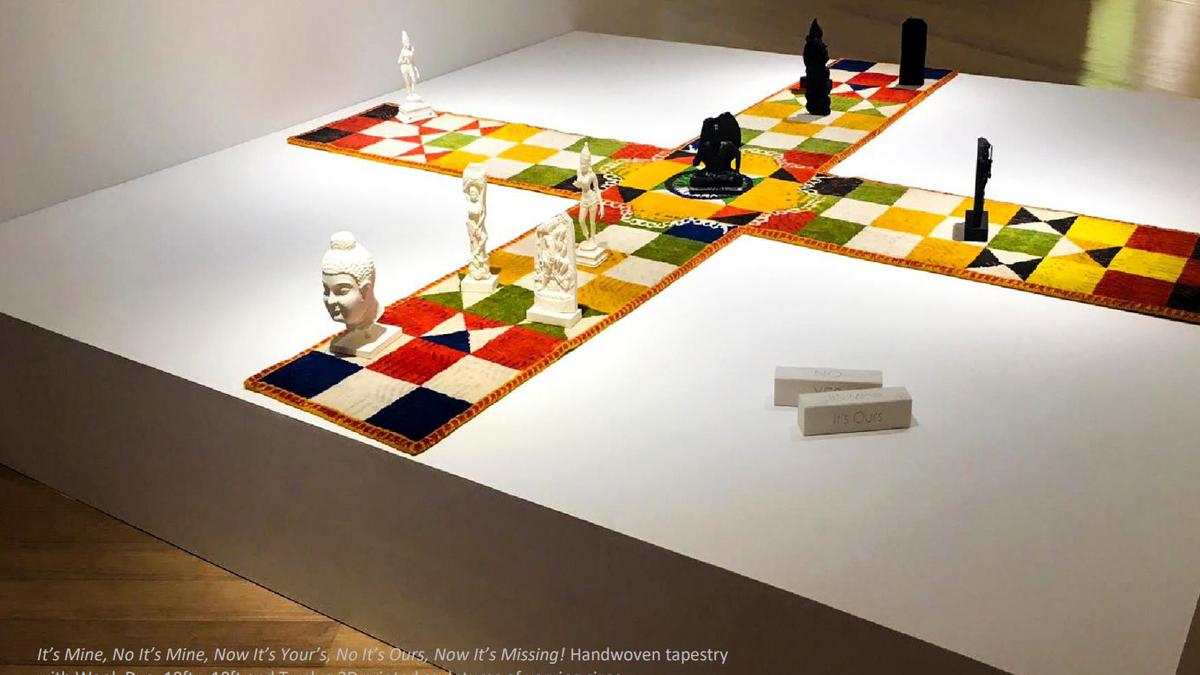
The first work he made for this collection, It’s Mine, No It’s Mine, Now It’s Yours, No It’s Ours, Now It’s Missing! has a dozen 3-D printed sculptures of varying sizes arranged on a handwoven tapestry with wool and dye made to look like a chausar board. Shaurya explains that the person who holds the dice is the one who decides the fate of the sculpture. If you throw the dice, it keeps changing ownership from ‘mine’ to ‘ours’, poignantly underlying the sentiments behind stolen artefacts.
It was the 2003 CAG report highlighting the disappearance of 92 monuments from India that intrigued Shaurya Kumar, then a 24-year-old graduate of Delhi College of Art. A recent UNESCO study estimating that 50,000 idols and artifacts were smuggled out of India between 1947 and 1989 and 2,208 sculptures and idols looted from temples where they were still being worshipped, between 2008 and 2012, further piqued his curiosity.
“The plunder in India happened during peace time, when the country was not in religious or political turmoil, unlike events in the Middle and near East where ancient religious sites and artefacts were destroyed by the extremist forces,” says Shaurya, now a professor at the School of the Art Institute of Chicago.


IUML leader Kader Mohideen asserts that TVK's entry won't split minority votes, emphasizing the alliance's unity and support for the DMK.

There will be no power supply on March 28, from 10 a.m. to 5 p.m., to facilitate the shifting of a five-way Ring Main Unit (RMU) near Kaveramma Temple. As part of this operation, power supply will be temporarily suspended in areas served by the 66/11 kV Electronic City station.

The filmmaker's statement comes after a police complaint was filed against the makers and the actor for the image which shows Ranveer Singh's character smoking while wearing a turban.

The release of new Pay Revision Commission recommendations in Telangana is unlikely any time soon as the deadline for completion of pending pay fixation has been extended to September 30, 2026

CBI conducts searches in Reliance Telecom Ltd. case involving alleged ₹114.98 crore cheating of State Bank of India.

BJP received over ₹6,000 crore in donations for 2024-25, outpacing all other national parties combined by tenfold.

Chief Electoral Officer highlights cash-for-votes as a major challenge in Puducherry elections, emphasizing strict measures to combat it.

ICAR-CTCRI develops an electronic starch indicator to help cassava farmers accurately measure starch content for fair pricing.

Karnataka government to request VIP tickets for MLAs for IPL matches amid complaints about difficulty in getting hold of tickets and pricing.

Telangana struggles to retain IT professionals in Tier-II and III cities, with youth favoring Hyderabad after training.

CPI(M) leader K.K. Shailaja aims to capture Peravoor, leveraging development promises and local dissatisfaction with Congress leadership

BIMS celebrates 50 years of excellence in management education with a golden jubilee event in Mysuru on March 28.

The film is based on the book ‘Operation Sindoor: The Untold Story of India’s Deep Strikes Inside Pakistan’ by Lt Gen K.J.S. Tiny Dhillon