Are cantaloupes safe to eat? Deadly salmonella outbreak now over
Global News
The outbreak, which sent 68 Canadians to hospital between October and December last year, ended in January, Public Health Agency of Canada officials say in a health notice.
A deadly salmonella outbreak linked to cantaloupes that killed nine Canadians appears to be over, health officials say.
The outbreak, which sent 68 Canadians to hospital between October and December last year, ended in January, Public Health Agency of Canada (PHAC) officials said in a health notice.
The U.S. Centers for Disease Control and Prevention (CDC) also declared an end to its outbreak on Jan. 19; six people died from it last year, and 158 people were hospitalized.
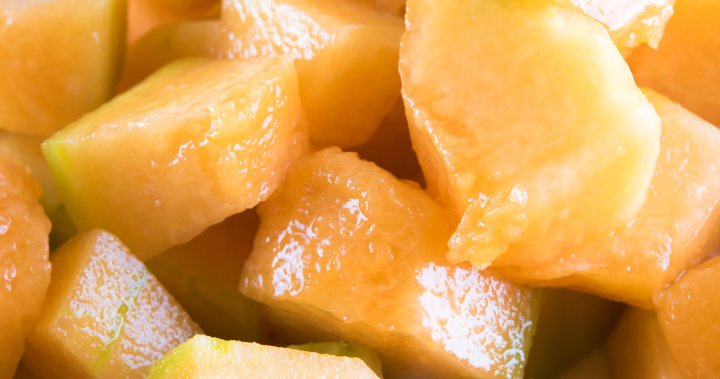
Investigation findings identified consumption of Malichita and Rudy brand cantaloupes as the likely source of the outbreak. The melons are grown in the Senora region of Mexico.
In December, Mexico’s Health Department ordered the temporary closure of a melon-packing plant implicated in salmonella infections. However, last month, Mexican authorities said tests were negative for traces of salmonella, but added that a new analysis of water, product and surface samples in production and packaging plants would be carried out this month.
PHAC said its investigation spread across nine provinces: British Columbia, Alberta, Saskatchewan, Ontario, Quebec, Prince Edward Island, New Brunswick, Nova Scotia, and Newfoundland and Labrador.
The Canadian Food Inspection Agency (CFIA) issued food recall warnings in November for Malichita brand cantaloupes sold between Oct. 11 and Nov. 14. On Nov. 24, the CFIA updated the food recall warning to also include Rudy brand cantaloupes sold between Oct. 10 and Nov. 24.
Additional secondary recalls were issued for products that were made using recalled cantaloupes, like fruit trays, and for produce that was processed alongside recalled cantaloupes such as honeydew, pineapple and watermelon.


Dr. Michael Domeier, director of the Marine Conservation Science Institute, told Global News that they tag the adult females as they are the most interesting.

Regina’s recycling contamination is currently triple the limit and city is urging resident to change sorting habits now to avoid citywide fines and higher resident fees.

The study found that higher ultra-processed food intake at age three years was associated with adverse behavioural and emotional symptoms at age five years.

Edmonton's single-use waste rules were controversial and unpopular when introduced in 2023 — but new data shows the changes are having the intended effect of reducing garbage.

Carney's speech to Australia's parliament highlighted a soon-to-launch Canadian low earth orbit satellite network that experts say could soon compete with Elon Musk's Starlink.

The Pentagon said in a statement Thursday that it has “officially informed Anthropic leadership the company and its products are deemed a supply chain risk, effective immediately.”

Opioid overdose deaths in Canada are falling, but there's growing concerns on a certain veterinary tranquilizer being cut into fentanyl and other opioids.

The product is being recalled in Alberta, British Columbia, Manitoba, Ontario, Quebec and Saskatchewan due to 'undeclared almonds' being found.

Toronto Maple Leafs defenceman Chris Tanev is out for the rest of the season, the NHL team announced Wednesday.

A large swath of southern Alberta is under a snowfall warning, with up to 30 centimetres of snow forecast to fall in some areas before the snow tapers off by Saturday morning.

Coined forever chemicals due to the years it takes for them to break down, PFAS are 'a group of thousands of human-made chemicals' commonly found in everyday items.