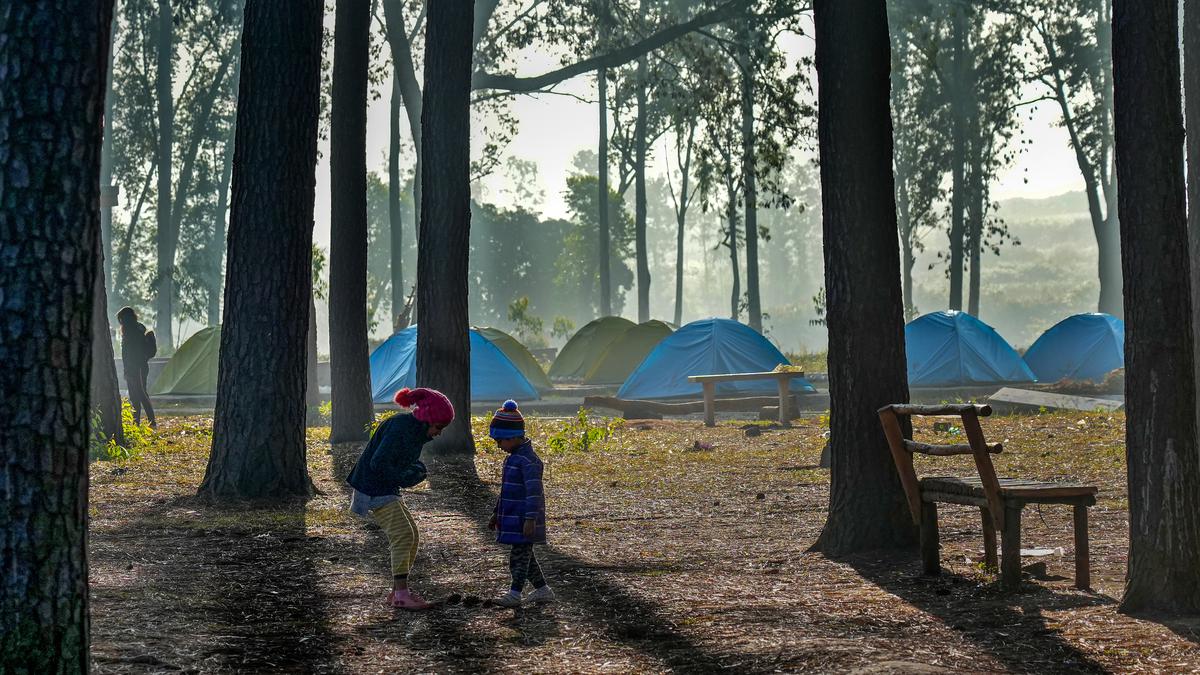
Araku Pinery, a new community-based eco-tourism project near Visakhapatnam
The Hindu
Escape to the serene Araku Pinery, an eco-tourism initiative surrounded by pine trees and breathtaking views in Visakhapatnam, Andhra Pradesh.
Chugging along the winding road beyond Araku’s last market area where the weekly shandy is held, a neatly-laid pathway less than half a kilometre-long tucks in a surprise.
Ahead are rows of towering, gently swaying, pine trees veiled by a curtain of fog, lifting slowly. This is the Araku Pinery, a new eco-tourism initiative started by the Andhra Pradesh Forest Department in Anjoda. This new tourist destination, a one-of-its-kind government initiative at the region, is developed on a patch of pine plantation overlooking the valley and being managed by the Van Sanrakshan Samiti (VSS) of the local tribal community of Shantinagar village. Nestled in the lap of the valleys of Eastern Ghats, here you can escape the confines of a rushed city life. Here, the air is instantly cleaner and the surroundings, greener.
Wrapped in a blanket of mist, a tall wooden gate welcomes visitors. The sun’s soft rays spreading unevenly through the pine plantations and the icy cool breeze make it an immersive experience.
The Araku Pinery is one of the few places in the Agency Areas where tropical pine plantations were developed in the year 1975-76 on an experimental basis. “The plantations thrived over the years; however, during cyclone Hudhud in 2012 about 25% of pine trees were lost. Since then, the spot had lost its charm,” says K Vinod Kumar, Deputy Conservator of Forest, Paderu.
Last year in November, the Andhra Pradesh Forest Department inaugurated an eco-tourism project to revive the beauty of the location by developing it at a cost of ₹1.06 crore with the support of Central Warehousing Corporation’s CSR initiative. “The main idea of the project is to create awareness among the public about the region’s ecological diversity as well as to empower the local community and improve their socio-economic situation. The place is run by the Van Sanrakshan Samiti of Shantinagar village from where 10 members, a majority being women, have been engaged for the project,” adds Kumar.
The place is not exactly a dense thicket, but is enveloped in hues of green. Surrounded by valleys and farm fields, the only sound one hears is the rustle of leaves and the chirping of forest birds. Along the entrance is a small patch of greens which is the nursery section. Colourful butterflies flutter around on the pathway dotted with tall pine trees.
The camping area at Araku Pinery has 34 tents of three categories that can accommodate two, three and six members depending on the size. The bonfire place in the centre lights up every evening around which campers, snugged in layers of woollens, gather together to enjoy the warmth.


Explore 2026's wallpaper trends in India, highlighting botanicals and handmade designs that enhance modern homes with nature-inspired aesthetics.

Mercedes-Benz CLA 250+ with EQ Technology review: design, performance, range and features explained. Discover how the new electric CLA combines advanced AI, long range, fast charging and futuristic styling for the next generation of luxury EVs.

AI tool for sparrow conservation

BTS’s comeback with ‘Arirang’ marks a major global music event. When does the album release, and where can you watch their concert live stream? We have all the details

The 2026 U.S. cholesterol guidelines urge starting screening and treatment at 30 to prevent cardiovascular disease effectively.

Olam Festival 2026 in Thiruvananthapuram returns March 27-29 with 120+ vendors, music, art, and cultural zones.

A few storytellers in Thiruvananthapuram share their journeys, challenges, and evolving methods on World Storytelling Day, inspiring young minds.

76-year-old Kurian Jacob from Kerala triumphs with seven medals, including five golds, at the Open Masters Games in Abu Dhabi.

Explore the nature of the human mind as an emergent property of brain activity and complex neural interactions.

CERN's Large Hadron Collider discovers the Xi-cc-plus particle, enhancing understanding of quantum mechanics and baryon behavior.

Vibha Batra’s latest book, Spotless (Hachette India) is a novel in verse for young adults

In its first edition, the Madras Art Salon spotlights the works of journalist and artist Narayan Lakshman at The Botanical Club, a social space in the British Deputy High Commission, Chennai

Cholesterol enhances melanoma cell invasion by making nuclei squishier, revealing a potential treatment target in cancer progression.