An alliance and poll arithmetic
The Hindu
AIADMK-BJP alliance revival crucial for challenging DMK dominance in Tamil Nadu elections, strategic alliances key to success.
The revival of the ties between the All India Anna Dravida Munnetra Kazhagam (AIADMK) and the Bharatiya Janata Party (BJP) has brought back to the political discourse how tie-ups are critical to the success of the main Dravidian parties, including the ruling DMK. Though their combined vote share was close to 66% of the votes polled in the seven Assembly elections since 1991, the two main Dravidian parties had always faced the electorate in the company of one or more parties. An exception to this rule was former Chief Minister Jayalalithaa putting up the AIADMK nominees in 227 constituencies during the 2016 election and allotting one constituency each to seven parties that contested on the AIADMK symbol. This gamble paid off. But 2016 is a distant past and neither the DMK nor its main adversary, AIADMK, would like to take any such risk in 2026. Moreover, the principal Opposition party learnt a lesson the hard way in the 2024 Lok Sabha election; it went to the polls in the company of smaller parties such as the Desiya Murpokku Dravida Kazhagam (DMDK), the Puthiya Tamizhagam, and the Social Democratic Party of India to take on the DMK, which joined hands with the Congress, two Left parties, the Viduthalai Chiruthaigal Katchi, the Indian Union Muslim League, and the Marumalarchi Dravida Munnetra Kazhagam.
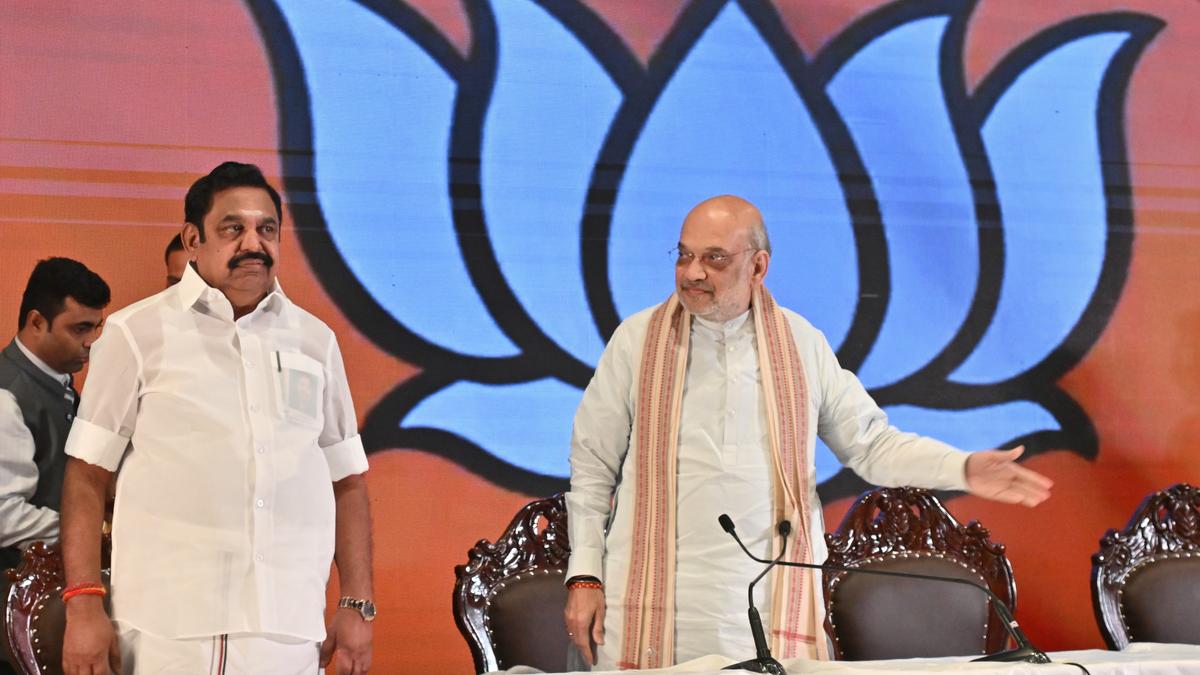
Given this backdrop, the AIADMK’s performance was predictably disastrous: it did not win a single seat and forfeited deposit in seven constituencies. It suffered such a debacle for the first time since it was formed in October 1972. The BJP-led National Democratic Alliance’s vote share was around 18.2%, with the BJP alone accounting for 11.4%. It was evident that had the AIADMK-led coalition, with a vote share of around 23.3%, and the NDA, which had the Pattali Makkal Katchi (PMK), the Tamil Maanila Congress (Moopanar), the Amma Makkal Munnetra Kazhagam (AMMK) and groups headed by O. Panneerselvam, A.C. Shanmugam, John Pandian, and T. Dhevanathan Yadav, been on the same side, the outcome would have been different. At least now, proponents of the coming-together of these two alliances say such a combine could have prevented the DMK-led front’s landslide. It is against these circumstances that the renewal of ties between the AIADMK and the BJP has assumed importance. Stitching the alliance last month, Union Minister for Home Affairs and senior BJP leader Amit Shah said in Chennai, “We will fight the election under the leadership of Edappadiji [AIADMK general secretary Edappadi K. Palaniswami].”
One more factor that led to the revival of the relationship is the perception that the BJP, led by a firebrand K. Annamalai for over three years till recently, had made inroads in the Kongu or western region, a traditional stronghold of the AIADMK. Take the instance of Thondamuthur, now represented by former Local Administration Minister and AIADMK’s face in Coimbatore S.P. Velumani. In 2021, Mr. Velumani polled about 1.24 lakh votes, whereas, three years later, his colleague could poll barely 58,000 votes in the segment that comes under the Pollachi Lok Sabha constituency. The BJP’s Vasantharajan took away around 56,800 votes. Had they remained together, they might have easily overtaken the DMK’s K. Eswarasamy, who polled 98,355 votes. In terms of the total number of votes polled in Thondamuthur , there was only a marginal decline — 2,30,531 votes in 2021 and 2,28,535 votes (excluding postal votes) in 2024. On its own, the AIADMK was ahead of the DMK-led coalition only in four Assembly constituencies in the western region, two of which (Edappadi and Kumarapalayam) are being represented by Mr. Palaniswami and former Electricity Minister P. Thangamani respectively. According to a study done by this journalist based on the performance of the parties in the 2024 election, had the AIADMK-led front and the NDA been together, the combine would have taken the lead in 34 more constituencies of the region.
While parting ways with the BJP in September 2023, the AIADMK thought that it would “get back” a part of the votes of the minority communities which, according to the party, had been lost because of its alliance with the national party. In fact, immediately after the 2021 election results were out, former Law Minister C. Ve. Shanmugam, who was defeated in Villupuram, had blamed the BJP for his party losing the support of the minority communities in his constituency, including 18,000 in Villupuram town. Mr. Shanmugam, now a Rajya Sabha Member, had polled 87,403 votes against 1,02,271 votes garnered by R. Lakshmanan of the DMK. Likewise, the party’s long-time spokesperson and former Fisheries Minister, D. Jayakumar, referred to his defeat in Royapuram (that he had represented since 1991, except during 1996-2001) and said that after netting 36,645 votes, he would not have lost by about 25,000 votes (the actual margin was 27,779), had the AIADMK gone to the polls without the BJP. However, in 2024, their party’s performance was poorer than in 2021. In Royapuram and Villupuram, it polled 24,247 votes and 62,825 votes respectively. “They [the minority communities] do not want us to be with the BJP. But they would not vote for us in elections. Under such circumstances, what else can we do?” wonders an AIADMK veteran in the western region.
The biggest weak spot for the AIADMK is the region of Kancheepuram, Tiruvallur, Chengalpattu, and Chennai (KTCC), where it could win only one (Madurantakam) out of 37 constituencies in 2021. There has not been much change in the situation since then. Had the formations led by the AIADMK and the BJP contested together, they would have got one more — T. Nagar, where the AIADMK lost to the DMK four years ago by 137 votes. Another problematic region for the AIADMK is the Cauvery delta, where the party bagged only four of the 41 constituencies. They were won by former Ministers R. Vaithilingam (Orathanadu), O.S. Manian (Vedaranyam), R. Kamaraj (Nannilam), and C. Vijayabaskar (Viralimalai). If the 2024 voting pattern is any indication, the party needs the support of the national party and its partners to win even in Viralimalai and Vedaranyam.
Assuming that all the allies of the BJP and the AIADMK, including the PMK and the DMDK which are yet to decide on the alliance, remain in the NDA, such a combine, based on the 2024 performance, would not be able to defeat the DMK and its allies next year. It requires one more party, which can either be the Naam Tamilar Katchi, which grabbed 8.24% of the votes polled last year, or the Tamilaga Vettri Kazhagam. As the TVK is an untested force, it is too early to assess its strength. However, if one is to go by what the DMDK, founded by Vijayakant, polled in the 2006 Assembly and 2009 Lok Sabha elections when it contested alone, one can assume that the TVK’s vote share can be 8% to 10%. As of now, NTK leader Seeman has been maintaining that his party will go it alone, while TVK founder Vijay says his party will head a coalition. If the AIADMK-BJP combine brings the NTK to its side, it can win 48 more constituencies, of which 19 are in the KTCC and Cauvery delta regions.
Though the circumstances under which the people are going to vote next year will be different from what they were last year, the possibility of the revamped NDA (comprising parties that include the AIADMK, the BJP, the PMK, and the NTK) giving a tough fight to the DMK-led front is real. At the same time, even the DMK’s critics would acknowledge that the biggest strength of the party and its allies is their vote-transferring capacity. It was not by coincidence but by design that the DMK-led front could have a vote share of 47% in 2024. Also, all its constituents had a vote share, ranging from 42% to 51%, in their contested seats. Individually, the DMK, by getting about 5.34 lakh votes in every contested Lok Sabha constituency last year, had demonstrated that its vote base in every Assembly seat was, on an average, 89,000 votes, as six Assembly segments constitute one Lok Sabha constituency. This would be formidable, given that a prospective winner in the Assembly election would require around 90,000 votes. Between the 2016 Assembly election and the 2024 Lok Sabha election, around 4.41 crore voters had exercised their franchise. This meant that roughly 1.88 lakh votes were cast in every Assembly constituency. The DMK’s score of 89,000-odd should be viewed only against this context. Predictably, the AIADMK is in no position to better its arch rival; hence, it needs more allies. This requirement has been realised by Mr. Palaniswami, who has been saying that more parties will come over to his side. It remains to be seen whether the Leader of the Opposition is able to beat Chief Minister M.K. Stalin, who appears to have an edge over others.


Parliament Budget Session LIVE: Track updates on the Parliament Budget Session as the Transgender Bill moves to the Rajya Sabha. Follow The Hindu for the latest updates on the Budget Session on March 25, 2026.

Congress leaders in Kerala accuse LDF and NDA of a secret deal to undermine their influence in the upcoming Assembly elections.

Agnikul Cosmos successfully test-fires a revolutionary 3D printed booster engine, enhancing launch efficiency and scalability in space transportation.

Katha Dhara Hyderabad event by Katha&Krafts brings theatre to government school students. The initiative introduces government school students to theatre, puppetry and creative expression.

Gaurav Gogoi dismisses Himanta Sarma's Pakistan allegations as a "wild theory," asserting focus on corruption and government accountability.

T.N. CM Stalin urges the Centre to build consensus with transgender persons before imposing changes to the Trans Amendment Bill 2026.

Trump's engagement with Pakistan as a mediator for Iran echoes Nixon's historical diplomacy with China amid shifting geopolitical dynamics.

Telangana's Petroleum Dealers Association assures no fuel shortage, attributing temporary stock issues to panic buying fueled by rumors.

The Ottiyambakkam panchayat had an harrowingly difficult time keeping people from swimming in the deadly quarry with its protruding rocks under the water. There had been many deaths. And then nature intervened, and the fatal accidents stopped. An invasive, floating weed that is a bane of water sources everywhere, the water hyacinth is not just tolerated in the quarry but welcomed

Fuel supply panic causes severe traffic congestion in Hyderabad on March 25, 2026, prompting police intervention to manage long queues and road chaos.

Mohamed Salah will leave Liverpool at season's end, concluding a remarkable nine-year tenure at Anfield.

Telangana CM to hold urgent meeting on March 25 to address petrol, LPG, and urea stock concerns amid rising demand.

Karnataka Minister announces efforts to resume separate Haj terminal at Mangaluru airport, pending Centre's approval.