Alberta researcher pitches Australian-made beehives as new alternative for Canadian beekeepers
CBC
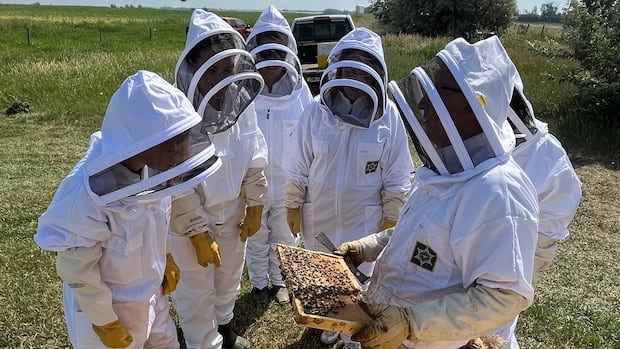
A master beekeeper in Alberta is putting an insulated hive to the test he says could help a struggling Canadian industry.
Sheldon Hill, who works as an educator three hours southeast of Calgary, says an Australian-made product could help change the beekeeping game.
“The sensor data is telling me that the bees are easily able to regulate the area inside their hive much more efficiently,” Hill told CBC News.
He has found that the insulated hive results in a stronger buildup and increased honey production — but it could be a hard sell for an industry that often avoids such big changes.
Hill was a commercial apiarist for three decades in Porcupine Plain, Sask., working for a family of generational beekeepers.
He recently left large-scale beekeeping behind to take on a new role as an educator and researcher with the Prairie Rose School Division in southeast Alberta.
Through a partnership with Medicine Hat College’s Centre for Innovation, Hill is running a year-long test comparing a HiveIQ setup next to a traditional wooden hive at a Neubauer Farms property about five minutes outside Medicine Hat.
His pilot project started in May during the spring buildup and continued into the all-important summer honey producing period.
While Hill cautioned that large-scale research will still be required, he said the hope is that beekeepers, often wary of silver bullets, will be open to the innovative potential of insulated hives.
“I'm really trying to change the minds of the industry because right now a lot of producers don't think much of this concept,” he said.
For over a century beekeepers across the world have relied on a system of stackable wooden boxes known as the Langstroth hive.
In 2011, third-generation beekeeper Victor Croker started developing an insulated solution made out of polystyrene to combat the Australian outback’s extreme heat.
Over a decade later, Croker’s HiveIQ is now being sold around the world — and tested in Alberta by Hill.
While many Canadians may think of insulation as a way to keep something warm in the winter, HiveIQ wanted to keep bees cool with the same method.


Jenelle Hughes says she worries every time her two older children take their car to get to Fanshawe College in London, Ont., from their home in Dutton.

Oil prices fell Monday morning after President Donald Trump said the U.S. would hold off on striking Iran’s energy infrastructure amid productive talks between the two countries.

While spring technically started late last week, Newfoundland and Labrador isn't free from winter weather just yet.

The Sudbury School Bus Consortium is suspending all school buses in Greater Sudbury as the community continues to clean up following a major storm.

Two large corporate landlords owning a combined 9,008 rental units in Halifax are reporting smaller annual increases in their average rents for 2025 than the previous year.

The Holt government has reached a deal with Ottawa on compensation for tens of millions of dollars in lost sales tax revenue from the Christmas season in 2024.

The government of Saskatchewan has announced plans to reduce the length of non-resident game bird hunting licences to combat illegal guiding.

An 87-year-old Alberta man is fighting extradition to the United Kingdom to stand trial for historical allegations of physical and sexual assault involving minors.

Eight casinos across southwest B.C. have been sold to First Nations in the last two years, with the province's gambling scene set to be reshaped as a result.

Hamilton hosts the Junos Sunday, and the musical awards show is bringing tourists, musicians, concerts and a ton of themed events to the city this week.

The multi-million-dollar deal at the heart of a high-profile fight between the Canadian government and one of the world’s biggest carmakers contains multiple clauses about the company’s footprint in Ontario, according to a copy obtained by CBC Windsor.

In recent months, Calgary police have carried out three day-long safety blitzes, parading out dozens of officers to flood an area with their increased presence — at least, temporarily.

A national organization is seeking people with experience in Canada's forestry sector as they put together a working group that will examine ways to improve forest recovery following wildfires.