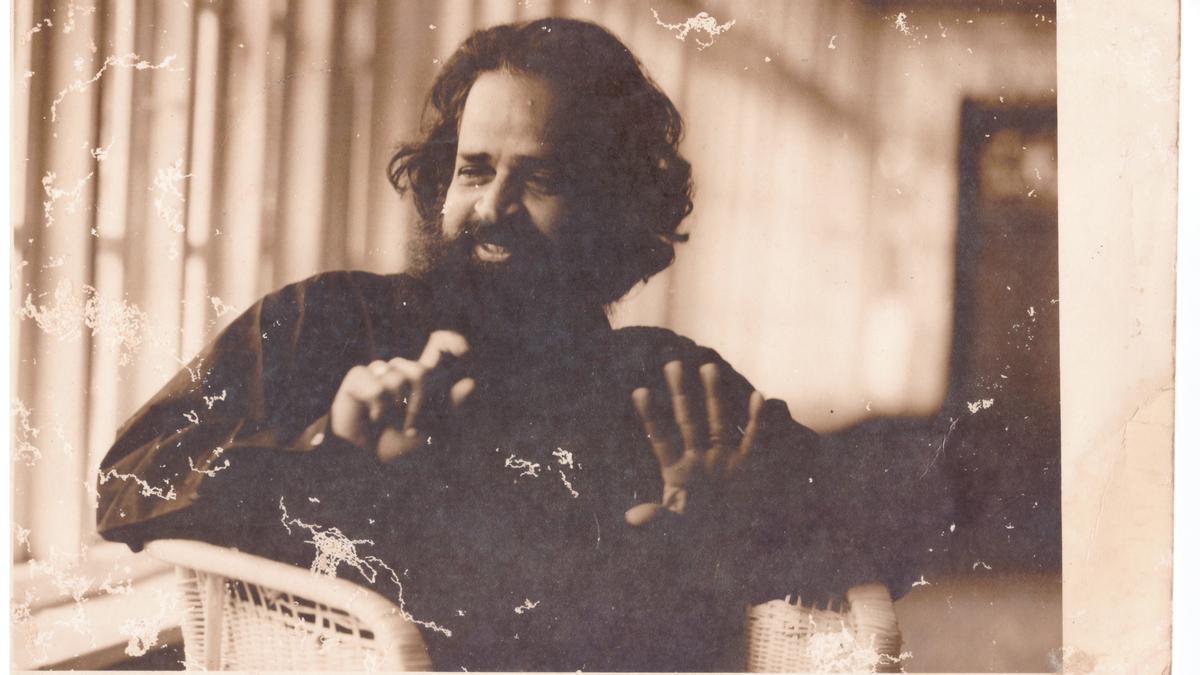
Achuthan Kudallur’s legacy: Retrospective exhibition unveiled at Lalit Kala Akademi
The Hindu
Discover the captivating artwork of Achuthan Kudallur at the retrospective exhibition in Chennai, showcasing his significant contributions to India's contemporary abstract art movement.
When Achuthan Kudallur unexpectedly passed away in July 2022, he left two home studios stacked with luminous paintings, sensitive drawings and rare early work. Now you can see some of his most striking canvases at Ashvita Gallery’s retrospective exhibition, Achuthan Kudallur: A life in Art, on at Lalit Kala Akademi, Chennai.
The show, which features about 40 important artworks from the Achuthan Kudallur Estate, demonstrates why he was a significant force in India’s contemporary abstract art movement.
Hailing from Kudallur village in Palghat, Kerala, Achuthan’s fondest memories were of his childhood, much of it spent with his cousins and siblings, swimming in the Bharathapuzha and Kunthipuzha rivers that intersected beside his home. His memories of this idyllic phase are reflected in his work, particularly the strong greens and blues, but the exhibition also captures how dramatically his style and colour changed as he grew older.
“He was a prolific artist, and he has left a few hundred canvases,” says curator Ashvin Rajagopalan, adding, “He has left behind a body of work that starts from the 1970s.”
When the artist’s two sisters and nephews asked Ashvita to handle the Estate, Ashwin says he started studying Achuthan’s art, and how it transformed over the years. “Most artists change their style, but it is usually a fluid process. With Achuthan, he stayed with figurative work, oil on canvas in the 1970s, then did ink on paper drawings, and then in the late ‘80s, everything started to expand,” says Ashvin.
He points at vast canvases, some designed as diptychs, to demonstrate how the artist worked with large format paintings. “They were rolled and stored separately, but we are pretty sure these are meant to go together,” he says, pointing at another painting, which is accompanied by a blank canvas, to demonstrate that it was designed to be a diptych.
Pairing the paintings was just one of the many challenges of categorising the art, and putting the show together. “It literally was forensic. We first had to co-relate everything between two locations, since he lived and worked in two houses. Then, we had to correlate the time period with the paintings,” says Ashvin.


Rampant encroachments in Tiruchi threaten pedestrian safety and traffic flow, undermining smart pavement initiatives and exacerbating congestion.

Discover Kerala's electoral history in 'Vottarivu,' a 201-page booklet released ahead of the 2026 Assembly elections.

Experts at a floriculture conference in Shivamogga stress the need to reduce greenhouse gas emissions and enhance soil carbon levels.

First randomisation of EVMs and VVPATs for Tiruchi and Perambalur districts completed with political party representatives present.

Puducherry elections see ongoing DMK-Congress rift over seat-sharing, leading to candidate conflicts on nomination day.

Einstein College and Sri Sarada College in Tirunelveli celebrated significant events, honoring academic excellence and cultural heritage.

Priyanka Gandhi criticises PM Modi's West Asia remarks, urging for a comprehensive Parliament discussion on the matter.

Learn who can vote by postal ballot in the upcoming Tamil Nadu Assembly election, including seniors and persons with disabilities.

Decomposed body of a missing 25-year-old man discovered in Dindigul stone quarry, prompting calls for investigation and quarry closure.

SVEEP activities launched in The Nilgiris aim to boost voter turnout at 13 polling booths with low participation rates.

Learn who can vote by postal ballot in the upcoming Tamil Nadu Assembly election, including seniors and persons with disabilities.

Shorts News:Watch: UDF linked to communal forces in Kerala: CPI(M) leader A Vijayaraghavan

Karnataka government postpones Deendayal Upadhyaya event at KSOU Mysuru due to protocol violations and lack of government involvement.