A wobble reveals the most massive stellar black hole in our galaxy
CTV
Astronomers have spotted the most massive known stellar black hole in the Milky Way galaxy after detecting an unusual wobble in space.
Astronomers have spotted the most massive known stellar black hole in the Milky Way galaxy after detecting an unusual wobble in space.
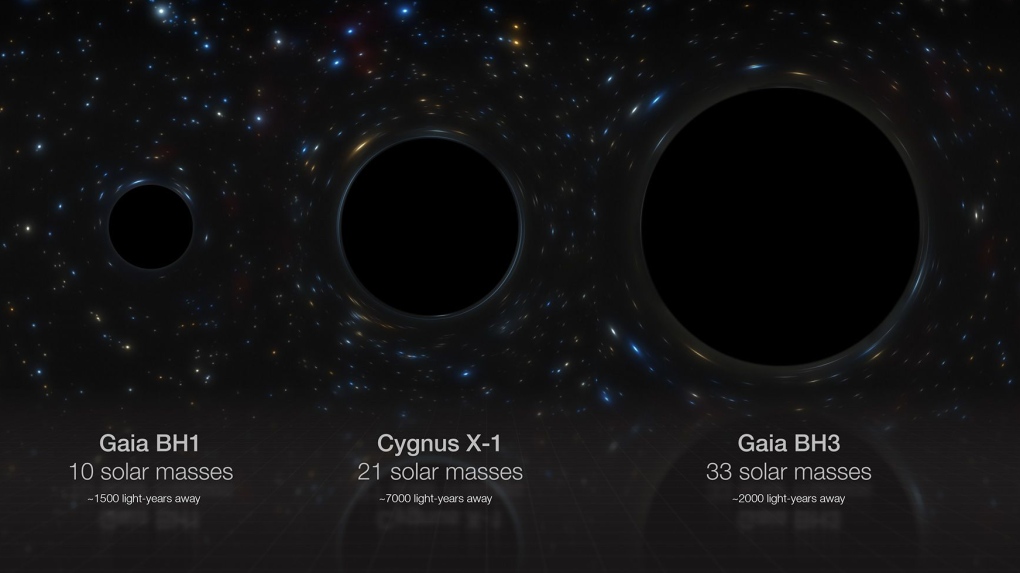
The so-called "sleeping giant," named Gaia BH3, has a mass that is nearly 33 times that of our sun, and it’s located 1,926 light-years away in the Aquila constellation, making it the second-closest known black hole to Earth. The closest black hole is Gaia BH1, which is located about 1,500 light-years away and has a mass that is nearly 10 times that of our sun.
Astronomers discovered the black hole while combing through observations taken by European Space Agency’s Gaia space telescope for an upcoming data release to the scientific community. The researchers weren’t expecting to find anything, but a peculiar motion — caused by Gaia BH3’s gravitational influence on a nearby companion — caught their eye.
Many “dormant” black holes don’t have a companion close enough to munch on, so they are much more difficult to spot and don’t generate any light. But other stellar black holes siphon material from companion stars, and this exchange of matter releases bright X-rays that can be spotted through telescopes.
The wobbling movement of an old giant star in the Aquila constellation revealed that it was in an orbital dance with a dormant black hole, and it’s the third such dormant black hole spotted by Gaia.
The researchers used the European Southern Observatory’s Very Large Telescope in Chile’s Atacama Desert and other ground-based observatories to confirm the mass of Gaia BH3, and their study has also offered new clues to how such huge black holes came to be. The findings appeared Tuesday in the journal Astronomy & Astrophysics.
"No one was expecting to find a high-mass black hole lurking nearby, undetected so far," said lead study author Pasquale Panuzzo, an astronomer at the Observatoire de Paris, part of France’s National Centre for Scientific Research, and a Gaia collaboration member, in a statement. "This is the kind of discovery you make once in your research life."


Friday marks the first official day of spring in the northern hemisphere, but it will still feel like winter this weekend for many Canadians, as snow, sleet, rain and sub-zero temperatures are forecast across the country.

A social media post from the U.S. Food and Drug Administration this week shows a big-eyed macaque staring out from behind bars.

Young people in southeast England and beyond are lining up for the meningitis B vaccine after an outbreak killed two people, sparking supply warnings from pharmacies and raising broader questions about the best public health response to the disease.

Many wage earners are engaging in “microshifting,” a flexible scheduling approach that involves tackling job duties in short, productive bursts instead of a single nine-to-five stretch.

Tyson Atleo, a hereditary leader of the Ahousaht First Nation, says the creation of three new forestry areas to be managed by his community and two others on the west coast of Vancouver Island marks the realization of a long-standing promise.

As artificial intelligence continues to reshape industries worldwide, Canadian universities are emerging as key players – not only in developing technology but in teaching students how to use it responsibly.

Switching up your exercise routine does more than fight boredom. Engaging in varied forms of movement may significantly boost your longevity, according to research.

A seven-bedroom, five-bathroom home in Ottawa’s Rothwell Heights neighbourhood is currently the most expensive home on the market in the capital.

David Suzuki, the geneticist-turned-environmentalist, who is days away from his 90th birthday, reflected on his legacy as he prepared to release his latest book, “Lessons from a Lifetime,” which compiles photos and stories from his life, as well as testimonials written by those he inspired.

Microsoft subsidiary Bethesda said Tuesday hit space exploration game “Starfield” will appear on rival Sony’s PlayStation 5, effectively ending the practice of keeping some releases exclusive to Xbox consoles.

A woman visiting her family in Canada from the United States became ill and was admitted to the hospital, and without travel insurance, the family was shocked to get a bill for more than $110,000.

Renowned Canadian angler Jeff Gustafson back in Kenora Ont. after Bassmaster Classic absence.

A special weather statement remains in effect for Toronto Tuesday morning with winds gusting up to 80 km/h in some areas after an overnight snowfall.