A tad more than what is necessary
The Hindu
Private colleges in Tamil Nadu overcharge students on application fees, prompting calls for government intervention and transparency in admissions.
When G. Prem, of Ammapet in Salem, went to an aided college at Kondalampatti in the Salem Corporation, he was told to pay ₹100 for the application form and ₹6,000 in annual fee. The government has fixed, for the B.A. course that Mr. Prem had applied for, an annual fee of ₹1,592. The college website was not updated, he said. “It only shows the fee structure for 2022-23, and it was mentioned as ₹900 a year,” says Mr. Prem.
A parent in Tiruchi had a similar experience. “Students are being made to buy admission forms for at least three more subjects, besides their chosen one, in shift II (colleges operate in two shifts — one in the morning and the other in the afternoon), based on their marks. Though my son was interested in applying only for Visual Communications, we ended up buying forms for Geography, History, and Maths, on the advice of the administrative staff. I spent ₹400 on four forms when the alternative options could have been included in a single form. Selling more forms seems to be a new money-spinner for private colleges,” he says. A parent in Chennai says his daughter had applied to two premier colleges in the city. She paid ₹500 and ₹400 as application fees. A friend of hers had paid higher at a college on the outskirts of the city.
Receipts for application or registration fees are not issued, concedes the principal of a prominent arts and science college in Coimbatore. Officials of the Directorate of Collegiate Education (DCE) admit that there is no mechanism to ensure that self-financing colleges comply with the government order. Academics in Coimbatore say there are visible signs that colleges are deviating from the application and registration fee norms.
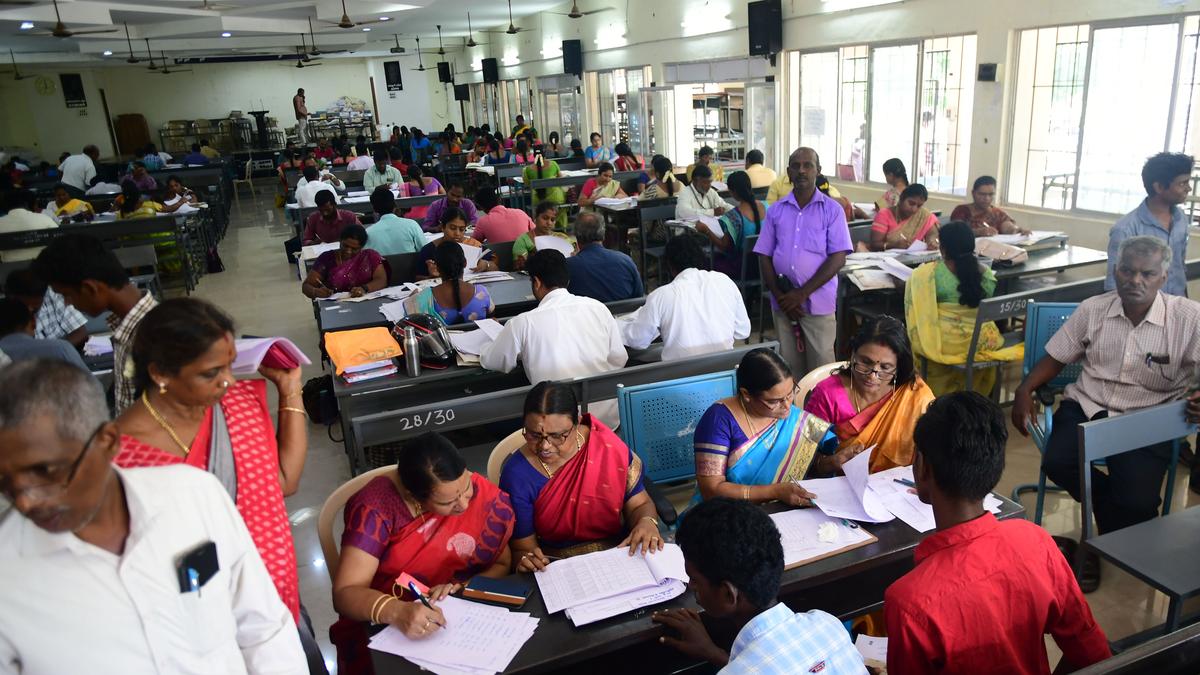
During the admission season, parents must set aside several thousand rupees for applications alone. Then, they must scrape together the money needed to pay the tuition fee. Some aided colleges allow students to use a common application form for self-financing programmes; but, at a women’s college in the city, separate application forms must be filed for each programme.
Meanwhile, Bharathiar University recently notified that the registration fee for postgraduate admission was ₹400 for an application and it must be submitted online for each subject. For Scheduled Caste and Scheduled Tribe candidates, the fee is ₹200 per subject. A senior professor at the university says students could approach the Fee Nivaran Cell under the University Grants Commission’s e-Samadhaan platform for refund of any excess fee.
A professor of Madurai Kamaraj University says the issue of overcharging has been persisting for years. “Only when there is strong opposition from students or associations, it becomes a matter of concern.” The regulation, which associations and members of the public demand, should have been put in place when private colleges were being established, he says. The online application process, which private colleges claimed would ensure transparency, does not seem to have solved the issue. “When the government-fixed fee is mentioned in the application, in the later stages of admission, the student is being made to pay the remaining amount the college intended to collect,” the professor alleges.
When the government fails to address the issue seriously, what can be done in the aftermath of the processes, he asks. Only when an audit report exposes the issue, will the government talk about it.


Telangana Governor Shiv Pratap Shukla attends Bihar Foundation Day celebrations in Hyderabad, honoring Bihar's historical and cultural contributions.

Samsung workers protest for the reinstatement of 27 suspended employees, citing unfulfilled promises from the Labour Minister.

The Vice-Chancellor of Rajiv Gandhi University of Health Sciences (RGUHS) B. C. Bhagavan said on Sunday that the university will soon open a research centre on Yoga and Naturopathy on 60-acre land in Bengaluru.

UT Matters: Construction of Uppar drain road overbridge in Puducherry to be completed in four months, amid traffic regulations.

Union Minister Dharmendra Pradhan highlights Bharat Innovates' aim to elevate Indian deep-tech startups to the global stage.

In an exclusive interview, DMK MLA Ezhilan discusses Tamil Nadu's 2026 elections, party structure, and local governance challenges.

Minister Satish Jarkiholi asserts confidence in retaining Davangere and Bagalkot seats in upcoming bypolls amid addressing internal discontent.

Sunil Ambekar of RSS emphasizes national unity, defending road prayer restrictions and promoting awareness of shared ancestry in India.

Opposition MPs and activists voice strong concerns against proposed amendments to the Transgender Persons Act at a Delhi hearing.

Four Assam police commandos injured in an extremist attack during a gunfight in Tinsukia district, officials report.

Campaigning intensifies in Ernakulam district as candidates engage voters ahead of the crucial Assembly polls.

Lord Rama rides Hanumantha Vahanam on sixth day of Brahmotsavams in Tirupati

Nagapattinam faces underdevelopment and resource challenges, impacting its rich heritage and the livelihoods of its fishing community.