A new normal in India-Pakistan ties Premium
The Hindu
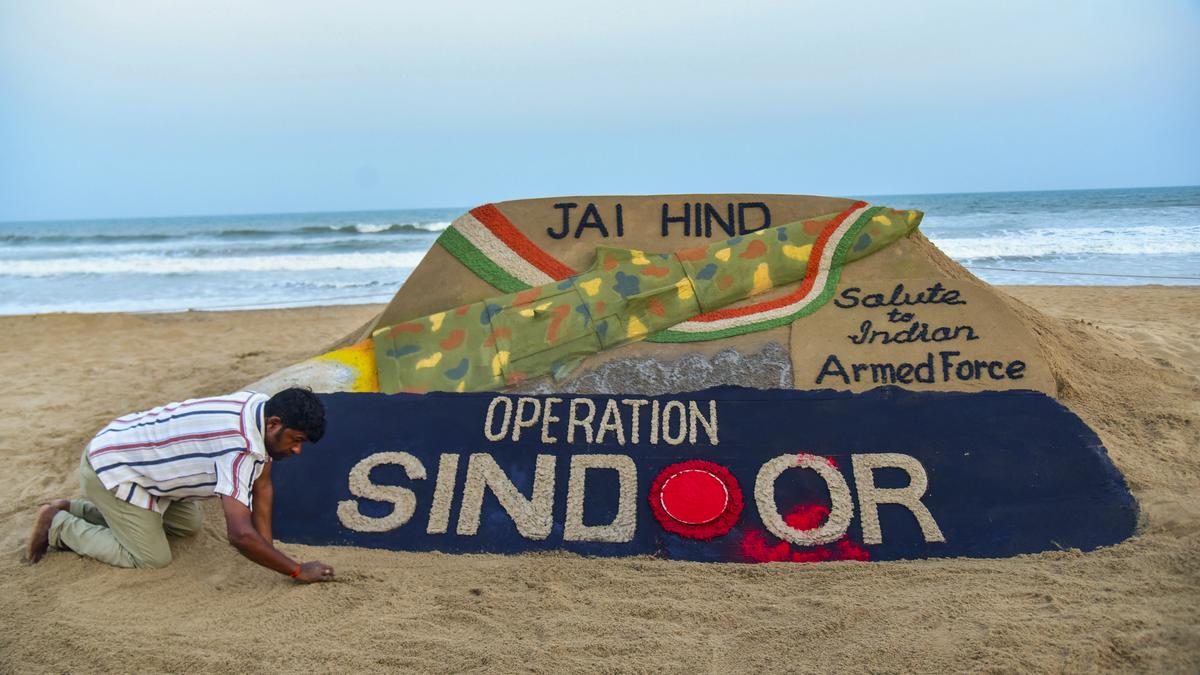
Operation Sindoor: Until 2016, India’s strategy for dealing with terrorist attacks relied on diplomatic efforts to isolate Pakistan, economic penalties related to terror financing, and pressure on Islamabad to crack down on terror networks. This approach saw limited success.
On September 22, 1965, during a speech at the UN Security Council, Zulfikar Ali Bhutto, who was then part of the Ayub Khan administration, declared that Pakistan “will wage a war for 1,000 years” against India. Years later, Gen. Zia-ul-Haq, who captured power in a 1977 coup by toppling Prime Minister Bhutto (who was later executed), turned Bhutto’s ‘1,000 years of war’ into a ‘Bleed India through a Thousand Cuts’ doctrine — use low-intensity and sub-conventional warfare with militancy and infiltration to continue to bleed India. Pakistan suffered a humiliating defeat in the 1971 war, which saw the dismemberment of the country. The Pakistani military, having failed in conventional warfare, turned to this indirect approach. The doctrine gained traction after the Soviet withdrawal from Afghanistan. Pakistan, with support from the U.S. and Saudi Arabia, had successfully applied the ‘Thousand Cuts’ tactic in Afghanistan against the country’s communist regime and its Soviet backers. Bled out by the Pakistan and U.S.-backed mujahideen’s thousand cuts, the mighty Soviet troops withdrew from Afghanistan in 1989.
The same year marked the beginning of a surge in militancy in the Kashmir valley. By the early 2000s, terror was exported to other parts of the country. India’s Parliament was attacked in December 2001; and in 2008, Mumbai, the country’s commercial hub, suffered a major terrorist assault. By then, Jaish-e-Mohammed and Lashkar-e-Taiba, two anti-India terrorist outfits with close links to Pakistan’s security establishment, had built sprawling networks in Pakistan. The Pahalgam massacre of April 22, 2025, in which 26 people, mostly civilian tourists, were brutally gunned down by terrorists, was the latest sign that the ‘Thousand Cuts’ doctrine remains alive in Rawalpindi’s strategic thinking. The attack came days after Pakistan’s military chief Gen. Asim Munir said “Kashmir is out jugular vein”. The Resistance Front, which India believes is a front of Lashkar-e-Taiba, initially claimed responsibility for the attack, but later denied any role.
Until 2016, India’s strategy for dealing with terrorist attacks linked to Pakistan largely relied on three measures: diplomatic efforts to isolate Pakistan internationally, economic penalties related to terror financing, and pressure on Islamabad to crack down on terror networks. This approach saw limited success as Pakistan was briefly put on the ‘grey list’ of the Financial Action Task Force (FATF), an inter-governmental body established to combat money laundering and terror financing, and was compelled to take some face-saving actions against terrorist entities. But India stopped short of taking direct military retaliation, because it did not want an all-out war between the two nuclear powers. India’s diplomatic and economic responses did not stop attacks by Pakistan-based terrorists. Islamabad-Rawalpindi continued to wage the Thousand-Cuts campaign with low cost and high immunity. Both would change soon.
India adopted a doctrinal shift in its response strategy following the Jaish-e-Mohammed attack at the Indian Army Brigade headquarters in Uri in Jammu and Kashmir on September 18, 2016, which killed 19 soldiers. Ten days later, the Indian commandos conducted a cross-border operation targeting terror launchpads and safe houses in Pakistan-occupied Kashmir, according to the military. This marked a significant departure from India’s earlier posture. In addition to the diplomatic and economic measures, India would also take direct military steps targeting terror infrastructure across the Line of Control in response to attacks.
This strategic shift did not immediately establish a strong deterrent. The Uri response did not prevent the deadly suicide bombing in Pulwama in February 2019. Similarly, the Balakot airstrike that followed Pulwama did not deter the attack on civilians in Pahalgam. Nevertheless, what is important is that by launching military operations inside Pakistan in response to terror attacks, New Delhi has effectively established a new normal in India-Pakistan relations.
Until recently, Pakistan’s nuclear deterrent had constrained India from pursuing conventional military responses to terror attacks. India also came under high international pressure to de-escalate every time tensions flared because of the same nuclear angle. This allowed Pakistan’s Generals to persist with the ‘Thousand-Cuts’ doctrine with minimal cost. But that dynamic has begun to shift. With each flare-up, India has stepped up its response in both scope and scale. If the 2016 surgical strike was limited to Pakistan-occupied Kashmir, the 2019 Balakot strike was extended to Khyber Pakhtunkhwa. And this time, India struck nine locations, including Bahawalpur and Muridke in Punjab, Pakistan’s heartland, marking its largest aerial operation on Pakistani soil since 1971.
India’s evolving strategy carries significant risks. In 2019, following the Balakot strike, Pakistan scrambled its fighter jets, triggering an aerial dogfight in which an Indian aircraft was downed and its pilot captured (he was soon returned home, which helped de-escalate the crisis). After Operation Sindoor, as India’s military response to the Pahalgam massacre is called, Pakistan chose to escalate by targeting what India’s Ministry of Defence said “military stations at Jammu, Pathankot & Udhampur” with drones and missiles, which were “swiftly neutralised”. India launched its counter attacks “in the same domain and same intensity of Pakistan”, according to the Ministry. Pakistani media reported that India fired at least 77 drones in two days. In essence, the killing of 26 Indians in Pahalgam by terrorists has brought India and Pakistan dangerously close to the brink of an all-out war.


Russia claims control of Potapivka village in Ukraine's Sumy region amid ongoing military efforts to establish a buffer zone.

Iranian missile strikes on Israeli towns cause widespread damage and injuries, marking a significant escalation in the ongoing conflict.

As Gor makes first trip as U.S. Special envoy to South Asia, Delhi watches strategic signals closely
Sergio Gor's inaugural trip as U.S. Special Envoy to South Asia signals strategic U.S. engagement amid regional tensions.

Slovenians vote in a tight election between liberal and populist candidates, impacting the country's future domestic and foreign policies.

Netanyahu asserts U.S.-Israel alliance fights Iranian threats, emphasizing global security after missile strikes on Israeli and European targets.

Israeli settlers attack Palestinian villages in the West Bank, causing injuries and destruction amid ongoing settlement expansion.

Britain asserts no evidence of Iran planning missile strikes on Europe, despite Israeli claims of missile capabilities.

UNESCO reports over half of countries have banned phones in schools due to concerns about attention, cyberbullying, and social media impact.

Analysis reveals a U.S.-operated Patriot missile likely caused a pre-dawn explosion in Bahrain, injuring numerous civilians.

Sri Lanka raises fuel prices by 25% amid ongoing West Asia conflict, impacting petrol and diesel costs significantly.

Iran strikes near Israeli nuclear research center as Trump threatens attacks on Iranian power plants
Iran's missile strikes near Israel's nuclear site escalate tensions as Trump threatens retaliation against Iranian power plants.

Saudi Arabia intercepts one of three ballistic missiles targeting Riyadh amid ongoing regional tensions and threats from Iran.

Iran's death toll exceeds 1,500 amid escalating war, with heavy airstrikes and shifting U.S. and Israel strategies reported.