A graphic novel that brings to life Francis Buchanan’s survey of south India Premium
The Hindu
Although he is someone who “could not believe that curses come true…I am quite a rationalist”, he thought of investigating this story, going into the project with an open mind. “Wherever we went, in Mysore and places around it, people generally believed in it,” he recalls. And while there appeared to be some anecdotal evidence, with many of the Mysore rulers failing to beget heirs and having to adopt, “it all seemed very confusing,” says Sashi, who researched the subject, with a colleague, for a year and a half, “getting stuck along the way, because there was very little evidence about all this.”
Dr. Sashi Sivramkrishna’s recently published graphic novel, A Journey into the Furnace of History: The Dying Embers of Ancient Iron-Smelting in India, has an origin story that spans nearly two decades. The kernel for this book, which documents Sashi’s own attempts to retrace the journey of the Scottish physician, botanist and surveyor Francis Buchanan through the erstwhile Mysore State, emerged in the early 2000s when he was working on a documentary on the curse of Talakadu.
“It is an interesting story about the Mysore Maharajas combined with two natural phenomena,” says the Bengaluru-based economist and the chairman of the Foundation to Aid Industrial Recovery (FAIR), a not-for-profit society that focuses on helping the country’s under-managed sectors. This 400-year-old curse, which is believed to have been uttered by Queen Alamelamma, the queen of the once-strong but now crumbling Vijayanagara Empire, when the Wadiyars dethroned her husband and took over Mysore, had three parts to it: Talakadu would become a desert, the river Malangi would turn into a whirlpool, and the Mysore Kings would bear no heirs.
Although he is someone who “could not believe that curses come true…I am quite a rationalist”, he thought of investigating this story, going into the project with an open mind. “Wherever we went, in Mysore and places around it, people generally believed in it,” he recalls. And while there appeared to be some anecdotal evidence, with many of the Mysore rulers failing to beget heirs and having to adopt, “it all seemed very confusing,” says Sashi, who researched the subject, with a colleague, for a year and a half, “getting stuck along the way, because there was very little evidence about all this.”
In 2005, as part of his research, Sashi visited the library of the Mythic Society on Bengaluru’s Nrupathunga Road, looking through some references, when he came across Buchanan’s three-volume survey titled A Journey from Madras through the Countries of Mysore, Canara, and Malabar, published in 1807. Buchanan, who became a medical officer with the British East India Company in 1794, had been commissioned to survey South India in 1800, following the death of Tipu Sultan and the British’s decisive victory over the Kingdom of Mysore. While going through the survey, he discovered this. “Buchanan had visited Malangi, and he does talk about some curse and states that Talakadu was covered in sand,” says Sashi, who went on to make a film about the curse in 2005. “That was my introduction to Buchanan.”
Sashi then found himself delving deeper into Buchanan’s work, becoming increasingly fascinated by this survey. “Normally, when you look at history, it is about battles and wars,” he says. “But here, Buchanan touches upon people and the day-to-day life in these places. He talks about farmers, agricultural labourers, people weaving blankets, things we don’t usually learn as part of our history education.” That is when he decided that he wanted to trace Buchanan’s journey, travelling back and forth, between Bengaluru and the places chronicled in Journey from Madras through the Countries of Mysore, Canara, and Malabar, trying to understand whether the occupations Buchanan had described continued to exist and in what form.
As Sashi, accompanied by other researchers, travelled to places such as Channarayana Durga, Yelladakere, Chikkanayakanahalli and Gattipura, and talked to the people who inhabited them, they became deeply intrigued by one of the occupations described by Buchanan: iron-smelting. In South India, where iron has been smelted since at least 2000 BCE, going by artefacts at very early iron age sites, they couldn’t help but wonder why the traditional craft of smelting has largely disappeared, says Sashi, who worked with Mahadev Nayak, Amalendu Jyotishi and GJ Lingaraj on this project. “We met people who told us that smelting would happen even in the 1930s and 40s; they remember their grandfathers doing it,” he says, adding that, in India, there is usually a certain continuity of tradition, with things rarely disappearing completely. “So I started looking for answers to why and when iron smelting disappears from this region,” says Sashi, who was involved in this research till 2010 and has published it in several academic journals, including Environment and History and Economic and Political Weekly.
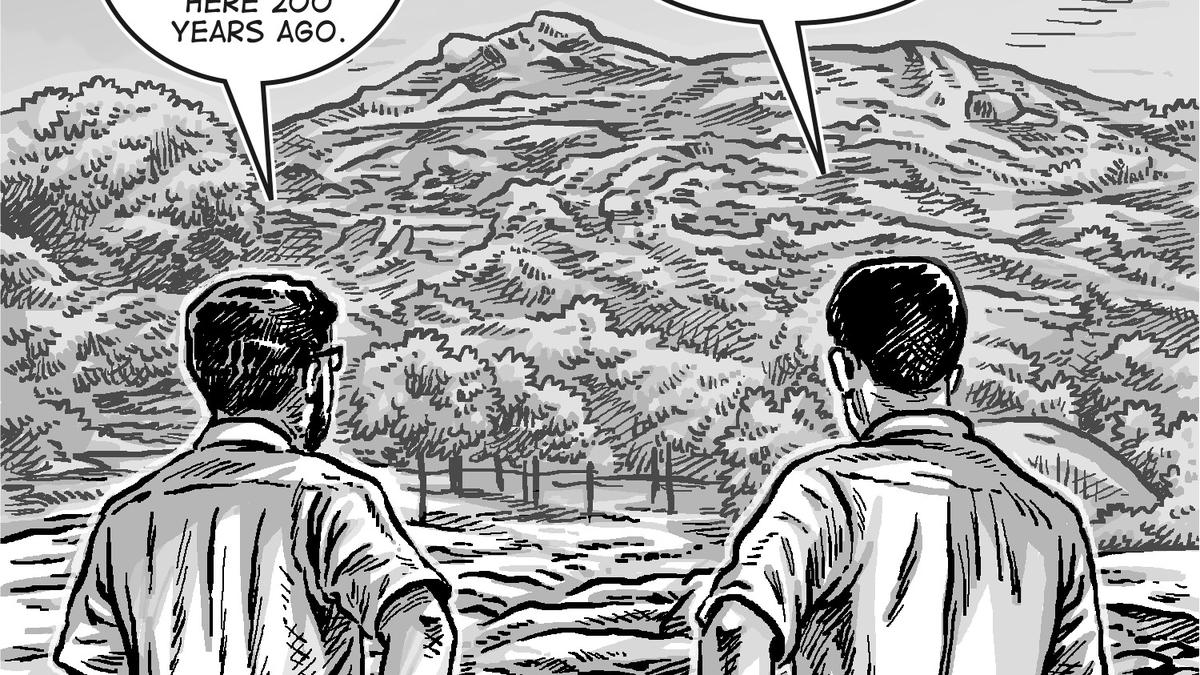
To make his research more accessible and to document his own journey, in 2022, he thought of putting it together into a graphic novel, which eventually became A Journey into the Furnace of History, beautifully illustrated by the Kolkata-based illustrator and a graphic novelist himself, Harsho Mohan Chattoraj. “I got in touch with a friend in Kolkata who introduced me to Harsho, a renowned artist in this space,” he says. They worked together, with Sashi sending him old pictures, and Harsho slowly creating them, panel by panel, he recalls. “I wrote the whole script, having an idea of what it needed to be, panel by panel. I could visualise the novel because I come from a documentary space,” he says of the 210-panel-long novel, which took about two years to create and was officially released in 2024.


The ‘Swastha Mysuru’ initiative aims to promote healthy living and preventive healthcare in Mysuru through community engagement and awareness.

Farmers in Ongole protest against BJP's policies, citing dangers to their livelihoods and demanding support for local agriculture.

From March 24, paneer queserotta, prawn tostadas, beef birria and more feature on MadCo's special Mexican pop up menu by Chef Mathangi Kumar alongside experimental cocktails, including a marigold highball

Revenue Minister Krishna Byre Gowda defends subsidies as crucial for economic growth, emphasising their role in boosting consumer demand during recessions.

Three doctors were arrested by the Mico Layout traffic police on Monday (March 23) after a video allegedly showing them triple-riding without helmets with one of the pillion riders seen drinking from a bottle went viral on social media.

Assembly protest ends in arrests as BJP targets Government over guarantees

Andhra Pradesh accelerates city gas distribution with streamlined approvals, enhancing access to cleaner energy and supporting sustainable urban development.

Sattankulam father-son custodial deaths case: Trial court convicts all nine accused police personnel
Nine police personnel convicted in Sattankulam custodial deaths; sentencing to be announced on March 30.

Minister Laxmi Hebbalkar supports local protests against a solid waste management plant in Turmuri, addressing residents' concerns.

Sattankulam father-son custodial deaths case: Trial court convicts all nine accused police personnel
Nine police personnel convicted in Sattankulam custodial deaths; sentencing to be announced on March 30.

Erode district conducts first EVM randomisation for April 23 Assembly elections, ensuring transparency and fairness in allocation.

TNCC conducts public consultation in Erode to gather community input for its upcoming election manifesto.

CID to investigate sexual assault allegations against suspended Moodbidri Police Inspector P.G. Sandesh, reveals Home Minister Parameshwara.