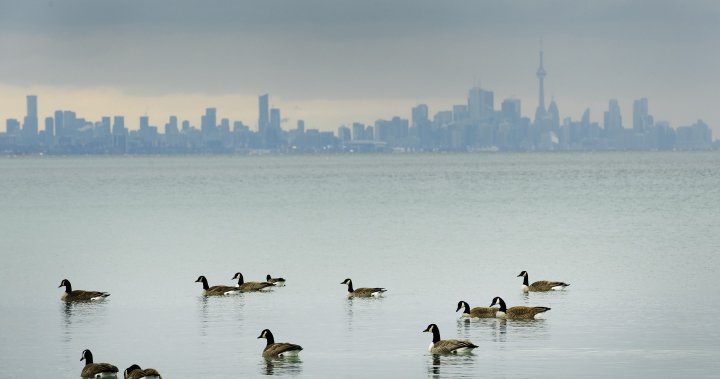
86% of Canadians live in areas with air pollution exceeding WHO guidelines: researchers
Global News
Most Canadians live in areas with levels of fine particulate matter and nitrogen dioxide higher than new air quality guidelines issued by the World Health Organization.
The majority of Canadians live in parts of the country where air pollution exceeds new guidelines set by the World Health Organization, and this could damage their health, researchers say.
According to researchers at CANUE – the Canadian Urban Environmental Health Research Consortium – around 86 per cent of Canadians live in areas where airborne fine particulate matter levels exceed the WHO guidelines that were issued in late September.
Around 56 per cent of people live in areas where the levels of nitrogen dioxide exceed the new guidelines, said Jeff Brook, an assistant professor in public health and chemical engineering and applied chemistry at the University of Toronto who works with CANUE.
The WHO’s new guidelines recommend an annual average concentration of PM2.5 of five micrograms per cubic meter of air. PM2.5 refers to airborne particles so tiny that they can penetrate the lungs when you breathe and enter the bloodstream.
While most of Canada was well under the old WHO guideline on fine particulate matter, much of urban Canada exceeds this new benchmark, as do parts of Western Canada with regular exposure to wildfire smoke, CANUE’s research shows.
“We should care because we can do something about it,” said Brook, who is also a former air quality scientist for Environment Canada. “It is contributing to the costs of health care. It is affecting the quality of people’s lives.”
Health Canada estimates that air pollution contributes to 15,300 deaths per year in Canada, with many more people losing days suffering from asthma and acute respiratory symptoms as a result of pollution. This is a little more than the number of Canadians who die annually in accidents like car crashes, according to Statistics Canada.
Other studies come to similar conclusions as the research from CANUE. A recent report from the B.C. Lung Association found that many B.C. municipalities, including Victoria, much of the Lower Mainland and especially communities in the Interior like Grand Forks, Castlegar and Nelson, exceeded these levels.


Some experts say that a cyberwar through 'proxies' may be the next stage of the Iran war, with civilian infrastructure also coming under threat.

The study is being billed by the university as "the first to study a wide range of factors which link ADHD symptoms and mental ill health symptoms over time."

The group says MAGA Energy hasn't paid its lease for three years, and therefore the company is no longer allowed on their land in Edmonton.

The analysis by the Canadian Climate Institute says oilsands producers will pay an average of about 50 cents per oil barrel, if the minimum carbon price rises to $130 per tonne.

Between November 29 and February 27, authorities recorded 406 outbreaks of bird flu in domestic birds in 32 European countries and 2,108 outbreaks in wild birds, they said.

Dr. Michael Domeier, director of the Marine Conservation Science Institute, told Global News that they tag the adult females as they are the most interesting.

Regina’s recycling contamination is currently triple the limit and city is urging resident to change sorting habits now to avoid citywide fines and higher resident fees.

The study found that higher ultra-processed food intake at age three years was associated with adverse behavioural and emotional symptoms at age five years.

Edmonton's single-use waste rules were controversial and unpopular when introduced in 2023 — but new data shows the changes are having the intended effect of reducing garbage.

Carney's speech to Australia's parliament highlighted a soon-to-launch Canadian low earth orbit satellite network that experts say could soon compete with Elon Musk's Starlink.

The Pentagon said in a statement Thursday that it has “officially informed Anthropic leadership the company and its products are deemed a supply chain risk, effective immediately.”

Opioid overdose deaths in Canada are falling, but there's growing concerns on a certain veterinary tranquilizer being cut into fentanyl and other opioids.

The product is being recalled in Alberta, British Columbia, Manitoba, Ontario, Quebec and Saskatchewan due to 'undeclared almonds' being found.