50 hours, no breaks: Union says change necessary for medical technologists in Saskatchewan
CBC
Dexter Mercer thought becoming a medical radiation technologist would set him onto a path for success. Instead, his job at Battlefords Union Hospital has become a nightmare.
"I've personally experienced working over 50 hours straight with no longer than 45 minutes between callbacks, leaving little to no room for rest," Mercer said, recounting an incident from a few years ago.
Exhaustion and lack of sleep eventually took its toll and as Mercer pulled into the hospital parking lot he lost consciousness. The vehicle slammed into a lamppost, causing thousands of dollars of damage to the vehicle.
While the incident is horrifying, Canadian Union of Public Employees (CUPE) 5430, the union representing medical technologists and technicians in Saskatchewan, says it is becoming more and more normal as positions go unfilled.
Technologists are a key part of the province's health service. They perform tests and analyze results that are necessary for doctors to make a diagnosis or to declare a patient well to go home.
"If there's no technologists, there's no one there. The ER closes," said Sharlise Tubman, a medical technologist that works in Lumsden.
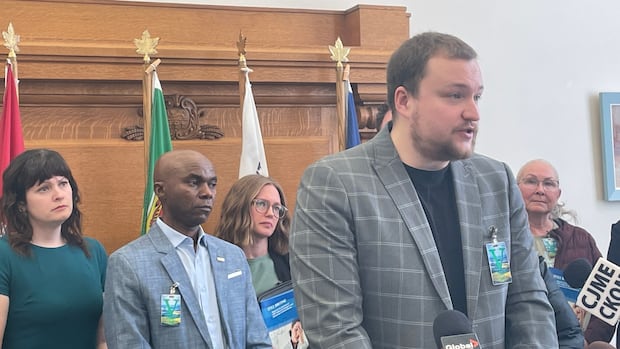
That's why the union brought 15 of its members to the provincial legislature on Monday, calling on the provincial government to provide more health-care funding after its members raised concerns of under-staffing and increased workload.
CUPE 5430 represents 906 medical technologists and technicians in the province.
Union president Bashir Jalloh described technologists as the key pieces of the medical system that no one ever gets to see. Despite the key role technologists play in the province's health-care system, they are treated terribly, according to Jalloh.
"Health-care workers, in our province, including technologists, are underpaid and undervalued and this is not something that we can continue," said Jalloh.
CUPE released a report titled Still Waiting on Monday to highlight the lack of support. That report highlights that of the 156 members that responded to a union survey, 87.8 per cent of them said their workload had increased in the past five years.
According to CUPE that is an increase from 81.7 per cent that said their workload had increased when they were asking in a similar survey conducted in 2017.
That increased workload has affected the quality of services provided to patients, according to 89.7 per cent of the survey respondents, while 91 per cent say it had an impact on the health and safety of patients and residents.
It has also affected the morale of staff negatively, according to 91 per cent of the survey's respondents. That's a significant jump from the 79.5 per cent of respondents that provided the same response in 2017.


As the province doubled down on its “tough on crime” measures and calls for federal bail reform this week, rates of violence across Ontario jails — both inmate-on-inmate and inmate-on-staff assaults — are rising, according to an analysis of data shared with CBC News by the Ontario Public Service Employees Union (OPSEU).

Finance Minister Eric Girard is set to table Quebec’s provincial budget on Wednesday — less than a month before the Coalition Avenir Québec (CAQ) chooses a successor to Premier François Legault.

Manitoba's finance minister says the NDP is funding education adequately, yet won't acknowledge some school divisions are raising taxes because they feel provincial funding hasn’t kept pace.

Saskatchewan's Serious Incident Response Team (SIRT) says an RCMP officer who struck a teen with a police truck during a high-speed chase on Kawacatoose First Nation last year should not be charged.

Finance Minister Jim Reiter unveiled his footwear for Wednesday's provincial budget: The same black shoes as last year.

A new report by the Alberta Council of Women's Shelters highlights the importance of investing in transportation in rural parts of the province in order to save lives.

B.C. Premier David Eby has signalled he won't support the federal government's move to temporarily increase rural employers' allowances for temporary foreign workers, saying there should be a pathway to permanent residency instead.

P.E.I. Progressive Conservative MLA and cabinet minister Mark McLane has died, with Premier Rob Lantz paying tribute to his colleague as someone who could always be counted upon.

Whitehorse city council is considering a proposal to study 14 lots throughout the city for housing development.

In the closing days of the NDP leadership race, Avi Lewis's past activism has resurfaced. But the front-runner's campaign is standing by his past work and a decade-old vision that's been both criticized within the New Democrats' ranks and weaponized by their opponents.

Some rural municipalities want the province to know ambulance response times and basic care in their communities are not meeting the mark.

The sighting of a sniper on Saturday during St. Patrick’s Day celebrations in Waterloo was met with fear and shock by some partygoers, but one policing expert says this was a proactive measure designed to keep the crowd safe.

A 25-year old Prince Edward Island man has been sentenced to six months in jail for firearms offences.