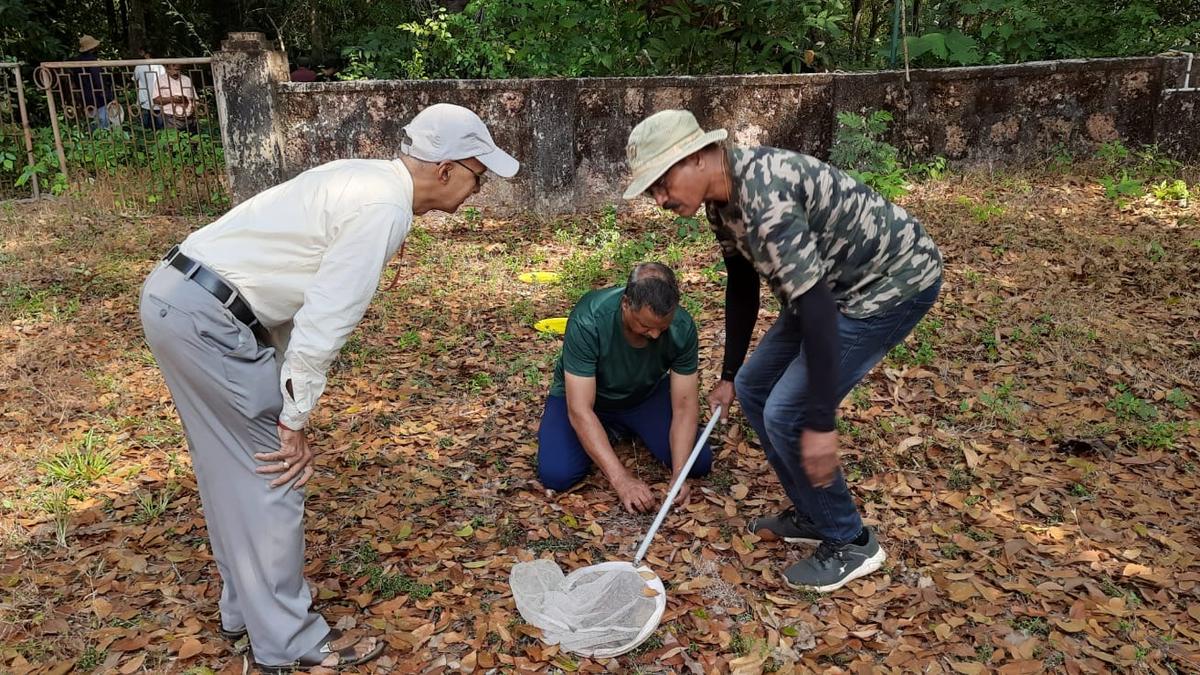
Zoological Survey of India scientists sight mountain skink on Mangalore University campus
The Hindu
A team of scientists from the Zoological Survey of India (ZSI), which is conducting a faunal diversity survey of Mangalagangotri campus of Mangalore University for last three days, sighted Eutropis clivicola (mountain skink) on the campus on Friday.
A team of scientists from the Zoological Survey of India (ZSI), which has been conducting a faunal diversity survey of Mangalagangotri campus of Mangalore University for last three days, sighted an Eutropis clivicola (mountain skink) on the campus on Friday. This species is listed as ‘endangered’ on the IUCN (International Union for Conservation of Nature) red list categories.
“Sighting the mountain skink on the Mangalagangotri campus may be a new record for Karnataka,” Vishwanath D. Hegde, Scientist-E and Officer-in-Charge, and Muhamed Jafer Palot, Scientist-C, ZSI, told The Hindu. “Interestingly today (on Friday) we saw a skink, i.e., Eutropis clivicola. That may be a new record for entire Karnataka. Earlier it was recorded in Ponmudi, Thiruvananthapuram district in Kerala,” Mr. Palot said.
He said that Pallid Harrier and Chestnut Shouldered Petronia were new bird species sighted on the university campus during the survey.
“We also saw Pantala flavescens, the globe skimmer dragonfly, known for inter-continental migration,” Mr. Hegde said.
Mr. Hegde said that the team got several ootheca (egg cases) of praying mantis which is used for biological control of insects. An ootheca contains several eggs.
“This is the best season for the praying mantis. Recently, we were at Parambikulam Tiger Reserve in Kerala. We did not find ootheca of praying mantis in large numbers there like we did here. The number of species we saw in the tiger reserve was less. The ootheca is sold at a high price in the online market,” he said.
Amal S., Senior Zoological Assistant, ZSI, said, “We expected parasitic wasps in large numbers on the campus since they are common. But they were not seen much. We don’t know why.” Mr. Amal said that about three species of solitary bees were spotted in addition to rock bees.


Telangana MP urges Centre to expedite ₹1,270 crore dues transfer from Andhra Pradesh for financial fairness and development.

A Karnataka man was detained with ₹62.5 lakh in cash during election checks on NH 544, claiming it was from a property sale.

Telangana Government issued 16 notifications to fill 31,798 vacancies, with 67,763 total recruitments since Congress took power.

Supreme Court directs Tarun Butolia's family to seek safety assessment from Delhi Police after fatal Uttam Nagar clash.

CM Stalin asserts unity in the DMK-led alliance, dismissing division attempts and emphasizing collaborative efforts for the upcoming elections.

Rahul Gandhi to skip Kerala rally due to Sonia Gandhi’s ill health; Kharge to attend Kozhikode event
Rahul Gandhi will miss the Kerala rally due to Sonia Gandhi's health; Congress president Kharge to attend instead.

Thunderstorms with lightning and gusty winds forecasted for 20 Telangana districts on March 26

TGSRTC reduces Metro AC and Deluxe bus fares by 30% in Hyderabad to encourage public transport amid the fuel crisis.

Supreme Court criticises Haryana Police for mishandling a four-year-old rape case, mandates swift action and oversight with a Special Investigation Team.

On World Theatre Day 2026, artists in Hyderabad call for affordable venues as rising costs and infrastructure gaps challenge the city’s theatre ecosystem.

Madhapur police seize 31 illegally transported commercial gas cylinders, ensuring public safety and compliance with regulatory norms.

Punjab AAP MLA Harmeet Singh Pathanmajra arrested in Gwalior after evading police in a rape case for over six months.

Bose Krishnamachari resigned from the Kochi Biennale Foundation amid sexual harassment allegations, confirmed by the foundation's chairperson.