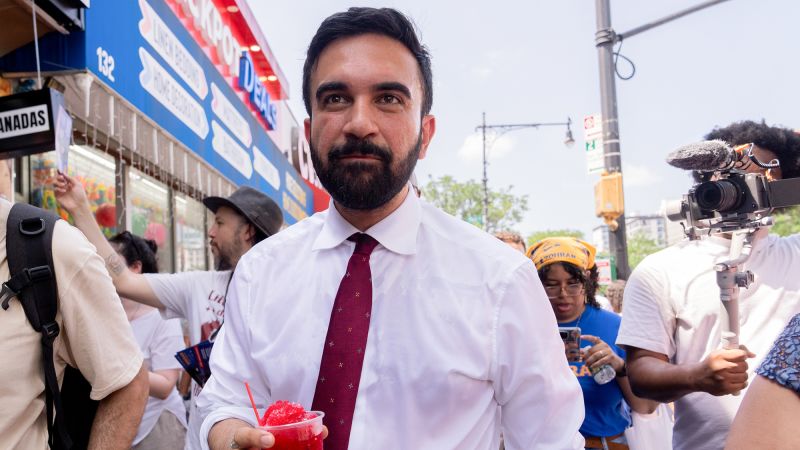
Zohran Mamdani wants to build government supermarkets. America already has them
CNN
Zohran Mamdani, the favorite to become New York City’s next mayor after winning the Democratic primary, has a contentious plan to create a network of city-owned grocery stores to offer lower prices to customers. But it’s less radical than critics portray, some food policy and grocery industry experts say.
Zohran Mamdani, the favorite to become New York City’s next mayor after winning the Democratic primary, has a contentious plan to create a network of city-owned grocery stores. But it’s less radical than critics portray, some food policy and grocery industry experts say. Mamdani has proposed five municipally owned stores, one in each New York City borough, to offer groceries at lower prices to customers with limited access to supermarkets. In some New York City neighborhoods, more than 30% of people are food insecure. The proposal has been blasted as a “‘Soviet’ style disaster-in-waiting,” “farcical” and “economically delusional.” John Catsimatidis, the owner of New York City-based supermarket chain Gristedes, threatened to close stores if Mamdani is elected. (Catsimatidis is a two-time Republican candidate for mayor.) But Mamdani is drawing on government-owned and subsidized models that already exist in the United States, such as the Defense Department’s commissaries for military personnel, public retail markets that lease space to farmers and chefs, and city-owned stores in rural areas such as St. Paul, Kansas. Atlanta is opening two municipal grocery stores later this year after struggling to draw a private grocery chain. Madison, Wisconsin, and rural Venice, Illinois, also plan to open municipally owned stores. “This is more common than people are aware of,” said Nevin Cohen, director of the City University of New York’s Urban Food Policy Institute. “There’s a wide spectrum of food retail establishments that could be created by or with the support of city government.” Mamdani has not released all the details of his plan yet, and it’s not clear what role New York City would play in the opening or operation of grocery stores. Would it build stores? Lease them out to a private company or a non-profit? Would the employees be on the city’s payroll?


The war with Iran is disrupting global oil flows, damaging energy infrastructure and raising fears of prolonged conflict. But gold, usually considered a safe haven during periods of economic uncertainty, has slumped.

US stocks and bonds fell, oil prices rose and gold had its worst week in four decades as the Iran war continues to ripple through financial markets.

The White House on Friday released its long-awaited national artificial intelligence legislative framework, a move to prevent states from enacting their own laws and enforce the Trump administration’s light-touch approach to AI regulation.

“Today is a difficult day,” CBS executives wrote to staff, explaining the cuts as a tough but necessary reallocation of newsroom resources.

President Donald Trump has repeatedly promised that Americans will get larger tax refunds this year thanks to his “big, beautiful bill.”

President Donald Trump has repeatedly promised that Americans will get larger tax refunds this year thanks to his “big, beautiful bill.”

Oil prices edged lower on Friday after a tumultuous day that saw the international benchmark surge above $119 a barrel as the Middle East conflict deepened energy supply fears.

The war in Iran has delivered what economists call a “black swan” event — an unforeseen shock so destructive, no one is immune to it.

The war in Iran is driving up the cost of buying a home in America.

Eight state attorneys general have filed an antitrust lawsuit to block Nexstar’s pending acquisition of Tegna, which would strengthen the right-leaning Nexstar and shrink the number of station owners in the US.

The Iran war has driven oil prices to their highest levels in years. Now, a wave of attacks in the past 24 hours on energy production sites across the Middle East have turned the spotlight on another crucial fossil fuel: liquefied natural gas, or LNG.

Oil and natural gas prices spiked Thursday, as Iran ramped up strikes on energy infrastructure across the Middle East and attacked one of the world’s most important liquefied natural gas (LNG) facilities in Qatar.

In normal times, the Federal Reserve would more or less ignore an oil price shock like the one we’re in now.