Zakir Hussain leaves behind a treasure trove of values Premium
The Hindu
Zakir Hussain leaves behind a treasure trove of values
There is no single day I dreaded more in my life than today. The news of the demise of Ustad Zakir Hussain, or Z Ji, as I and many refer to him, is not only shocking but a humongous vacuum, which leaves the entire music community strangled, with many fans and admirers surely despondent. As someone who looked up to him as an idol, then teacher, and most recently a friendly guide, I still do not understand his absence. Maybe, I am just learning how to be still.
I had come to take it for granted that Z Ji was to be a permanent fixture in music, always among us in the iconic and charismatic physical form, which immediately induced a cherubic smile from me. The mere thought of those russet-coloured locks, the beautiful hands and the conversational naughtiness is almost a necessary daily vitamin for me and many who were fortunate to interact with him.
Also read: Tabla loses its vibrant voice
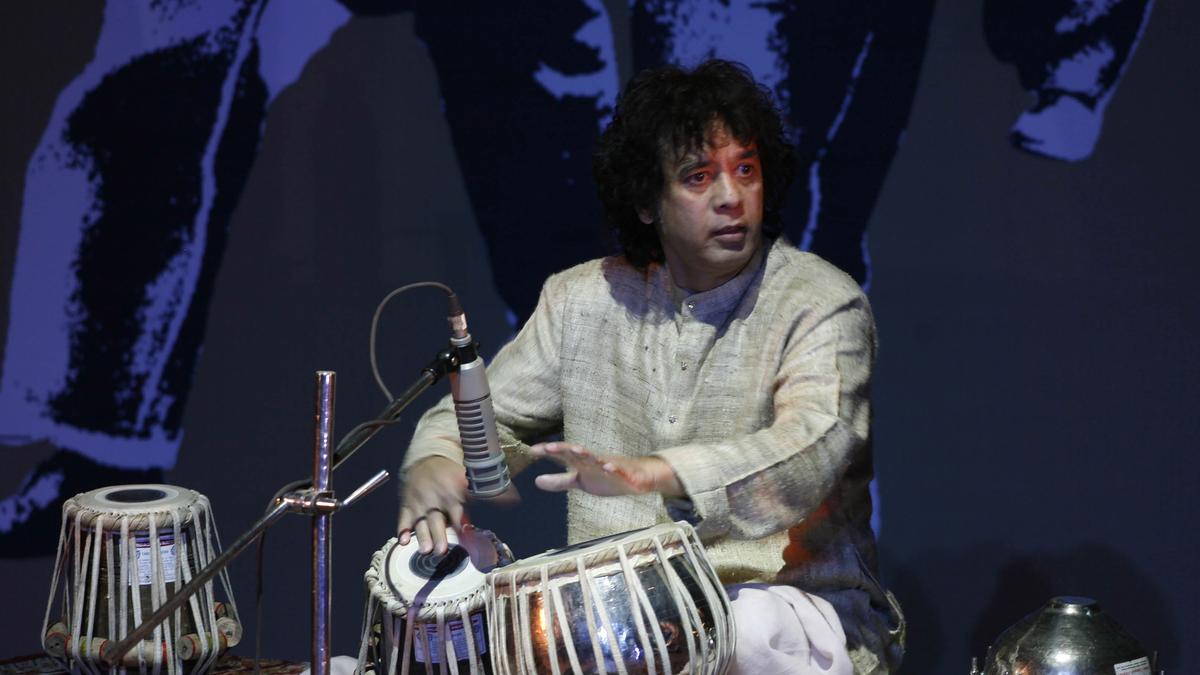
Musically, it is difficult to find another person who has made the entire music fabric of the world come together with a purposeful amalgamation. It was Z Ji and his tabla that made connections and bridges where one thought they did not previously exist. It is said the perfect instrument between the heart and the mind is the voice, but his tabla sang like no voice before. The dimensions of exploration of what a tabla can do has been defined by his personal creativity. The asymptote firmly approaches Z. From bluegrass, to electronic, to orchestral concertos, and without question Indian music, the Z Ji tabla sound was a natural embodiment of the most heightened aesthetics, erudition, and playful virtuosity.
As a teenager growing up in New Jersey, I first saw him live at Wesleyan University with Pandit Birju Maharaj in 1997 and then at the Town Hall in NYC where he performed a double header with Pandit Jasraj and M. Balamurali Krishna. These two live experiences changed me profoundly and suddenly the desire to learn the tabla became uncontrollable.
To this day, I can’t imagine that my fate allowed me to attend his annual tabla workshops in San Anselmo, play a mridangam solo in front of him at the Abbaji Barsi in 2014, get called to go on the Masters of Percussion tours, and eventually subside at a place of a personal mentorship under him speaking of family matters and life lessons. I must be the luckiest guy in the world.
As a teacher, he showed the greatest respect for that which has come before: the elders, the repertoire, the protocols and, at the same time, a thorough creative rationalist, he swiftly batted away blatant kowtow ideologies and discriminations. As a performer, his vision of music was at all costs an uncompromising preciousness that lived in improvisational moments.


What does it take to design gloves, masks and uniform that factor in the various challenges faced by workers on the waste beat? Indore, Bengaluru and Pune have an answer

Explore the behind-the-scenes of political strategy with "Inside the War Room," a must-read for aspiring politicians and managers.

Villivakkam faces civic challenges despite infrastructure improvements, with residents demanding better healthcare, transport, and green spaces ahead of elections.

District Collector launches e-dip lottery for Settipalle land plots, benefiting 2,111 beneficiaries with planned infrastructure development.

Chengalpattu's horticulture farm launches herbal tea, Idhazh, made from sun-dried hibiscus and organic herbs.

Hyderabad is set to become a global film hub, says CM Revanth Reddy at TGFA 2025, highlighting its cinematic potential.

Sivananda Damodara Pai appointed head of RMC Chennai, known for advancing seasonal rainfall and temperature forecasting models.

Madurai Collector chairs meeting with Election Observers

CBI interrogates Anil Ambani in a ₹2,929-crore cheating case involving alleged loan fund irregularities from State Bank of India.

Tamil Nadu's 2026 election features intense competition among established parties and a new disruptor, promising unique voter choices.

Explore the contrasting management styles of England and India cricket teams, highlighting player support and development challenges faced by Liam Livingstone and Sanju Samson.

Modi and Jaishankar advocate for dialogue as India and France collaborate to de-escalate tensions amid escalating strikes on energy infrastructure.

The star-studded event was held in Mumbai and was attended by rithik Roshan, Alia Bhatt, Bobby Deol, Shahid Kapoor, Vijay Varma, Sonakshi Sinha, Jyotika, Ali Fazal, Sonali Bendre, Preity Zinta, Ravi Kishan and others