Youth and student outfits screen BBC documentary
The Hindu
NEW DELHI
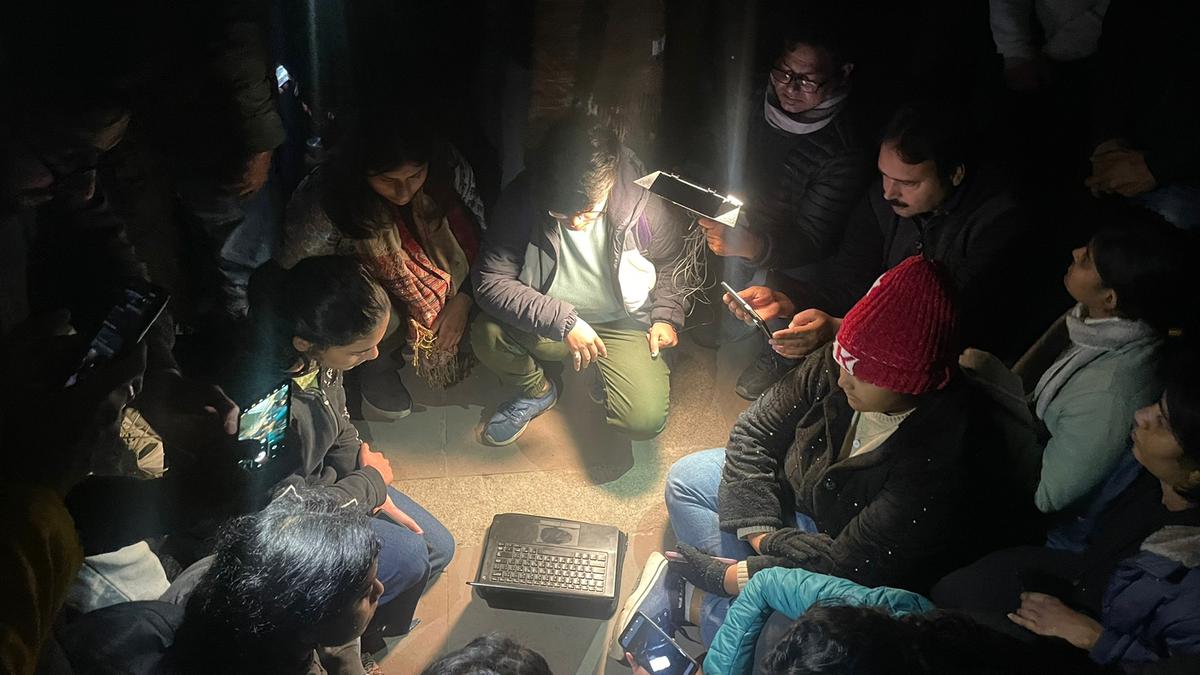
Youth organisations affiliated to the Opposition parties and student outfits on Tuesday screened the first episode of BBC’s “India: The Modi Question” across Kerala to lodge protest against the Centre’s recent move to ban it on social media, while a similar attempt at Delhi’s Jawaharlal Nehru University (JNU) was prevented by the authorities leading to group viewings on personal devices.
The JNU campus was shrouded in pitch darkness as the electricity had been cut off at most parts, especially outside the venue: Teflas, the Jawaharlal Nehru University Students Union (JNUSU) office. As the screening could not take place, the union shared the link of the documentary and the students, who had gathered in large numbers, viewed it together on their phones.
“You can shut one screen down but you cannot stop the thousands that light up instead,” said JNUSU president Aishe Ghosh while addressing the gathering. The students turned up despite an advisory from the university administration that such an “unauthorised activity” might disturb peace and harmony of the campus.
Ms. Ghosh said the union decided to go ahead with the screening as its task was to “strengthen democracy” and it would continue to do so. Referring to a Prime Minister’s Office tweet dated April 18, 2018, - that said “I want this Government to be criticised. Criticism makes democracy strong: PM @narendramodi”, — Ms. Ghosh said “I think the JNU administration missed the tweet by our PM tweeted some years back. Just reminding. We take his words quite seriously.”
“If the ABVP (Akhil Bharatiya Vidyarthi Parishad) or the administration had a problem with our protest screening of the documentary that the Centre is trying to hide, they could have carried out a parallel programme. That is the culture of dissent that we have on campus,” she said, adding that the students came together to uphold democracy and the right to dissent.
Reacting to the left-backed JNUSU’s plan for screening the documentary, the ABVP said supporting a “British-constructed narrative” was coherent with the “colonial mindset of British sepoys”. “Many in Opposition as well as so-called student organisations are indeed British stooges, spreading propaganda-driven BBC documentary in Indian educational institutions,” it said.
The Students’ Federation of India (SFI), in a statement, said its Central Executive Committee had decided to screen the documentary in all States to reveal the “real face” of the Modi government. “Though the authorities gave permission to ABVP to screen ‘Kashmir Files’ which is a propaganda movie of RSS-BJP politics, Central universities/institutions are giving orders to cancel the screening of this documentary. Union Ministry of Information and Broadcasting has also issued directions to block the first episode of the BBC documentary. SFI condemns this autocratic step of the central government,” it said.


Assembly polls 2026: Follow updates from The Hindu on the upcoming elections in five States, on March 22, 2026

Currently, only the services in the 32 series stop at the section of the road adjacent to the Broadway terminus, temporarily closed on account of reconstruction work. Small traders association tells R. Ragu that ensuring the services now accommodated at the temporary terminus at Island Grounds stop at NSC Bose road would benefit visitors to the markets in Parrys

The Hindu photo feature on Aragam which is now known as book village. Photos and text by Imran Nissar

The silent reading movement in the Mylapore-Mandaveli-RA Puram area showed up first at Nageswara Rao Park around two years ago, with modest ambitions, when Balaji launched it along with other reading enthusiasts from the region. This initiative has now moved parks, and seems to set to get entrenched in one. Due to renovation work at Nageswara Park, the reading session became irregular. With the Nageswara Rao park work gaining more surface area, it had to be shifted elsewhere. And it seems set to continue with a newly discovered green patch in RK Nagar in the Sundays to follow.

Explore Tamil Nadu's upcoming four-cornered election contest, featuring key players DMK, AIADMK, TVK, and Naam Tamizhar Katchi.

Trump plans to deploy ICE officers for airport security unless Democrats fund the Department of Homeland Security amid ongoing shutdown.

Cuba experiences its second nationwide blackout in a week, exacerbated by an ongoing U.S. oil blockade and energy crisis.

Kamal Haasan urges Tamil media to avoid the term "censorship" in films, advocating for artistic freedom and recognition of certification.

Pottalurani residents boycott elections again, demanding closure of fish waste processing units impacting health and environment.

VCK leader Thirumavalavan emphasizes the need for local candidates amid concerns over past electoral losses due to outsiders.

Women teachers over 50 express discontent after Revenue Department denies blanket exemption from SIR and census duties in Karnataka.

Union Minister skips crucial NCTP meeting amid backlash over controversial Transgender Rights Bill, raising concerns within the community.

Former Minister Semmalai urges parties to limit freebies and prioritize development for Tamil Nadu's future prosperity.