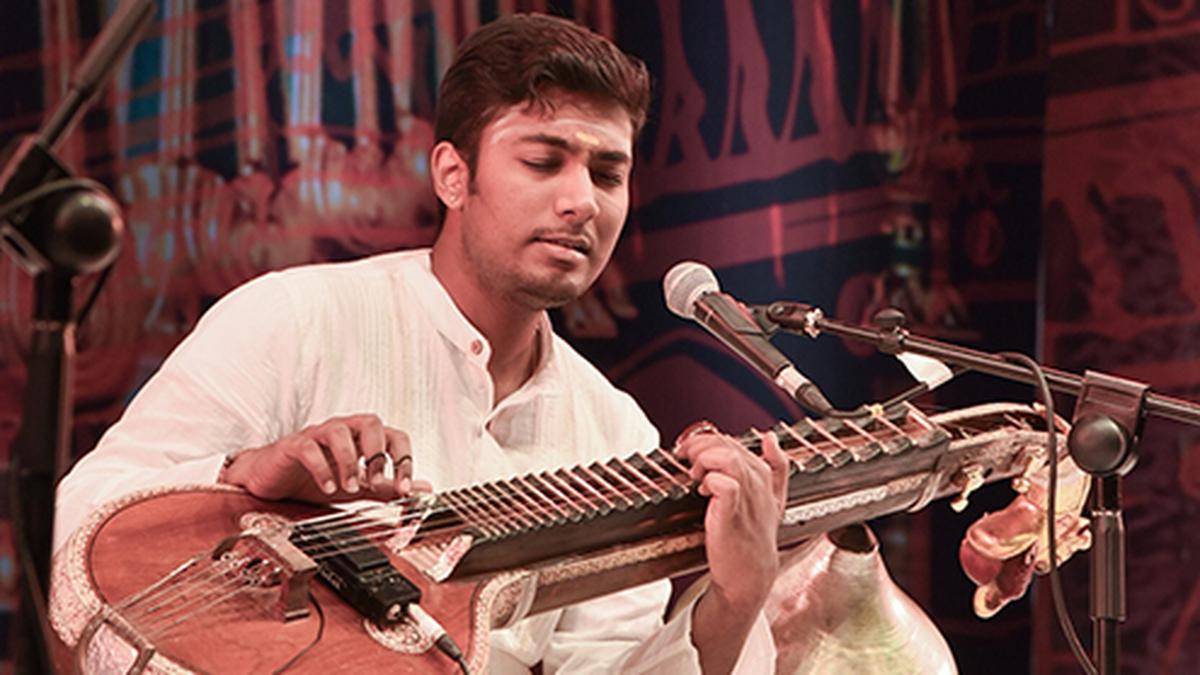
Young veena players reinvent the instrument for a wider reach
The Hindu
The veena has evolved from traditional to electronic through collaborations, innovations, and educational initiatives in Carnatic music.
Picturise a concert hall filled with listeners maintaining pin-drop silence. A round of speedy kalpanaswaras are being rendered on the veena with some rigorous meetus and it is almost time for the final swara. It is one of those days when a particularly puzzling kanakku falls into place spontaneously. The mridangam and ghatam players are in full focus to trace the patterns and in that moment, the three instruments become one, resulting in a stunning display of teamwork. The vainika was the young Ramana Balachandran, who has been expanding the potential of this ancient instrument, and in the process has shown how it continues to remain relevant.
Collaborations between instrumentalists are not new. However, vainikas in the Carnatic space have mostly performed with violin players and flautists resulting in the famed ‘veena-venu-violin’ combo. But young veena artistes such as Veena Venkatramani are exploring new concepts and combinations. Veena’s ‘Vadhya Milan’ series is an interesting watch as she indulges with various instruments such as the chitravina, sarod, sitar, keyboard and nagaswaram, in addition to the violin and flute. The series also includes some prominent percussionists who handle the mridangam, kanjira, thavil and konnakol.
So what makes the veena appealing across generations? Maybe its enduring melody, quaintness and majestic appeal. But it is a difficult instrument to learn. It is also large in size and requires vigilant electric amplification, because it is traditionally a chamber music instrument.
Over the years, many have felt that the traditional Saraswati veena’s length and shape made it difficult to carry it around. Also, acoustic pickups gave the veena an unusual sound that changed its natural character.
One of the first innovations in the last two decades is the electronic veena Sunadavinodini by Radel. Although artistes are divided when it comes to using the electronic veena for performances, it has gained immense popularity among students who are a part of the Indian diaspora abroad. Apart from this, there are several other modified veenas — Madhura veena developed by Kannan Balakrishnan, Chandra veena made by boutique veena makers in Kannur and Baradwaj Raman’s Sarasvitar.
The renewed interest in the instrument could be attributed to the open mindedness of its new-age practitioners, who are experimenting with its strings to create a diverse soundscape. They are also using social media to not only connect with their audiences but to also educate them on the intricacies of the instrument and explore its potential.
Jayanthi Kumaresh is renowned for her online content that attracts viewers from across the globe. Her series Cup O’ Carnatic aims to popularise Carnatic music in general, and the veena in particular. Launched in 2017 and spanning more than six seasons, the series explores ragas from different points of view, takes viewers through Jayanthi’s music journey and even includes a section for children.


Fuel crisis leads to rising food prices in Coimbatore, affecting restaurants, retailers, and the common man.

Comprehensive arrangements are being made for a smooth and successful 'Chandanotsavam' at Simhachalam on April 20.

The Phalguni Nadi Ulisi Horata Samithi will hold a massive protest in front of the Karnataka State Pollution Control Board’s Regional Office, protesting unbridled pollution of Phalguni River by industrial and municipal waste in Mangaluru on Friday.

All India Radio retains its credibility and distinct identity even in the digital era, while steadily expanding its presence on social media, says D-G Rajeev Kumar Jain.

Over 500 kg of plastic covers collected from pilgrims at Maruthamalai temple, promoting sustainability with cloth bag distribution.

Andhra Pradesh is modernising 150 AYUSH centres to enhance traditional medicine access, with significant investments and new constructions underway.

Niranjanaradhya highlights Gandhi's vision of life skills-based education and critiques the neglect of government schools in India.

Leader of Opposition R. Ashok on Tuesday alleged in the Legislative Assembly that the ruling Congress government is planning to shut down Bengaluru’s only Government Flying Training School (GFTS) at Jakkur to develop an exclusive club for MPs, legislators, and senior bureaucrats.

The highlight of every edition of the Whitefield Art Collective is the Kala Car, an exhibit that showcases the creative and artistic prowess of art students. Over the years, this clever play on words has titled vehicles that have either been rescued from the scrap yard or sponsored or auctioned or all of the above.

Devotees flock to Sri Kanaka Durga Temple for serene Pushparchana celebrations during Vasantha Navaratri, adorned with fragrant floral decorations.

CAG audit reveals Arvind Kejriwal's bungalow renovation exceeded budget by 342%, costing ₹33.66 crore instead of ₹7.91 crore.

Unexpected hailstorm and evening showers in Hyderabad catch commuters off guard on March 24, 2026 evening, providing relief from the intense afternoon heat.

EVMs and VVPAT units dispatched to Erode's eight Assembly constituencies ahead of polling on April 23, 2026.