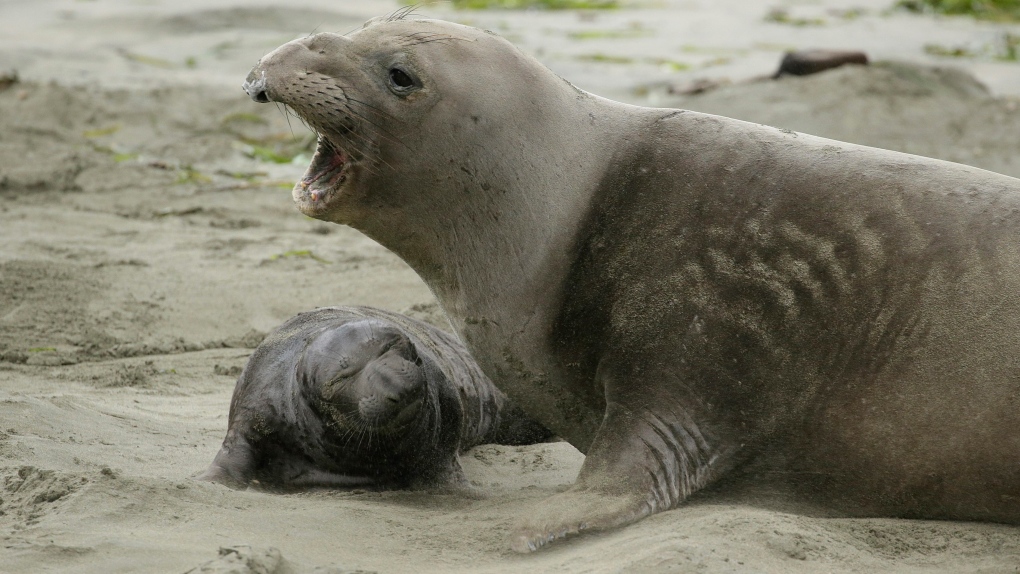
You think you need more sleep? Tell that to an elephant seal
CTV
Sleep is a precious commodity for people and across the animal kingdom, indispensable even as its biological purpose remains somewhat mysterious. We spend about a third of our lives asleep. But some animals get a lot less slumber - with certain species like the northern elephant seal taking sleeplessness to an extreme.
Sleep is a precious commodity for people and across the animal kingdom, indispensable even as its biological purpose remains somewhat mysterious. We spend about a third of our lives asleep. But some animals get a lot less slumber - with certain species like the northern elephant seal taking sleeplessness to an extreme.
Researchers in a new study described the unusual sleep habits of this species, finding that during Pacific Ocean foraging journeys that can last seven months these bulky marine mammals sleep just two hours a day - cobbled together from naps of about 10 minutes each as they dive deep to avoid predators. The only other mammal known to get so little sleep is the African elephant.
The seals' sleep duration during these ocean voyages differed significantly from the 10 hours a day they spend sleeping on the beach during breeding season at places like California's Año Nuevo beach.
The researchers placed on the heads of the seals a non-invasive waterproof synthetic rubber cap with sensors to monitor sleep signals generated by the brain, heart rate, location and depth. The researchers focused on female seals because they engage in the long open-ocean journeys while males feed in coastal waters.
The study documented unorthodox sleep behaviour.
During dives lasting about 30 minutes, the seals went into a deep sleep stage called slow-wave sleep while maintaining a controlled downward trajectory. When they then experienced rapid-eye-movement (REM) sleep, a stage causing sleep paralysis, the seals drifted into a corkscrew "sleep spiral," turning upside down and sometimes ending up motionless on the seafloor.
"Then, at the deepest point of their sleeping dive - up to 377 meters deep (1,237 feet) - they wake up and swim back to the surface," said Jessie Kendall-Bar, a postdoctoral fellow at the University of California San Diego's Scripps Institution of Oceanography and lead author of the study published this week in the journal Science.


Renowned Canadian angler Jeff Gustafson back in Kenora Ont. after Bassmaster Classic absence.

A special weather statement remains in effect for Toronto Tuesday morning with winds gusting up to 80 km/h in some areas after an overnight snowfall.

Fraudsters are using seniors as tools in online scams without their knowledge.

Using medical or recreational marijuana to ease symptoms of numerous mental health conditions doesn’t work, according to two new analyses of existing gold-standard research.

A haunting whale song discovered on decades-old audio equipment could open up a new understanding of how the huge animals communicate, according to researchers who say it’s the oldest such recording known.

Despite the delays for the NASA’s Artemis II mission around the moon and back, a space medicine researcher says the crew, which includes Canadian astronaut Jeremy Hansen, are physically ready for when the time comes to launch.

If a teen is interested in losing weight, chances are they may turn to artificial intelligence platforms to get advice.

The public downfall this week of Denmark’s Rene Redzepi, arguably the world’s top chef, has forced a reckoning in real time over when “brigade de cuisine” becomes abuse and what should happen to perpetrators who direct the creation of edible art.

A new study suggests climate change is doing something few people could ever notice: it’s making Earth’s days slightly longer.

Artificial intelligence is taking some of the discomfort out of trying to perfect your resume, but the growing use of the technology in job applications is creating new challenges for employers trying to sort through candidates and figure out who they’re really dealing with.

An expert on body image is warning of a new social media trend that is sending a negative message to boys and men.

Japan's stunning Seto Inalnd Sea offers a wonderful collection of art, history and luxury to travelers looking beyond the country's iconic sites.
