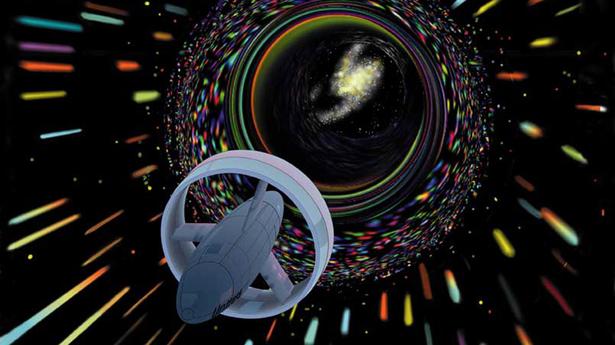
Wormhole
The Hindu
Understanding how rapid interstellar travel may be possible
Discussions between theoretical physicists can sound very other-worldly and often seem to buzz around highly abstract concepts and ideas. Many times, it even appears that the talk touches the limits of science-fiction. Cosmology, especially, has this flavour, and more so when the talk dwells on black holes, wormholes, time travel and multiple universes. Whether it is the catchy terminology or the fact that it is closely related to the question of origins, these concepts often trigger a lot of reading, writing and discussion.
American cosmologist, Nobel Laureate and ace story-teller Kip Thorne describes the following anecdote in his book, Black Holes and Time Warps: Einstein’s Outrageous Legacy. Once, he got a special request from his friend and astronomer Carl Sagan. The latter said that he was writing a novel in which his heroine had to take a shortcut through spacetime and move from Earth to the neighbourhood of a star Vega in just one hour. Vega is 26 light years away, so it will take even light, which is the fastest object in our universe, 26 years to cross this distance. Sagan had proposed a mode for rapid interstellar travel in which she enters a black hole and tunnels through to Vega. He was asking Thorne whether this was allowed by the laws of physics.
Thorne knew that this was impossible but wanted to give his friend an alternate suggestion. He read Sagan’s manuscript on the way from Pasadena to Santa Cruz where he was going to attend an event. During the return journey, it occurred to him that instead of a black hole, Sagan must use a “wormhole”. He worked out a mechanism that can stabilise such a wormhole and suggested it to Sagan, who incorporated it into his, by now famous, novel — Contact.
To understand how a wormhole can help in rapid interstellar travel, let us first imagine that we humans, sitting in a four-dimensional world, are observing a two-dimensional sub-universe embedded in our universe. This sub-universe is like a sheet of paper or a ribbon on which tiny bugs, live, crawling on the ribbon. When the ribbon is flat, there is only one way to get from one point to another. But if the ribbon is bent like a U, the observer can see that some parts of the folded ribbon may appear to be close to other parts.
According to her, to get from one of these points to the other it would be quicker if the bug could jump across the intervening space. However, the bug being a two-dimensional creature cannot even see this closeness. Also, it is constrained to move on the surface of the ribbon. So, it has to traverse the whole length of the ribbon to reach the other point ; it cannot jump across the fold and make a shortcut to the second point.
Our universe when viewed from a higher dimension is like that of the ribbon, and we are the bugs constrained by its limits. When there is no gravity, our universe will be flat like a sheet. When there is a strong gravitational field, this sheet will bend so that a portion of it may look like the piece of ribbon that was folded over. We, like the bugs on the ribbon, are constrained to take the long route through spacetime to reach points that appear close to the higher-dimensional observer.
Now, imagine if a bridge was built connecting the two points on the ribbon. The bugs could then crawl over the bridge to the target point instead of crawling down the entire length of the ribbon.


76-year-old Kurian Jacob from Kerala triumphs with seven medals, including five golds, at the Open Masters Games in Abu Dhabi.

Explore the nature of the human mind as an emergent property of brain activity and complex neural interactions.

CERN's Large Hadron Collider discovers the Xi-cc-plus particle, enhancing understanding of quantum mechanics and baryon behavior.

Vibha Batra’s latest book, Spotless (Hachette India) is a novel in verse for young adults

In its first edition, the Madras Art Salon spotlights the works of journalist and artist Narayan Lakshman at The Botanical Club, a social space in the British Deputy High Commission, Chennai

Cholesterol enhances melanoma cell invasion by making nuclei squishier, revealing a potential treatment target in cancer progression.

The designers reinterpret the Swedish artist’s symbolic forms and colour energy through contemporary resortwear silhouettes

Discover the inspiring legacy of Bibha Chowdhuri, a pioneering woman in physics and a trailblazer in STEM history.

Discover the inspiring legacy of Bibha Chowdhuri, a pioneering woman in physics and a trailblazer in STEM history.

Ashdeen’s Spring 2026 collection features saris inspired by the designer’s Parsi gara archive

Red ochre burials, ritual markings and myths across cultures show that red repeatedly marks liminal thresholds such as puberty, sacrifice and death; anthropologists argue that the colour functions as a technology of collective ritual and value, binding communities through shared symbolic acts

India approves 23 institutions for quantum labs under the National Quantum Mission, aiming to advance quantum technology and research.

India approves 23 institutions for quantum labs under the National Quantum Mission, aiming to advance quantum technology and research.