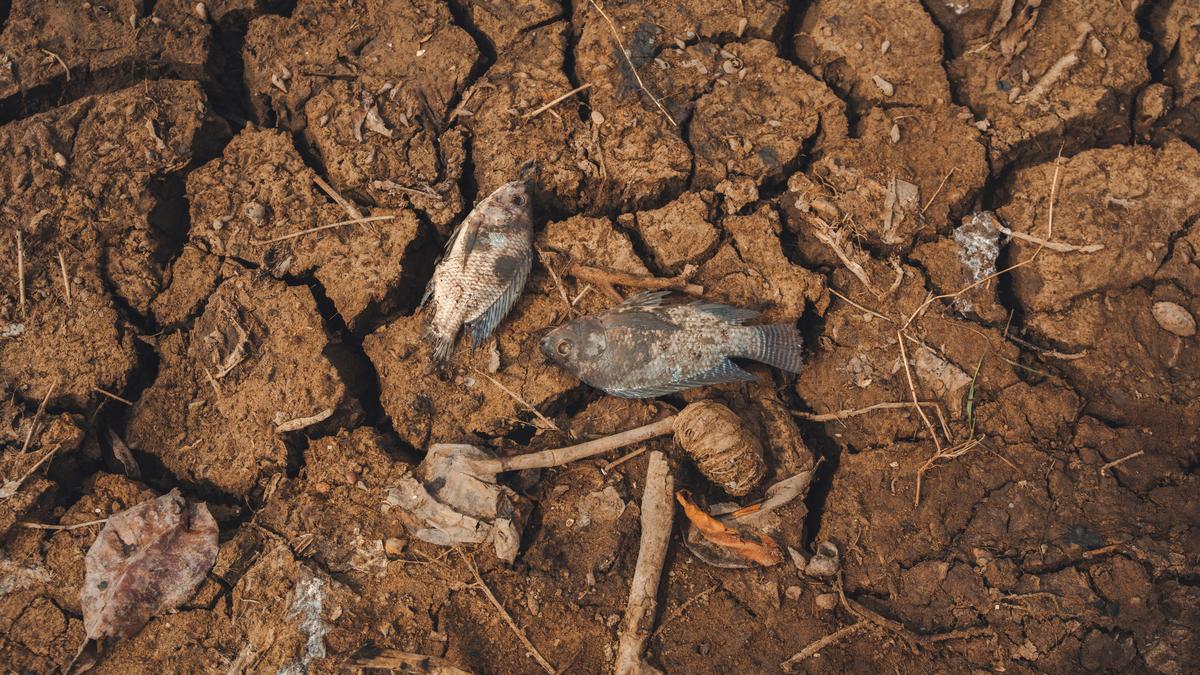
World Water Day | Running out of water and understanding the scarcity’s aftermath
The Hindu
Water scarcity is a global crisis affecting billions due to increasing demand, climate change, and mismanagement.
Water scarcity is not a new issue haunting the world; nevertheless, it is still seen as a challenge that affects billions every year. The increasing water demand, coupled with climate change and mismanagement, has made water a scarce commodity, especially in developing countries like India. Scarcity essentially occurs when there is limited availability of a resource in comparison to its demand. Water scarcity can occur due to a variety of reasons, including pollution, inefficient use and climate change. Most of these reasons point back to the destructive actions and habits of human beings and how humans dig their own graves yet again while being around Mother Nature.
Two-thirds of the world’s population is experiencing severe water scarcity for at least one month each year, and over two billion people live in regions with inadequate water supply. The countries that face the most water scarcity are in the Middle East and North Africa and include Bahrain, Cyprus, Kuwait, Lebanon, and Oman. These countries use at least 80% of their water supply for domestic needs, industry, livestock, and irrigation. Today, 2.4 billion people live in water-stressed countries, defined as nations that withdraw 25 percent or more of their renewable freshwater resources to meet water demand.
According to the NITI Aayog report, nearly 600 million Indians face high-to-extreme water stress, with around 200,000 people dying annually due to inadequate access to safe water. Major cities like Delhi, Bengaluru, and Chennai are experiencing severe water shortages, and the situation is expected to worsen with time. Hard-hit regions include Southern and Central Asia and North Africa, where the situation is considered critical. Even countries with highly developed infrastructure, like the United States, are seeing water levels drop to record lows.
In many rural areas of India and other developing nations, women and girls bear the responsibility of fetching water for their households. Due to the lack of nearby water sources, they often have to walk long distances—sometimes up to 5 to 10 kilometres daily—to access clean water. This not only consumes their time but also exposes them to physical exhaustion, health risks, and safety concerns. For example, villages in the mountain state of Uttarakhand suffered from a lack of water supply as the steep Himalayan terrain made it difficult to build and maintain the required infrastructure. For many villagers, particularly women, obtaining fresh water for domestic use meant travelling distances of over 1.6 kilometres. This is just one example from the present age; there are a lot more areas within India where thousands are having to walk kilometres and miles to collect for their daily consumption.
The burden of collecting water significantly affects their opportunities for education and employment, trapping them in a cycle of poverty and inequality, particularly in developing countries. Children, especially girls, often miss school because they have to spend hours fetching water. Even when they do attend school, the lack of clean drinking water and sanitation facilities makes learning difficult. Many schools in water-stressed regions lack proper hygiene facilities, leading to increased dropout rates, particularly among girls during menstruation. Ensuring access to clean water in schools can significantly improve attendance and overall educational outcomes.
Water wastage is a significant contributor to the global water crisis. A typical shower can use between 10 to 25 litres of water per minute. On average, a 10-minute shower can waste around 100 to 250 litres of water. In the United States, for example, more than 3.7 trillion litres of water are lost annually to faulty household plumbing.
In 2010, the United Nations recognised the human right to water and sanitation, stating that everyone has the right to sufficient, safe, acceptable, and affordable water for personal and domestic use. In 2022, 2.2 billion people still lacked access to safely managed drinking water services, and 3.5 billion people still lacked safely managed sanitation. There are still around 2 billion people worldwide without access to safely managed drinking water services. Among them, 771 million people cannot access even basic drinking water services. Over half of the global population, or 4.2 billion people, lacks safely managed sanitation services.


Discover the Minor Planet Centre, the key hub for tracking and verifying observations of small solar system bodies.

In this week's Science for All newsletter, XX explains

Test your knowledge with the quiz on Science films at the Oscars through history

Set between the Siwalik hills and the plains, Butwal offers travellers a mix of regional cuisine, pilgrimage trails to Lumbini and the comfort of Hyatt’s new hospitality landmark

Explore 2026's wallpaper trends in India, highlighting botanicals and handmade designs that enhance modern homes with nature-inspired aesthetics.

Mercedes-Benz CLA 250+ with EQ Technology review: design, performance, range and features explained. Discover how the new electric CLA combines advanced AI, long range, fast charging and futuristic styling for the next generation of luxury EVs.

AI tool for sparrow conservation

BTS’s comeback with ‘Arirang’ marks a major global music event. When does the album release, and where can you watch their concert live stream? We have all the details

The 2026 U.S. cholesterol guidelines urge starting screening and treatment at 30 to prevent cardiovascular disease effectively.

Olam Festival 2026 in Thiruvananthapuram returns March 27-29 with 120+ vendors, music, art, and cultural zones.

A few storytellers in Thiruvananthapuram share their journeys, challenges, and evolving methods on World Storytelling Day, inspiring young minds.

76-year-old Kurian Jacob from Kerala triumphs with seven medals, including five golds, at the Open Masters Games in Abu Dhabi.

Explore the nature of the human mind as an emergent property of brain activity and complex neural interactions.