Women with disabilities get exclusive space to train, exercise in Chennai
The Hindu
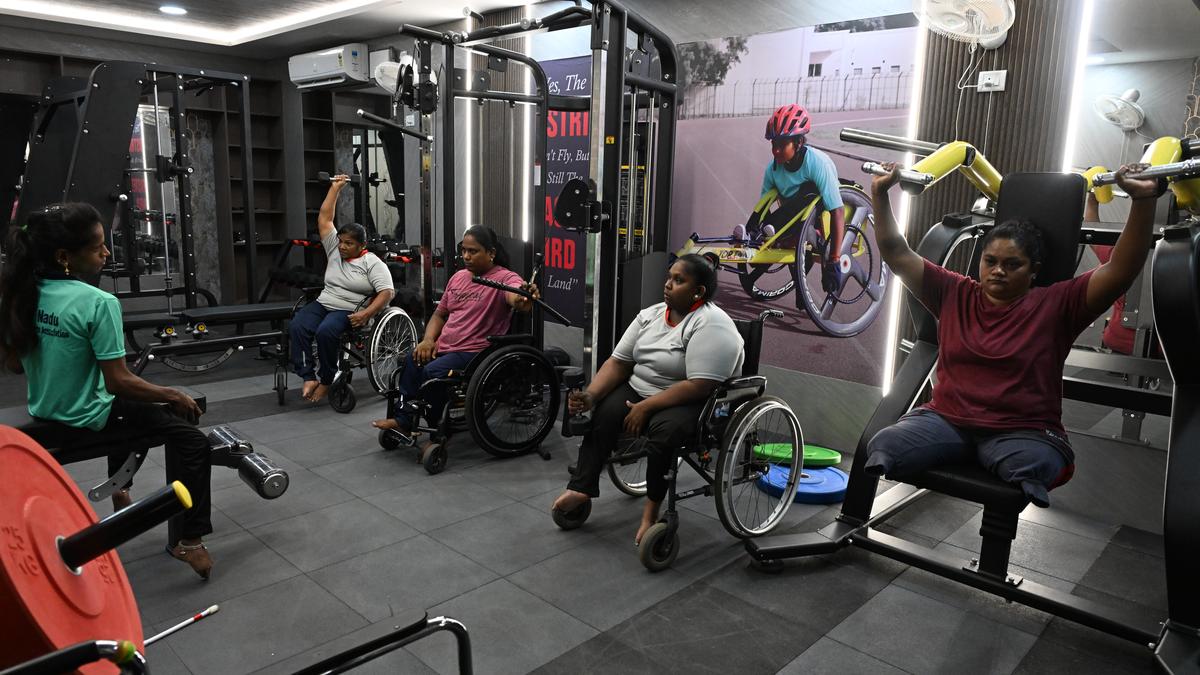
M. Nathiya, a para powerlifter, trains in a wheelchair-accessible gym for women with disabilities, promoting fitness and independence.
M. Nathiya swiftly pulls one side of the cable crossover machine weighing over six kg and proceeds to pull the other, grunting with each effort. Seated in her wheelchair, in the gym for women with disabilities, she soon falls into the rhythm of her training.
The seasoned para powerlifter is required to spend six hours at the gym, three in the morning and three in the evening as training for powerlifting. As a para powerlifter, she is required to train every muscle in the upper body including the back muscles, shoulders and arms apart from targeted spinal stability. As each set also requires rest, time factored to move around in a wheelchair, it takes a total of three hours.
However, with no accessible gym in the city, Nathiya was forced to complete her entire routine in one and half hours.
“I would require someone to help me get my weights or dumbbells at a gym designed for normal people. I’d require more time because I have to shift from my wheelchair to the equipment and most others would request that they finish first. I couldn’t train at ease,” said the seven-time national winner in powerlifting.
But the scene has changed in the last two months with the setting up of the gym dedicated to women with disabilities in Nungambakkam thanks to the Better World Shelter and the Greater Chennai Corporation (GCC).
“Today, I can train for three hours, every piece of equipment is spaced with a wheelchair in mind, nobody is hurrying me to finish the set, I can access the dumbbells and weights myself. The independence to train by myself has been liberating,” said Nathiya.
Like Nathiya, other women with disabilities recall the hardship in trying to find an accessible gym in the city Most gyms in the city are situated either on the first or upper floors with no accessibility via lift. People had no space to maneuver their wheelchair in the area and the gym constrained their training to about one and a half hours.


Explore 2026's wallpaper trends in India, highlighting botanicals and handmade designs that enhance modern homes with nature-inspired aesthetics.

Mercedes-Benz CLA 250+ with EQ Technology review: design, performance, range and features explained. Discover how the new electric CLA combines advanced AI, long range, fast charging and futuristic styling for the next generation of luxury EVs.

AI tool for sparrow conservation

BTS’s comeback with ‘Arirang’ marks a major global music event. When does the album release, and where can you watch their concert live stream? We have all the details

The 2026 U.S. cholesterol guidelines urge starting screening and treatment at 30 to prevent cardiovascular disease effectively.

Olam Festival 2026 in Thiruvananthapuram returns March 27-29 with 120+ vendors, music, art, and cultural zones.

A few storytellers in Thiruvananthapuram share their journeys, challenges, and evolving methods on World Storytelling Day, inspiring young minds.

76-year-old Kurian Jacob from Kerala triumphs with seven medals, including five golds, at the Open Masters Games in Abu Dhabi.

Explore the nature of the human mind as an emergent property of brain activity and complex neural interactions.

CERN's Large Hadron Collider discovers the Xi-cc-plus particle, enhancing understanding of quantum mechanics and baryon behavior.

Vibha Batra’s latest book, Spotless (Hachette India) is a novel in verse for young adults

In its first edition, the Madras Art Salon spotlights the works of journalist and artist Narayan Lakshman at The Botanical Club, a social space in the British Deputy High Commission, Chennai

Cholesterol enhances melanoma cell invasion by making nuclei squishier, revealing a potential treatment target in cancer progression.