Without reforms, UNSC 'ill-equipped' to address global challenges: G4 nations
The Hindu
G4 countries advocate for UN Security Council reform to address lack of representation and enhance global peace.
A reform of the U.N. Security Council that does not address the lack of representation, particularly in the permanent category, would only “exacerbate” the current imbalances in its composition and render it “ill-equipped” to address current global challenges, India has said on behalf of the G4 countries.
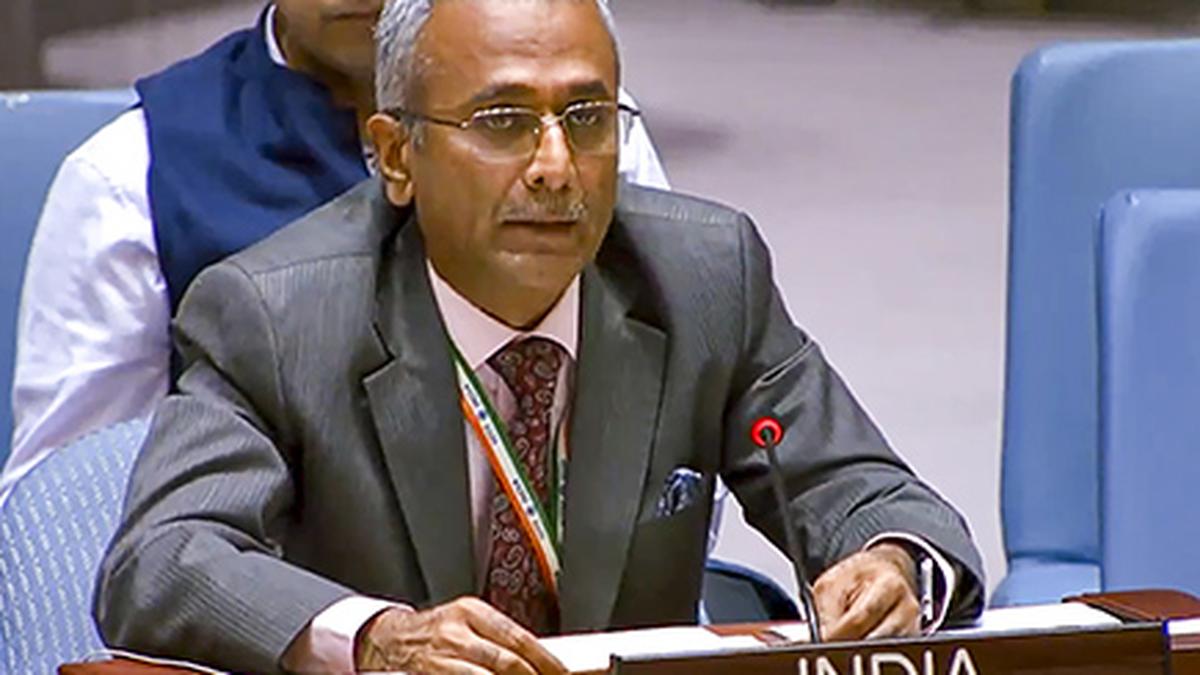
“Recent global geopolitical events have clearly shown that the U.N. Security Council is unable to deliver on its primary responsibilities to safeguard international peace and security when the world needs it the most,” Chargé d’Affaires and Deputy Permanent Representative of India to the U.N. Ambassador R. Ravindra said on Monday (August 12, 2024).
He was delivering a statement on behalf of the G4 countries – Brazil, Germany, Japan and India – at the UNSC High-Level Debate on ‘Maintenance of International Peace and Security: Addressing the Historical Injustice and enhancing Africa’s effective representation in the UNSC’.
The realities of 1945, when the Council was established, have long been superseded by current geopolitical realities, with the need for change being felt across the board, Mr. Ravindra said ahead of next month’s annual high-level U.N. General Assembly session which world leaders will attend.
He noted that for the G4, the primary reason for the underperformance of the critical U.N. Security Council remains the non-representation of Africa, Latin America and the Caribbean, and the under-representation of Asia Pacific in the permanent category.
“It is the G4’s firm belief, shared we believe by Africa and other groups, that any reform of the Council that does not address the lack of representation, particularly in the permanent category, would only exacerbate the current imbalances in the Council’s composition and render it ill-equipped to address Monday‘s (August 12, 2024) international challenges,” he said.
The 15-nation UNSC comprises five permanent, veto-wielding members – China, France, Russia, the U.K. and the U.S. – and 10 non-permanent members, without veto powers, who are elected for two-year terms.


Trump considers winding down military operations in Iran, rejecting a ceasefire amid escalating tensions and regional conflict.

BTS returns with a massive concert in Seoul, attracting 260,000 fans and streaming live on Netflix.

U.S. airport delays are expected to worsen as TSA staffing issues persist amid an ongoing government shutdown.

Iran-Israel war: Follow the latest updates from The Hindu on the West Asia war, on March 21, 2026

A federal judge blocks the Pentagon's restrictive press access policy, emphasizing the public's right to diverse information.

UK approves US strikes from British bases on Iran missile sites, while Prime Minister Keir Starmer seeks to avoid war.

Czech authorities investigate a suspected arson at a drone technology warehouse linked to anti-Israel group claims.

Ayatollah Khamenei claims Iran has struck a significant blow against enemies amid escalating tensions and ongoing conflict with Israel.

Trump labels NATO allies "cowards" for not supporting the U.S.-Israel war against Iran, criticizing their inaction amid rising oil prices.

Iran warns that global tourist sites are unsafe for Israeli and U.S. officials, while continuing missile development amid ongoing conflict.

Explore how U.S. and Israeli assassinations have transformed Iranian leaders into martyrs, reinforcing a culture of sacrifice and defiance.

Exiled Iranian writer Shahrnush Parsipur’s banned novella explores women’s freedom amid political repression and cultural patriarchy.

Sri Lanka denies U.S. warplanes access to its airport, balancing ties with the U.S. and Iran amid trade interests.