Wind turbines keep killing bats in Canada. Advocates say this needs to change
CBC
Bats don't exactly have a glowing public image. After all, they're associated with blood-sucking vampires, gloomy caves and all things spooky.
But researchers say migratory bats in Canada are in desperate need of protection because wind turbines have been slaughtering their populations for decades.
“We are not talking about if these migratory bats go extinct. We are just talking about when," said Cori Lausen, director of bat conservation with the Wildlife Conservation Society, based out of B.C.
Lausen and other experts say there are solutions that can help stave off further destruction of bat populations, including curtailing how often the deadly turbine blades operate. And she says it's not just bat lovers who should pay attention.
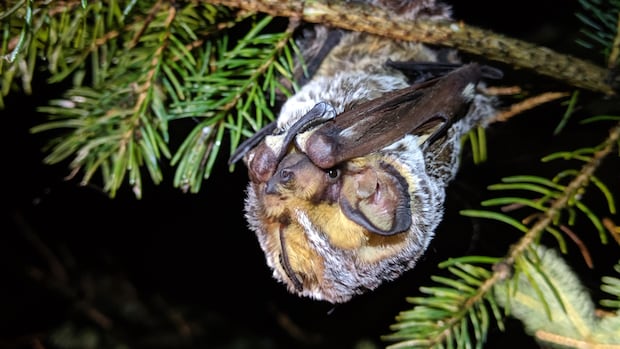
There are three migratory bat species in Canada: the hoary bat, eastern red bat, and silver-haired bat. All three are endangered, according to Canada's Committee on the Status of Endangered Wildlife. The federal government is reviewing whether to add them to the Species at Risk Act.
According to a paper published in Biological Conservation in 2017 , the hoary bats' population could drop between 50 and 90 per cent in the next 50 years, and could go extinct within the century.
Lausen first saw how much danger wind turbines posed to bats back in the early 2000s, when she was studying bats at the University of Calgary.
TransAlta, the company operating one of the first wind energy projects in Canada, asked her lab supervisor to investigate after dead bats were found around their turbines near Pincher Creek, 200 km south of Calgary.
"Seeing the dead bats is really hard because these are long-lived mammals that can't withstand these high fatality rates. And you had this gut feeling like, this is going to be a problem," said Lausen.
Though at the time they didn't count exactly how many bats died, most were killed after being hit by the blades, while others died because of the pressure change near the turbines.
But it wasn't clear why they were getting so close to the turbines in the first place.
Lausen said they could be checking out the turbines out of curiosity, or their echolocation bounced off the turbines in strange ways, sending them in blind.
Their six-week migration also coincided with their mating season, and the bats might have mistaken the towering turbines for trees where they could find a mate.
Whatever the reason, one thing was clear: bats were dying.


This story is part of CBC Health's Second Opinion, a weekly analysis of health and medical science news emailed to subscribers on Saturday mornings. If you haven't subscribed yet, you can do that by clicking here.

Lac La Ronge Indian Band's Woodland Wellness Centre has received funding to start a mobile addictions outreach program to address the opioid and mental health crisis.

Adriana Avelina Ruíz Márquez uses fake eyelash glue to attach a tiny transmitter to the thorax, just behind the head, of the monarch butterfly.

After several delays to the mission that will take four astronauts around the moon, NASA held a press conference today announcing that Artemis II is on track to launch as early as April 1.

Snuneymuxw First Nation is calling for a temporary closure and environmental investigation of a hazardous waste services company following a January oil spill on Duke Point near Nanaimo, B.C.

In February, five people were killed in separate avalanches across B.C. and Alberta. That same month, more than a dozen people were killed in California and Utah, including a particularly deadly avalanche that claimed the lives of nine. In Europe, from Andorra to Slovakia, the season has recorded 125 deaths from avalanches so far.

Getting a proper vehicle to transport people for urgent medical care is an ongoing challenge in fly-in First Nations in northwestern Ontario.

A new supergroup of musicians from Six Nations of the Grand River and Mississaugas of the Credit First Nation have collaborated on a Robbie Robertson-inspired song they will perform at the Junos Honouring Ceremony later this month in Hamilton.

People as young as 45 should be invited to provincial and territorial programs to screen for colorectal cancer, the Canadian Cancer Society urged on Wednesday.

The Métis Nation-Saskatchewan (MN-S) has opened an office and retail space in Ottawa to create a stronger presence in the capital since removing itself from the Métis National Council in 2024.

Toronto resident Winhan Wong's lung cancer journey began in 2016, with a nagging cough that just wouldn't go away.

Last month, Assembly of First Nations National Chief Cindy Woodhouse Nepinak pointed out on social media that history was made this year because there are a record 164 female chiefs serving across the country.

Most of humanity has a great propensity to think in the short-term, but generally, long-term considerations — air pollution, deforestation and emissions, for example — just aren't our thing.