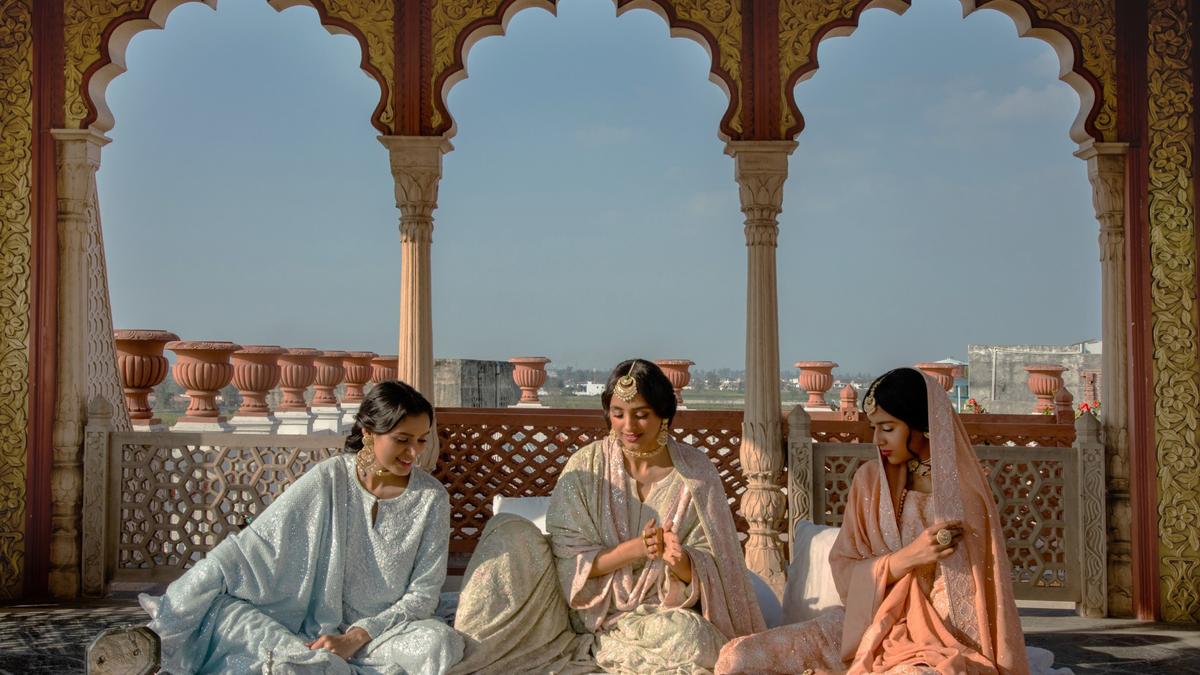
Why the fate of the Chikankari artisans hangs by a thread?
The Hindu
Tracing the history of Chikankari
A Geographical Indication (GI) tag 15 years ago have placed chikankari embroidery in and around Lucknow today. Earlier this year, Naseem Bano, a Lucknow-based practitioner of Anokhi Chikankari, where the embroidery is invisible on the reverse side of the fabric, was conferred the Padma Shri.
But did you know that the delicate style originated in East Bengal, and travelled all over undivided India before settling down in Lucknow?
In the early 19th century, Madras Chikankari, along with that of Calcutta, Dhaka, Lucknow, Bhopal, Peshawar and Quetta, was described in detail in ‘Indian Art at Delhi 1903’, the official catalogue of the year-long public exhibition that was held as part of the Delhi Durbar to celebrate the coronation of King Edward VII from 1902-1903.
Written by Sir George Watt, a Scottish botanist who served as the director of the Delhi Exhibition besides other government positions, ‘Indian Art at Delhi’ was a valuable source of information on the country’s rich heritage of crafts, quite a few of which have faded away, due to changing tastes, and the industrial revolutions of succeeding years.
Chikankari (a Persian/Urdu coinage indicating needle as a metaphor) is known for its thread work done on diaphanous and breathable fabrics, and is thought to have been brought to the Indian subcontinent by noble families of Iranian descent in the Mughal court. It is considered to be the oldest form of indigenous embroidery in India.
Watt, in his book writes, “in historic sequence, it is probable that the craft originated in Eastern Bengal and was only carried to Lucknow during the period of luxury and extravagance that characterised the latter term of the Court of Awadh. The Kings of Oudh attracted to their capital many of the famous craftsmen of India, hence Lucknow, to this day, has a larger range of artistic workers than are to be found in almost any other town of India.”
Lucknow-based designer Anjul Bhandari whose eponymous couture label supports over 2,000 women Chikan embroiderers in and around the city, says that folklore claims that Nur Jahan, the daughter of a Persian nobleman in Murshidabad, was very fond of the craft besides being a skilled needlewoman. “Since the summers were very warm here, Chikankari was done on the finest mulmul fabrics, to please her,” she says.


Explore 2026's wallpaper trends in India, highlighting botanicals and handmade designs that enhance modern homes with nature-inspired aesthetics.

Mercedes-Benz CLA 250+ with EQ Technology review: design, performance, range and features explained. Discover how the new electric CLA combines advanced AI, long range, fast charging and futuristic styling for the next generation of luxury EVs.

AI tool for sparrow conservation

BTS’s comeback with ‘Arirang’ marks a major global music event. When does the album release, and where can you watch their concert live stream? We have all the details

The 2026 U.S. cholesterol guidelines urge starting screening and treatment at 30 to prevent cardiovascular disease effectively.

Olam Festival 2026 in Thiruvananthapuram returns March 27-29 with 120+ vendors, music, art, and cultural zones.

A few storytellers in Thiruvananthapuram share their journeys, challenges, and evolving methods on World Storytelling Day, inspiring young minds.

76-year-old Kurian Jacob from Kerala triumphs with seven medals, including five golds, at the Open Masters Games in Abu Dhabi.

Explore the nature of the human mind as an emergent property of brain activity and complex neural interactions.

CERN's Large Hadron Collider discovers the Xi-cc-plus particle, enhancing understanding of quantum mechanics and baryon behavior.

Vibha Batra’s latest book, Spotless (Hachette India) is a novel in verse for young adults

In its first edition, the Madras Art Salon spotlights the works of journalist and artist Narayan Lakshman at The Botanical Club, a social space in the British Deputy High Commission, Chennai

Cholesterol enhances melanoma cell invasion by making nuclei squishier, revealing a potential treatment target in cancer progression.